
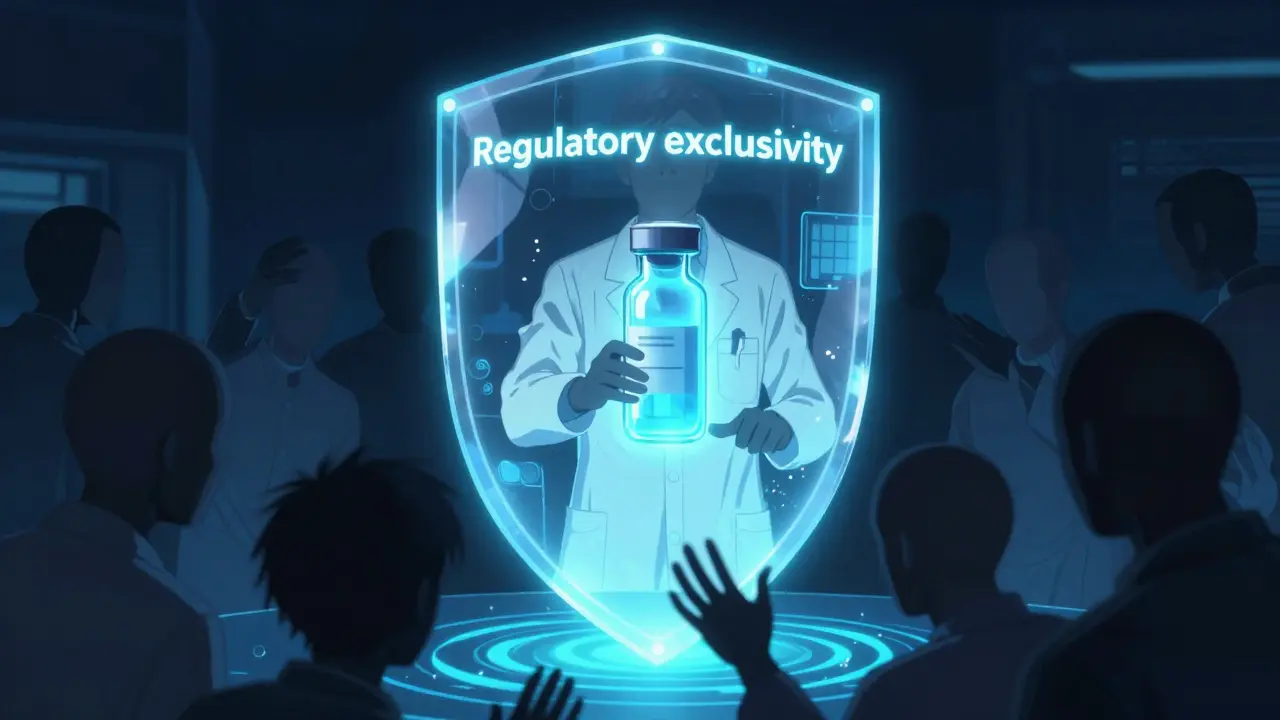
Imagine spending a decade and billions of dollars developing a life-saving drug, only to find out that by the time the government approves it for sale, your patent has already expired. This was a nightmare scenario for pharmaceutical companies decades ago. To fix this, governments created a second layer of defense: regulatory exclusivity. It isn't a patent, but it acts like a shield that prevents competitors from entering the market, regardless of whether a patent exists or has been challenged in court.
For those in the industry, this is the difference between a product that makes money and one that flops immediately upon launch. Unlike patents, which you have to fight for in court, regulatory exclusivity is essentially a "gift" from the regulator-like the FDA-once you prove your drug is safe and effective. It creates a legally mandated blackout period where generic versions simply cannot be approved.
The Core Difference Between Patents and Regulatory Exclusivity
People often lump these two together as "IP protection," but they are fundamentally different tools. A Patent is a property right granted by a patent office. If someone infringes on your patent, you have to sue them in federal court to stop them. It protects a specific invention, like a unique chemical structure or a specific way of delivering a drug.
On the other hand, Regulatory Exclusivity is a regulatory barrier. It doesn't protect an "invention"; it protects the drug product itself. The regulator (the FDA in the US) simply refuses to approve a competitor's application for a set number of years. There is no lawsuit required; the government does the enforcing for you. This is why many pharma executives view it as their most reliable form of protection.
| Feature | Patent Protection | Regulatory Exclusivity |
|---|---|---|
| Source | Patent Office (USPTO) | Regulatory Agency (FDA/EMA) |
| Enforcement | Private Lawsuits (Active) | Agency Denial of Approval (Automatic) |
| Start Date | Date of Filing | Date of Drug Approval |
| Scope | Specific Claims/Inventions | The Drug Product/Data |
| Risk | Can be invalidated in court | Fixed statutory term |
Types of Exclusivity and How Long They Last
Not all drugs get the same level of protection. The duration depends on what the drug is and who it's meant to help. In the United States, the framework is largely governed by the Hatch-Waxman Act, which tried to balance the need for new drugs with the need for affordable generics.
- New Chemical Entities (NCE): If a company brings a completely new molecular structure to market, they typically get 5 years of exclusivity. For the first 4 years, the FDA won't even accept a generic application (ANDA); by year 5, they still won't approve it.
- Biologics: These are complex, large-molecule drugs made from living organisms. Because they are so expensive to make, the BPCIA grants them a massive 12-year window of exclusivity. This is a huge deal because biologics often have development cycles that eat up most of their patent life.
- Orphan Drugs: When a drug treats a rare disease affecting fewer than 200,000 people in the US, it qualifies for 7 years of market protection under the Orphan Drug Act. This incentivizes companies to tackle diseases that would otherwise be too small to be profitable.
- Clinical Changes: If a company does new clinical trials to add a new use (indication) to an existing drug, they can get an additional 3 years of protection for that specific use.
If you look across the ocean to Europe, they use an "8+2+1" system. This means 8 years of data exclusivity (where generics can't use the originator's data) and 2 years of market exclusivity (where the generic can't be sold), with a potential extra year if a new indication is found. Japan takes a different route, often granting a flat 10-year period for new chemical entities.

The Economic Impact: Why This Matters for Pricing
From a business perspective, exclusivity is where the money is. When a drug is under regulatory protection, it's essentially a legal monopoly. Without generic competition, companies can set prices based on value rather than cost. Data from IQVIA shows that drugs with active exclusivity can command prices over 3 times higher than their generic counterparts.
Take the case of Humira (adalimumab). By layering patents on top of its 12-year biologics exclusivity, the manufacturer managed to keep biosimilars out of the US market until 2023, even though some patents had expired as early as 2016. This strategy helped the drug generate nearly $20 billion in US sales in a single year. While this is a win for the company's shareholders, it's a point of contention for healthcare providers and patients who face higher costs.
Practical Implementation and Strategy
You can't just "apply" for exclusivity in the way you apply for a patent. It happens during the approval process. Companies have to meticulously document their clinical milestones. For example, to get that 7-year orphan drug status, you have to prove the disease's rarity at the exact moment of approval.
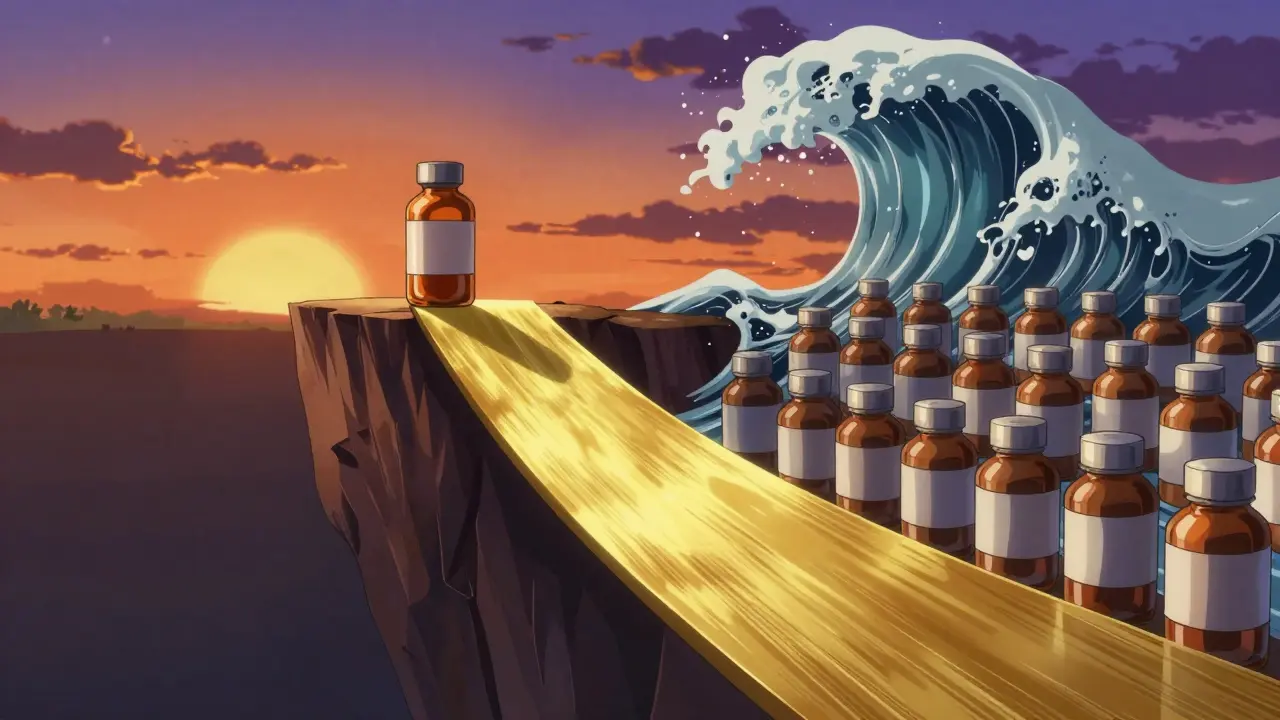
Managing these dates is a full-time job. Most big pharma companies employ dedicated exclusivity managers. Why? Because these periods often overlap. A drug might have a 5-year NCE window and a 7-year orphan window running at the same time. The "cliff" happens when the last of these protections expires, leading to a sudden and dramatic drop in revenue as generics flood the market.
To track this, professionals use the FDA Purple Book. It's the gold standard for checking the exclusivity status of biological products. If you're a generic developer, this book is your roadmap for when you can finally enter the market.
Common Pitfalls and Limitations
It's not a perfect system. Regulatory exclusivity only protects the specific version of the drug approved. If a competitor develops a slightly different molecular entity that does the same thing but isn't a "generic" of the original, they might be able to bypass the exclusivity window.
Furthermore, for the newest frontier of medicine-cell therapies-traditional exclusivity is becoming less relevant. Cell therapies are often so unique and hard to reproduce that they are protected by their own complexity rather than a government-mandated date. If a competitor can't figure out how to make the cell therapy exactly the same way, a 12-year window doesn't really matter because there is no "biosimilar" to block.
Does regulatory exclusivity start at the same time as a patent?
No. Patents start their clock the moment you file the application, which can be years before the drug is even tested in humans. Regulatory exclusivity starts only after the FDA (or equivalent agency) officially approves the drug for sale. This is why it's so valuable-it ensures a set period of profit regardless of how long the approval process took.
Can a company extend their regulatory exclusivity?
Generally, no. Unlike patents, which can sometimes be extended through "Patent Term Restoration" if the regulatory process took too long, regulatory exclusivity is based on fixed statutory periods (e.g., 5 years for NCEs). The only way to get more time is to qualify for a different type of exclusivity, such as adding a new pediatric indication or getting orphan drug status.
What happens to the price of a drug once exclusivity ends?
Typically, prices drop sharply. Once the "exclusivity cliff" is hit and generics are allowed on the market, competition drives prices down. In many cases, the price of a drug can drop by 80% or more within a year of the first generic entry.
Is regulatory exclusivity the same in every country?
Not at all. The US, EU, and Japan all have different rules. For example, the US gives biologics 12 years, while the EU uses a complex "8+2+1" year formula. This means a drug might lose protection in Europe but still be protected in the US, leading to different pricing and availability across the globe.
What is the "ANDA" mentioned in NCE exclusivity?
ANDA stands for Abbreviated New Drug Application. It's the shortcut that generic companies use. Instead of doing all the expensive clinical trials again, they just prove their version is "bioequivalent" to the original. Regulatory exclusivity is specifically designed to block ANDAs for a certain amount of time.