

ICH Guidelines Knowledge Quiz
Test Your Knowledge
What is the primary purpose of ICH guidelines?
Every time a new drug hits the market, it doesn’t just go through one country’s approval process. It must pass the scrutiny of regulators in the U.S., Europe, Japan, the UK, and dozens more. Without a common set of rules, companies would spend years repeating the same tests, using different methods, just to sell the same pill in different places. That’s where the International Council for Harmonisation (ICH) comes in. Founded in 1990 and officially established as a legal entity under Swiss law in 2015, ICH is the quiet engine behind global medication safety. It’s not a lawmaking body. It doesn’t issue fines. But its guidelines are followed by nearly every major pharmaceutical market in the world - because skipping them means your drug won’t get approved anywhere.
How ICH Makes Global Drug Approval Possible
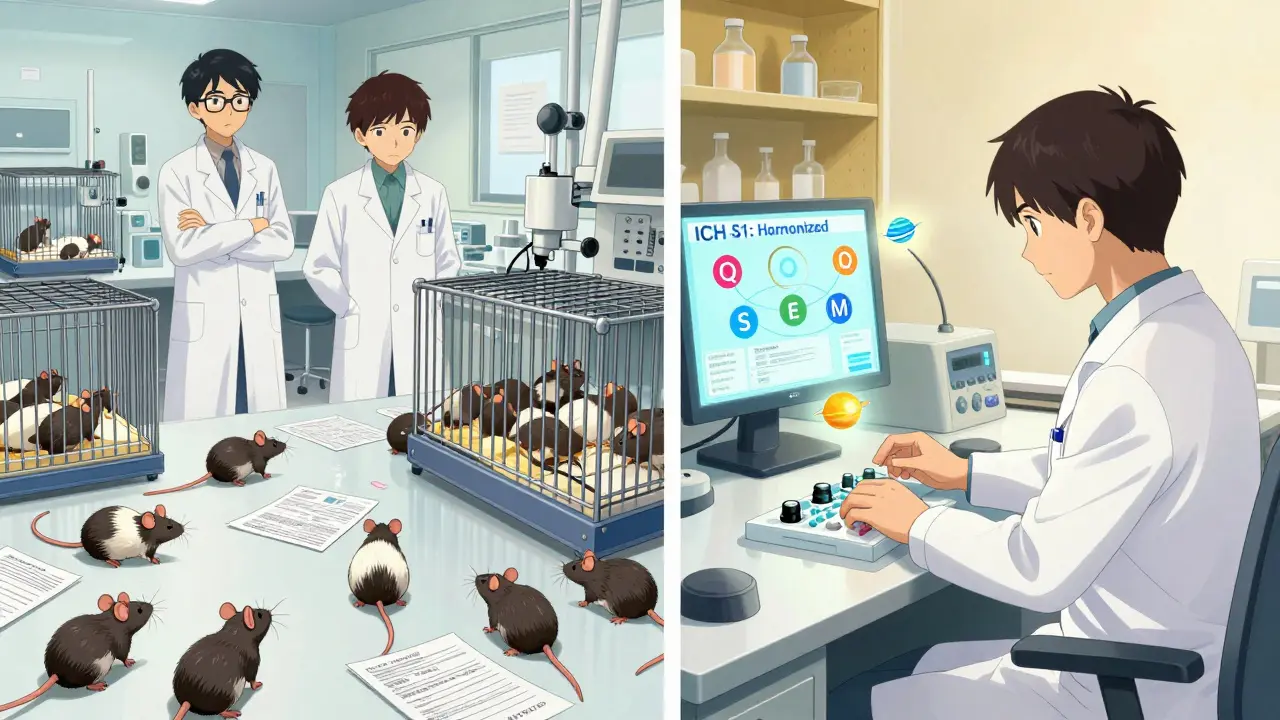
Imagine a pharmaceutical company developing a new cancer drug. In one country, they might be told to test for carcinogenicity using a two-year mouse study. In another, they’re asked to use a different strain of rat. In a third, they’re told to include a third group of animals for reproductive toxicity. That’s not science - that’s waste. ICH fixed that.
Through a strict 5-step process, ICH brings together regulators from the U.S. FDA, the European Medicines Agency (EMA), Japan’s PMDA, and now over 30 other countries to agree on one scientific standard. The process starts with experts from industry and government drafting proposals. Then comes public comment, revisions, and finally, Step 4: adoption. Once a guideline reaches Step 4, each member agency commits to implementing it as official policy. That’s how a single set of rules ends up governing how drugs are tested across continents.
The Four Pillars of ICH Guidelines
ICH organizes its guidelines into four clear categories, each tackling a different part of the drug lifecycle:
- Quality (Q): Covers how drugs are made - from raw materials to packaging. Think stability testing, impurity limits, and manufacturing controls.
- Safety (S): Focuses on what the drug might do to your body. This includes ICH S1 on carcinogenicity, S2 on genotoxicity, and S3 on toxicokinetics. These rules stopped companies from testing the same animals over and over in different countries.
- Efficacy (E): How do you prove a drug actually works? ICH E3 sets the structure for clinical trial reports. ICH E5 deals with ethnic factors - do results from Japanese patients apply to Europeans? ICH E6 is the gold standard for Good Clinical Practice, which governs how trials are run, documented, and monitored.
- Multidisciplinary (M): These bridge gaps between categories. ICH M13A, implemented in June 2024, standardizes bioequivalence testing for generic pills - a huge win for patients who rely on affordable alternatives.
Real-World Impact: From Animal Testing to Real-World Data
The benefits aren’t theoretical. The FDA says ICH harmonization has cut down unnecessary animal testing by up to 40% in some areas. That’s not just ethical - it saves companies millions and gets life-saving drugs to patients faster. Before ICH, a single drug might require 18 months just to re-run safety tests for each new market. Now, those tests are accepted globally.
But ICH isn’t stuck in the past. In June 2024, it adopted a major reflection paper on real-world evidence. This isn’t about lab mice or controlled trials anymore. It’s about using data from electronic health records, insurance claims, and patient registries to understand how drugs perform in everyday use. For the first time, regulators from the U.S., EU, and Canada agreed on a common definition of real-world evidence and how to report it. That means companies can now use data from routine clinical care to support new drug approvals - a huge shift in how we judge safety and effectiveness.
Who Follows ICH - And Who Doesn’t?
The short answer: almost everyone who matters. The U.S. FDA implements every ICH guideline as official guidance. That means if you’re a drugmaker selling in America, you’re legally expected to follow them. The EMA does the same in Europe. Japan’s PMDA has been a full member since day one. The UK, even after Brexit, became a full ICH member in May 2022 - proving the system works beyond political borders.
But ICH doesn’t force anyone. It’s voluntary. So countries outside the core group - like Brazil, India, or South Africa - aren’t required to adopt these rules. But they often do anyway. Why? Because if you want your drug sold in the U.S. or EU, you have to meet ICH standards. So even if your home regulator doesn’t enforce them, your company still follows ICH to access global markets. It’s not coercion - it’s economic necessity.
Recent Updates: What’s New in 2024
ICH doesn’t sit still. In 2024, two major updates reshaped the landscape:
- ICH M13A: This new guideline standardizes how bioequivalence is tested for common oral pills - like antibiotics or blood pressure meds. Before this, different countries had different methods for measuring how fast a generic pill dissolves. Now, there’s one clear method. That means faster approvals for generics, lower prices, and more access.
- ICH Reflection Paper on Real-World Evidence: As mentioned, this isn’t a binding rule yet. But it’s the first time regulators agreed on how to use real-world data in decision-making. It sets the stage for future guidelines that could let companies use data from 10 million patient records to prove a drug’s long-term safety - instead of waiting 10 years for post-market studies.
Why ICH Matters More Than Ever
With gene therapies, AI-driven drug discovery, and personalized medicines on the rise, the old rules are being stretched. ICH is already working on new guidelines for cell and gene therapies. But its real strength isn’t in the documents - it’s in the trust. When regulators and companies sit in the same room for months debating whether a certain test is needed, they build relationships. They learn each other’s priorities. They find common ground.
That’s why ICH survives political chaos, economic shifts, and pandemics. It’s not about politics. It’s about science. And in a world where drug shortages and counterfeit medicines are growing threats, having one clear standard for safety is the only thing that keeps patients protected.
Where to Find the Rules
If you’re a researcher, pharmacist, or even a patient curious about how drugs get approved, the official ICH website (ich.org) is your best source. It lists every finalized guideline, its status, and which countries have adopted it. The FDA and EMA also publish their own versions with explanations tailored to local audiences. No need to guess - the rules are public, free, and updated in real time.
What is the main goal of ICH guidelines?
The main goal of ICH guidelines is to create a single, science-based set of standards for developing and registering medicines so they can be approved faster and more efficiently across different countries - without sacrificing safety or quality.
Are ICH guidelines mandatory?
No, ICH guidelines are not legally binding by themselves. But once adopted by a regulatory agency - like the FDA or EMA - they become mandatory for any company seeking approval in that region. So while voluntary in theory, they’re effectively required in practice.
How many countries follow ICH guidelines?
Over 30 countries and regions have formally adopted ICH guidelines, including the U.S., EU member states, Japan, the UK, Canada, Australia, Singapore, and South Korea. Many others follow them informally because they need to meet ICH standards to export drugs to major markets.
What’s the difference between ICH E6 and ICH S1?
ICH E6 governs how clinical trials are conducted - focusing on ethics, data integrity, and monitoring. ICH S1 deals with how to test whether a drug causes cancer in animals. One is about human trials; the other is about long-term safety testing in labs.
Why did the UK join ICH after Brexit?
The UK joined ICH in May 2022 to ensure its regulatory system remained aligned with global standards. Even though it left the EU, it still needed to approve drugs quickly and allow its pharmaceutical companies to sell in the U.S. and EU. ICH was the fastest way to keep that access.
Do ICH guidelines affect generic drugs?
Yes. ICH M13A, adopted in 2024, created a single global standard for testing bioequivalence in generic pills. This means generic manufacturers no longer need to run separate tests for each market - cutting development time and lowering costs for patients.
How does ICH handle emerging therapies like gene editing?
ICH has already formed working groups to develop new guidelines for advanced therapies, including gene and cell-based treatments. These are still in early stages, but the goal is to create harmonized standards before these therapies become widespread - not after.
ICH doesn’t make headlines. But every time a patient gets a new drug faster, safer, or cheaper - it’s because of ICH. It’s not flashy. It’s not perfect. But in a world of fragmented regulations, it’s the closest thing we have to a global safety net for medicine.
Dylan Patrick
March 13, 2026 AT 20:49ICH is the unsung hero of modern medicine. No one talks about it, but every time you get a new prescription, it’s because someone in a room somewhere convinced regulators from Tokyo to Toronto to stop arguing over rat strains and just agree on one test.
It’s quiet. It’s boring. But it saves lives.
Kathy Leslie
March 15, 2026 AT 19:24I never thought about how much red tape goes into making a pill. But this makes sense-imagine having to redo all your animal studies just because you want to sell in Germany. ICH saved so much time and money. Honestly? Kinda amazing it works at all.
Jimmy V
March 16, 2026 AT 21:24Let’s be real-no one in pharma would ever follow ICH if it wasn’t mandatory in practice. It’s not about science, it’s about market access. The FDA and EMA hold the keys, and everyone else dances to their tune. ICH is just the choreography.
Scott Smith
March 18, 2026 AT 02:23The real win isn’t just harmonizing tests-it’s how ICH forced regulators to talk to each other. Before this, FDA and PMDA acted like rival kingdoms. Now? They sit in the same Zoom room for months arguing over impurity thresholds. That’s diplomacy in action.
And yes, it’s slow. But it works.
Sally Lloyd
March 19, 2026 AT 10:26So… who actually controls ICH? The big pharma companies? The FDA? The Swiss government? It’s all very convenient that the same guidelines that make testing cheaper also make it harder for small players to enter the market. Coincidence? I think not.
Adam M
March 20, 2026 AT 12:10Real-world evidence? Please. You’re telling me we’re going to trust insurance claims and EHRs to approve cancer drugs? That’s how you get another Vioxx. ICH is moving too fast and ignoring the basics.
Noluthando Devour Mamabolo
March 22, 2026 AT 01:38ICH M13A is a game-changer for bioequivalence standardization. The harmonization of dissolution profiles across jurisdictions reduces regulatory arbitrage and enhances therapeutic substitution fidelity. This is foundational for equitable access to generics in LMICs.
Leah Dobbin
March 22, 2026 AT 07:05It’s charming how everyone acts like ICH is some noble scientific endeavor. Meanwhile, the same people who wrote these guidelines are now on pharma advisory boards. The revolving door is wider than the Geneva conference table.
Ali Hughey
March 22, 2026 AT 13:35Wait… wait… you’re telling me that a group of regulators and Big Pharma reps, meeting behind closed doors in Switzerland, decided how ALL of us get our medicine? And now we’re supposed to be grateful? This isn’t harmonization-it’s a global cartel. Someone’s making billions while patients get stuck with the same price tags. I’m not buying it. Not one bit.
Alex MC
March 23, 2026 AT 11:08It’s easy to criticize ICH, but without it, we’d have chaos. Imagine if every country had its own testing protocol for a new vaccine. We’d still be waiting for approval in 2025. ICH isn’t perfect-but it’s the best system we’ve ever built. And it’s evolving. That’s worth supporting.
rakesh sabharwal
March 24, 2026 AT 23:22ICH? More like ICH-Not-For-India. While the West gets streamlined approvals, we’re still stuck with 12 different regulatory hoops just to get a generic approved locally. And now they want us to adopt their standards? Spare me. This is pharmaceutical colonialism.
Aaron Leib
March 25, 2026 AT 01:00One thing I love about ICH is how it forces collaboration. Even when regulators disagree, they have to listen. That’s rare in global governance. And the fact that they’re now including real-world data? That’s how science should work-adapting to real life, not just lab conditions.