
Most people assume that generic drugs are cheap because they’re generic. But the truth is, generic drugs don’t automatically cost less just because they’re not branded. The real savings come from how insurers and pharmacy benefit managers (PBMs) buy them - and too often, that system is broken.
In 2023, generics made up over 90% of all prescriptions filled in the U.S., yet they accounted for only 17% of total drug spending. That sounds great - until you realize that many patients still pay $50, $80, even $100 for a 30-day supply of a generic pill that could be bought for under $5 in cash. What’s going on?
How Bulk Buying Works - and Why It Matters
Bulk buying isn’t just about buying in large quantities. It’s about using market power to force prices down. Think of it like Costco for prescription drugs. Instead of each insurer negotiating separately with drugmakers, they group together thousands of patients and say: "We’ll buy 10 million tablets of this generic blood pressure pill - but only if you give us the lowest price."
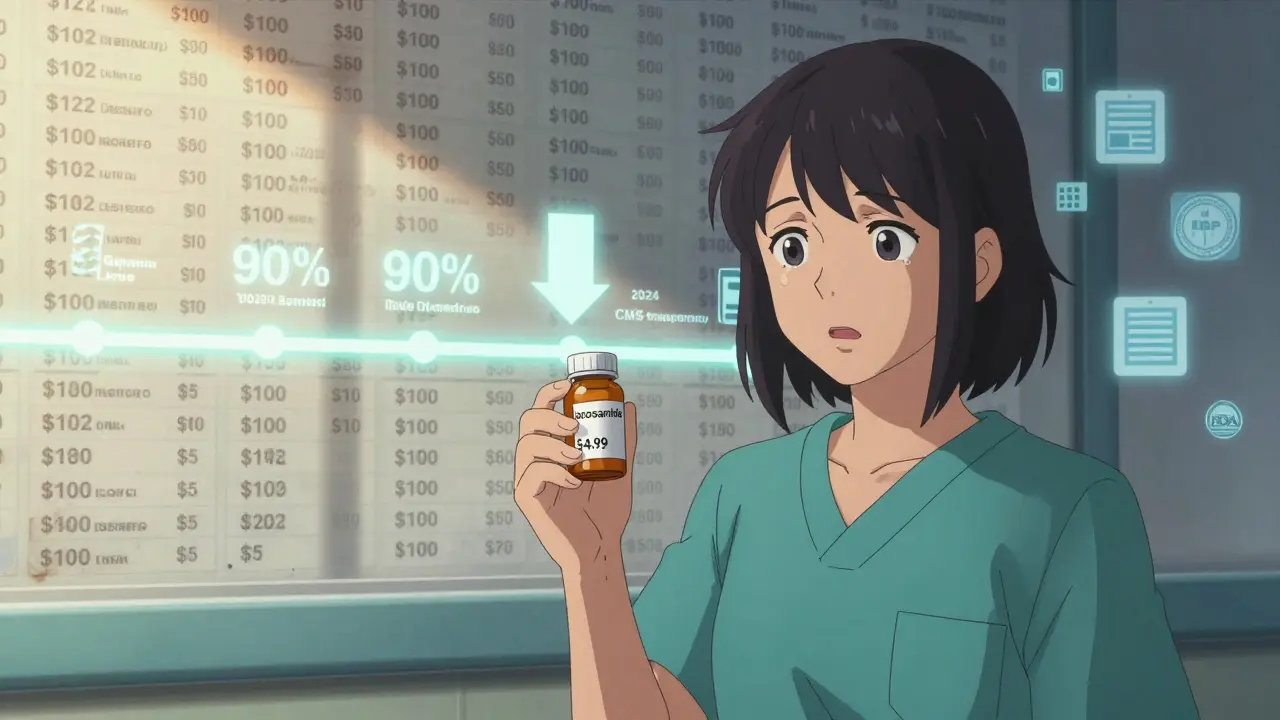
This is called tendering. Insurers issue requests for bids (RFBs) to multiple generic manufacturers. The company that offers the best price wins the contract - often for one to three years. The more manufacturers competing, the lower the price drops. When three companies make the same generic, prices can fall by 80-90% from the first launch price. For example, when the first generic version of lacosamide (Vimpat) hit the market in 2022, it saved over $1 billion in its first year alone.
But here’s the catch: not all generics are treated the same. Some have dozens of manufacturers. Others? Only one or two. And that’s where things go wrong.
The Hidden Cost of Fewer Competitors
Some generic drugs have very few manufacturers. Why? Because making pills isn’t profitable if the price is too low. When a drug’s price drops below the cost of production, companies quit. That’s what happened with albuterol inhalers in 2020. Prices crashed so hard that manufacturers shut down production. Hospitals across the country ran out. Patients couldn’t get their rescue inhalers.
This isn’t rare. The FDA found that in certain therapeutic classes - like antibiotics, heart medications, and seizure drugs - just three manufacturers produce 80% of all supply. That’s not competition. That’s a cartel waiting to happen. When there’s no competition, prices don’t fall. They stay high. And insurers end up paying more than they should.
How PBMs Turn Savings Into Profits
Enter pharmacy benefit managers - the middlemen between insurers, pharmacies, and drugmakers. PBMs like OptumRx, Caremark, and Express Scripts manage drug benefits for over 280 million Americans. Their job? Negotiate prices. But many of them don’t pass those savings along.
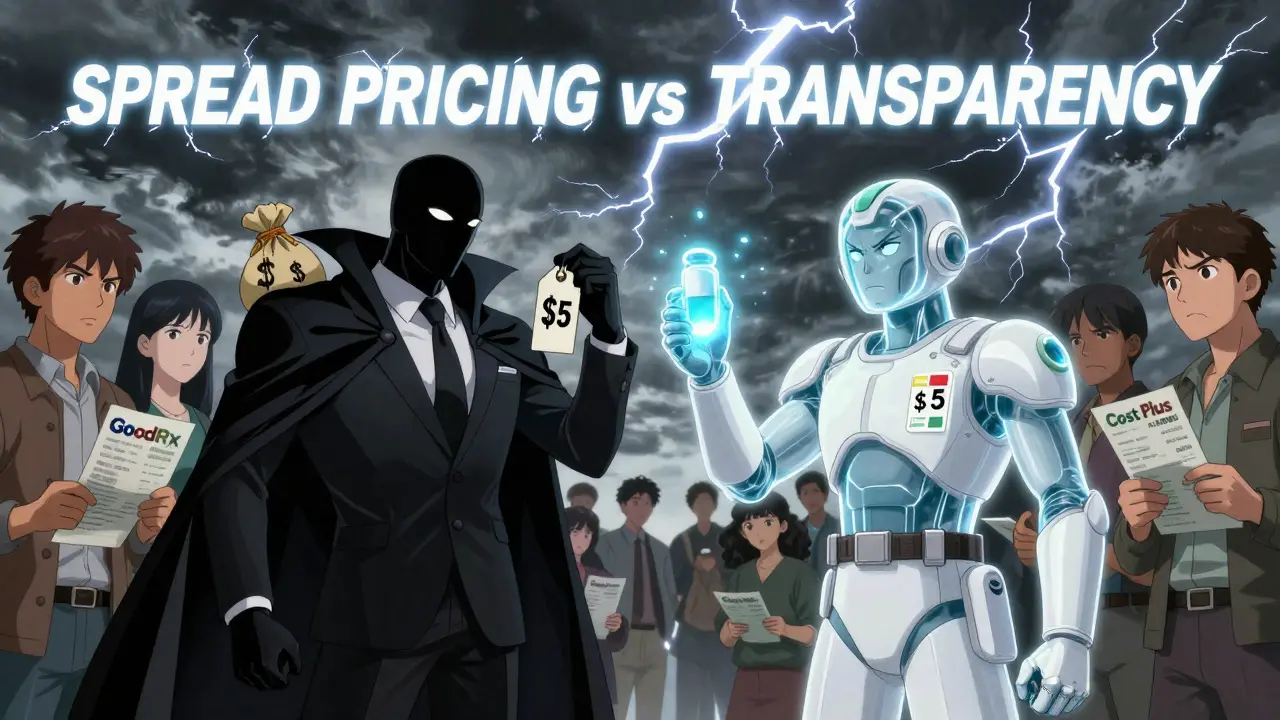
Here’s how it works: A PBM negotiates a $10 price with a drugmaker. Then they tell the insurer they paid $15. The insurer pays $15. The PBM pockets the $5 difference. That’s called "spread pricing." And it’s legal - as long as it’s hidden.
A 2022 study in JAMA Network Open found that many insurers had no idea how much they were really paying. Some generic drugs on their formularies cost twice as much as other generics in the same class - not because they were better, but because the PBM made more money off them.
And here’s the kicker: PBMs often place higher-priced generics on lower cost-sharing tiers - meaning patients pay less out of pocket… but insurers pay more. So patients think they’re getting a deal. But the real cost is hidden in premiums.
Transparent Models Are Changing the Game
There’s a growing movement to cut out the middleman. Companies like Cost Plus Drug Company and Blueberry Pharmacy don’t use spread pricing. They charge a fixed markup - usually 15% over the wholesale cost - plus a small service fee. No secrets. No hidden fees.
One patient on Reddit paid $87 for a generic medication through their insurance. When they paid cash at Cost Plus, it cost $4.99. That’s a 94% savings. Another user said they saved $32 a month on three generics by ignoring their insurance and using GoodRx. And it’s not just individuals. Employers who switched to transparent pricing models saw generic drug costs drop 22% in a single year.
Even Medicare is starting to wake up. In January 2024, the Centers for Medicare & Medicaid Services (CMS) required PBMs to disclose pricing details for Part D plans. That’s a big deal. For the first time, insurers will know exactly what they’re paying - and can demand better deals.
What Insurers Can Do Today
You don’t need to overhaul your entire system to save money. Start here:
- Review your top 10 most expensive generics. Are there cheaper alternatives with the same active ingredient? Often, yes.
- Ask your PBM: "Do you use spread pricing? Can you show me the actual price you pay for each generic?" If they refuse, it’s time to shop around.
- Push for multi-source tendering. Don’t just accept the first bid. Force competition.
- Use real-time data. Tools like GoodRx, SingleCare, and Blink Health show cash prices that are often lower than insurance copays. If your plan doesn’t cover a generic for less than $10, maybe it shouldn’t be on your formulary.
- Consider direct-to-consumer pharmacy partnerships. Some employers now offer employees access to Cost Plus or Navitus Health Solutions as an alternative to traditional pharmacy networks.
One health plan in Ohio switched from a traditional PBM to a transparent model. Within six months, their generic drug spending dropped 31%. No change in coverage. No change in patients. Just better buying.
The Bigger Picture
Generics saved the U.S. healthcare system $445 billion in 2023. That’s huge. But if insurers keep letting PBMs control the process without transparency, they’re leaving billions on the table. The same drugs that cost $150 at one pharmacy cost $5 at another. That’s not magic. That’s competition - and it’s available right now.
The system isn’t broken. It’s working exactly as designed - for PBMs and drugmakers, not for patients or insurers. But it doesn’t have to stay that way. Bulk buying works. Tendering works. Transparency works. The question isn’t whether these tools are effective. It’s whether insurers have the courage to use them.
Why do some generic drugs cost more than others even if they’re the same medicine?
It’s not about the drug - it’s about competition. If 10 manufacturers make a generic, prices drop. If only one or two do, they can charge more. Some generics have no competition because manufacturers quit after prices fell too low. Insurers often don’t realize they’re paying more because their PBM hides the real cost.
Can patients save money by paying cash instead of using insurance for generics?
Yes - and it’s more common than you think. A 2022 study found that 97% of cash payments for prescriptions were for generic drugs. Why? Because cash prices at pharmacies like Cost Plus, Walmart, or CVS are often lower than insurance copays. One patient saved $231 per prescription on an expensive generic by paying cash instead of using insurance.
What’s the difference between a PBM and an insurer?
An insurer (like Blue Cross or Aetna) pays for your healthcare. A PBM (like OptumRx or Caremark) manages how drugs are priced and distributed. Many PBMs are owned by insurers - which creates a conflict of interest. The PBM makes money when drug prices are high, even if the insurer ends up paying more.
How do I know if my PBM is using spread pricing?
Ask for a breakdown of what you’re paying per drug. If you’re told "we negotiate prices" but can’t show you the actual wholesale cost, they’re likely hiding spread pricing. States like California require PBMs to disclose price differences over 5%. If your plan is based in a state with such laws, you have the right to request this data.
Do government programs like Medicare or VA save more on generics?
Yes. The Veterans Health Administration negotiates prices 24% lower than Medicare Part D. Medicare Part D itself has cut total drug spending by 80% since 2007 - but much of that came from shifting patients to cheaper generics, not from better negotiation. The VA’s system is more transparent and less reliant on PBMs, which helps.
Next Steps for Insurers
If you’re an employer, broker, or insurer reading this, start with your top 5 most expensive generics. Compare their cash prices on GoodRx. If the cash price is lower than your plan’s copay, you’re overpaying. Then ask your PBM: "Can we switch to a transparent model? Can we do a tender for these drugs?" If they say no, it’s time to consider a different partner.
The savings are real. The tools are available. The question isn’t whether you can save - it’s whether you’re willing to stop letting someone else control the price.
Milad Jawabra
March 5, 2026 AT 01:46Bro, this is why I stopped using insurance for generics. Paid $112 for my blood pressure med last year. Went to Cost Plus? $6.50. WTF is wrong with this system? 😤
Tobias Mösl
March 6, 2026 AT 03:42Let me guess - PBMs are just corporate vampires sucking the life out of the system while pretending to be heroes. 😈
They don’t negotiate - they *extort*. And insurers? They’re too lazy or too corrupt to call them out. This isn’t broken. It’s *designed* to bleed you dry. And now we’re all stuck paying for it. #PBMscam
tatiana verdesoto
March 7, 2026 AT 16:29I had no idea this was happening. My mom’s on 3 generics and she’s always complaining about her copays. I just thought she was being dramatic. Turns out she’s right. 😔
Maybe I should help her switch to GoodRx. She’s 72 and on a fixed income - she deserves better.
Ethan Zeeb
March 9, 2026 AT 14:23Transparency isn’t a bonus - it’s a baseline. If you’re not showing me the actual wholesale price, you’re lying.
And yes, I’m calling out my own insurer. They’ve been hiding spreads for years. I’m switching to a transparent PBM next open enrollment. No more games.
Jessica Chaloux
March 11, 2026 AT 09:20I cried when I found out I was paying $89 for a pill that costs $4. I felt so stupid. Like I’d been played my whole life. 😭
Why does this feel like a horror movie? And why are we all just… letting it happen?
Mariah Carle
March 12, 2026 AT 01:47There’s a deeper metaphysical layer here: the commodification of survival.
We’ve turned medicine into a market puzzle where the rules are written in invisible ink. The patient isn’t a person - they’re a line item. And the system? It’s not broken. It’s *enlightened*. It knows exactly what it’s doing. We’re just the ghosts in the machine.
Justin Rodriguez
March 14, 2026 AT 00:51Just want to add: if you’re on Medicare Part D, check your plan’s formulary tier. Some generics are placed on higher tiers to make PBMs more money. You can often switch to a cheaper version with the same active ingredient - ask your pharmacist. They know.
Raman Kapri
March 15, 2026 AT 02:52While the article presents a compelling narrative, it ignores the systemic inefficiencies in generic manufacturing supply chains. The cost of raw API sourcing, regulatory compliance, and quality control in the U.S. is not trivial. To suggest that $5 cash prices are universally sustainable is economically naive. There are hidden costs in labor, logistics, and compliance that are not visible to consumers.
Tildi Fletes
March 16, 2026 AT 03:55As a former PBM operations analyst, I can confirm: spread pricing is rampant. But the real issue is contract language. Most insurers sign three-year deals with boilerplate clauses that prohibit price transparency. They’re not evil - they’re just uninformed. Training and contract review are the missing pieces.
Siri Elena
March 17, 2026 AT 15:58Oh honey, you think PBMs are the villains? 😘
Let’s not forget that the *real* criminals are the generic manufacturers who quit production when prices dipped below $0.02 per pill. They knew the game. They walked away. And now we’re all stuck with 3 companies holding the market hostage. Blame the greedy chemists, not the middlemen.
Pankaj Gupta
March 19, 2026 AT 09:25The data presented here is compelling, but it lacks context on global manufacturing. Many generics are produced in India and China, where labor and regulatory costs are significantly lower. The $5 price point is possible because of these externalities - which are not replicable in domestic production. A balanced view requires acknowledging this.
Alex Brad
March 20, 2026 AT 19:21Switch to GoodRx. Done.
Renee Jackson
March 22, 2026 AT 11:17Thank you for this thorough and actionable breakdown. As a benefits director at a mid-sized nonprofit, I’ve been pushing for transparent pricing for two years. Last quarter, we switched three high-cost generics to a direct model. Savings: 34%. No disruption. No patient backlash. Just smart procurement. This isn’t radical - it’s responsible.
Matt Alexander
March 23, 2026 AT 18:54My dad’s on a generic for cholesterol. Paid $110 with insurance. Paid $3.50 cash. I showed him. He’s never used insurance for meds again. Simple.
Gretchen Rivas
March 23, 2026 AT 21:26As someone who grew up in a country where medicine is a human right, I’m stunned by how convoluted this system is. The fact that we need Reddit threads to figure out how to afford pills… that’s a national failure. But hey - at least we have GoodRx. Small wins.