
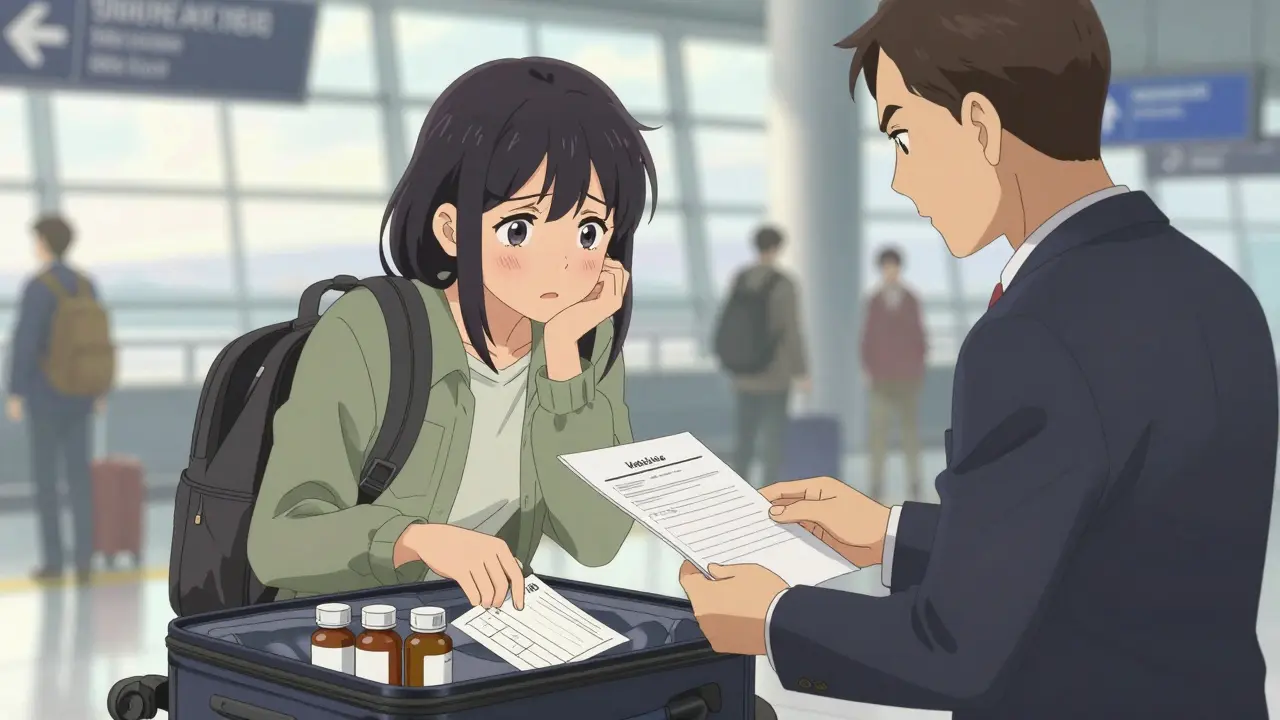
Running out of medication while traveling isn’t just inconvenient-it can be dangerous. Whether you’re on a two-week vacation or relocating for work, finding your prescriptions overseas isn’t as simple as walking into a pharmacy. Many countries have strict rules about what drugs are allowed, how much you can bring, and whether you need special paperwork. And if you don’t prepare ahead, you could end up stranded without your medicine, detained at customs, or forced to stop treatment entirely.
Why Medication Rules Vary So Much
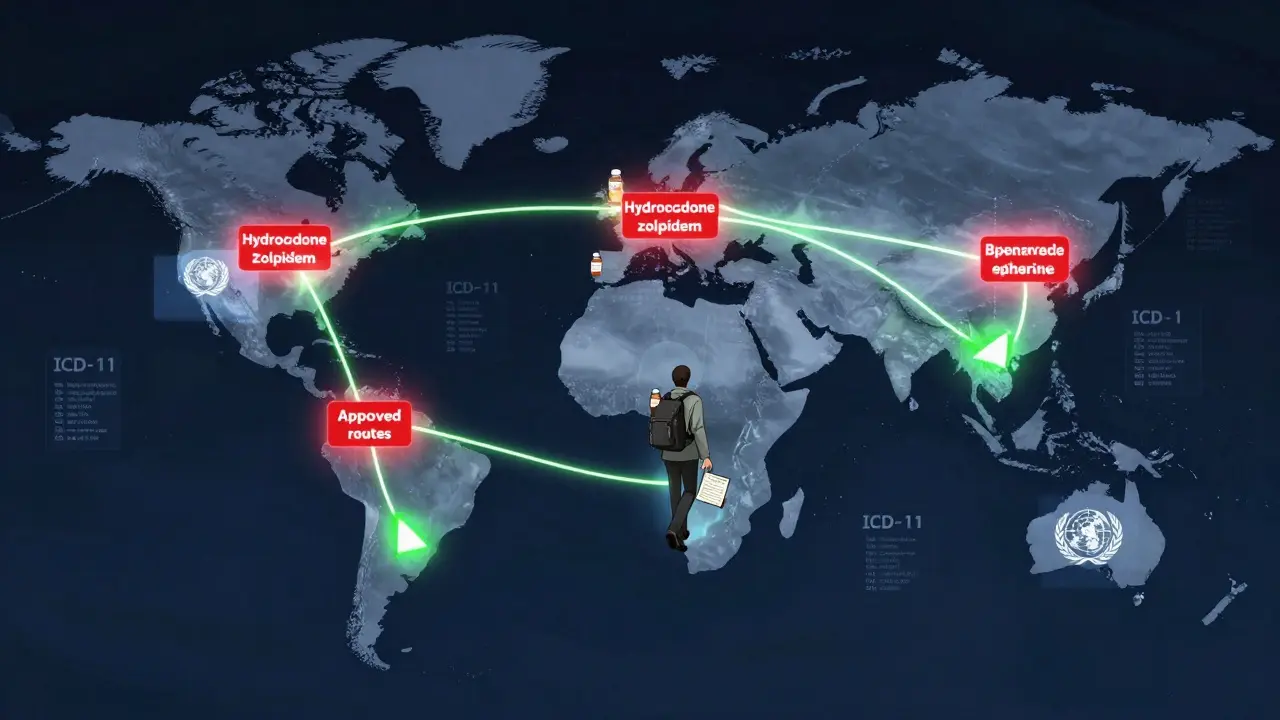
Not every country sees the same drug the same way. What’s legal in Canada might be banned in Japan. A pill you take daily for anxiety could be classified as a controlled substance abroad, even if your doctor says it’s safe. This isn’t about bureaucracy-it’s about history. International drug laws trace back to treaties from the 1960s that aimed to stop illegal drug trafficking. But those rules didn’t account for people who need these drugs to survive.For example, hydrocodone, commonly prescribed in the U.S. for pain, is completely illegal in Japan. Codeine is sold over-the-counter in Mexico but requires a special permit in Australia. Even something as simple as pseudoephedrine (found in many cold medicines) is banned in Australia, New Zealand, and the UAE because it can be used to make methamphetamine. In 2025, Sydney Airport alone seized 387 packages containing this ingredient from travelers.
The World Health Organization says 80% of the world’s population doesn’t have reliable access to pain medications. But that doesn’t mean every country is equally strict. The European Union has a unified system: if you have a valid prescription from one member country, you can usually fill it in another. In contrast, Southeast Asia is a patchwork. Thailand allows 30-day supplies with a prescription. Malaysia bans all benzodiazepines-even if you have a doctor’s note.
What You Can and Can’t Bring
The golden rule: always carry medications in their original containers. That means the bottle from the pharmacy, with the pharmacy label still attached. No pill organizers, no ziplock bags, no unlabeled vials. Airlines and customs officials require this to verify the medication is legitimate. The TSA allows medically necessary liquids over 3.4 ounces if you declare them, but you still need proof it’s prescribed to you.Quantity matters. Most countries allow a 90-day supply for personal use. But exceptions exist. Japan limits narcotics to 30 days. Singapore caps them at 14 days. If you’re bringing a six-month supply of antidepressants, you’re asking for trouble-even if you have a doctor’s letter.
Controlled substances are the biggest risk. This includes:
- Opioids (oxycodone, morphine, hydrocodone)
- Sedatives (alprazolam, diazepam, zolpidem)
- Stimulants (adderall, ritalin)
- Some anticonvulsants and mood stabilizers
According to CDC data, 43% of all medication-related travel incidents involve benzodiazepines. One Reddit user shared how their 10mg zolpidem prescription was confiscated in Dubai despite having a doctor’s note and WHO documentation. They lost three days of their trip fighting with customs.
How to Get a Local Prescription Abroad
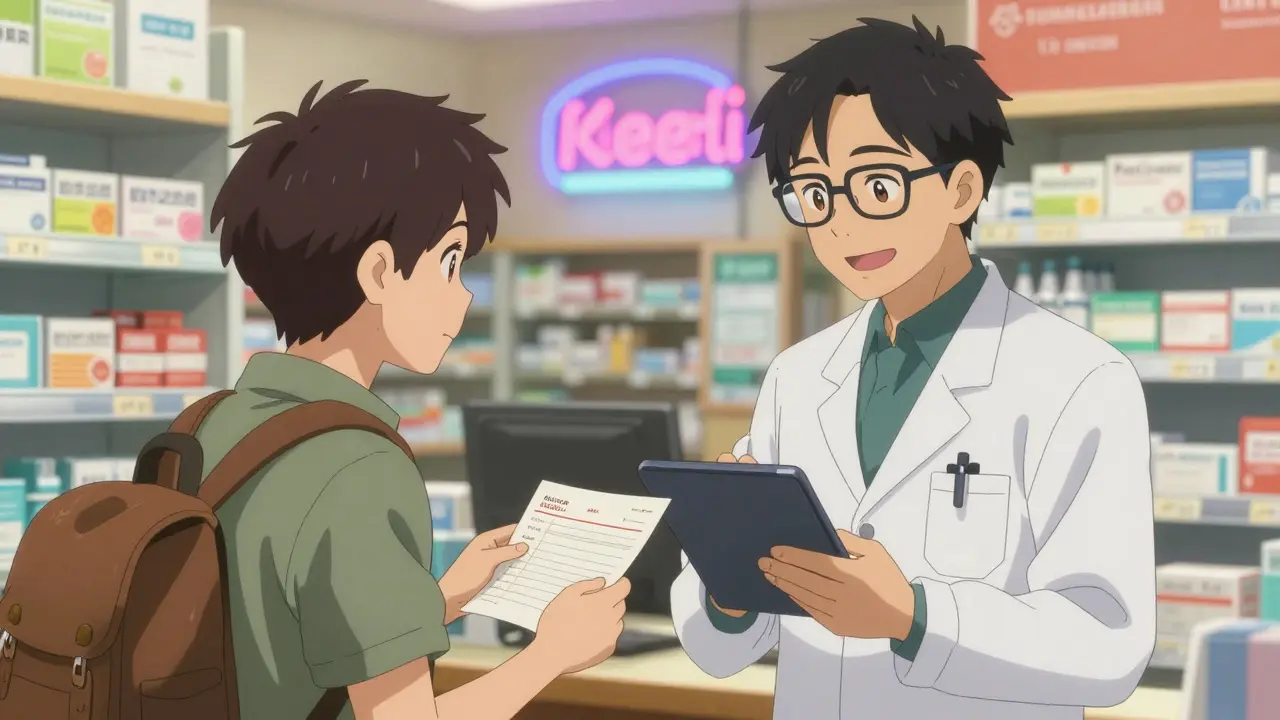
If you run out or need to refill while overseas, getting a local prescription is possible-but not easy. First, you need documentation. A simple printout of your prescription won’t cut it. You need:- Your original prescription with your name matching your passport
- A letter from your doctor on official letterhead
- The generic name of the medication (not just the brand)
- ICD-11 diagnosis codes (required by 83% of Schengen countries)
- A notarized translation if the country doesn’t use English
Some countries, like Germany and France, accept electronic prescriptions through the EU system. One traveler reported filling their sertraline prescription in France within two hours using their German e-prescription. But outside the EU, it’s hit or miss. In the UAE, you need pre-approval from the Ministry of Health-even for common medications like zolpidem. In 2024, over 1,200 travelers were delayed because they didn’t know this.
Pharmacies in major cities often have staff who speak English and understand international prescriptions. Use the International Association for Medical Assistance to Travellers (IAMAT) network. It lists over 1,400 verified clinics worldwide that are familiar with foreign prescriptions. Avoid random pharmacies-some sell counterfeit drugs.
Country-Specific Rules You Can’t Ignore
Here’s what you need to know about key destinations:| Country | Allowed Medications | Banned or Restricted | Documentation Required |
|---|---|---|---|
| United States | Most prescriptions with original labels | Pseudoephedrine (in some states), certain stimulants | Prescription label with patient name |
| Japan | Only 30-day supply of narcotics | Hydrocodone, oxycodone, codeine, ADHD meds | Special import permit from Ministry of Health |
| United Arab Emirates | Most medications with approval | Zolpidem, diazepam, tramadol, all stimulants | Pre-approval from Ministry of Health + notarized letter |
| Thailand | Most prescriptions accepted | High-dose opioids, certain sedatives | Prescription + doctor’s letter |
| Malaysia | Antibiotics, pain relievers | All benzodiazepines (alprazolam, diazepam) | Prescription not accepted for banned drugs |
| Canada | 90-day supply allowed under new import law | None for travelers from approved countries | Prescription + original packaging |
Canada’s 2025 import law lets travelers bring in 90-day supplies from certified pharmacies in the EU, UK, Switzerland, and other approved nations. The U.S. is moving toward similar rules, but as of 2026, it’s still patchy.
What to Do Before You Leave
Don’t wait until you’re at the airport. Start planning at least 8-12 weeks ahead. Here’s your checklist:- Check the INCB Country Regulations database (updated October 2025). Only 68 countries have published rules-124 don’t. If yours isn’t listed, contact the embassy.
- Call your destination country’s embassy. Ask: "What are the rules for bringing [medication name] into the country?" Write down their answer.
- Ask your doctor for a letter on letterhead with: your name, medication name (generic), dosage, quantity, ICD-11 code, and reason for use.
- Get the letter notarized if traveling to a non-English-speaking country.
- Carry two copies: one in your checked luggage, one in your carry-on.
- Use the TSA Cares program if flying from the U.S.-it gives you priority screening for medical items.
Most travelers skip steps 1 and 2. A 2025 GAO report found 63% don’t check embassy guidelines. That’s how people get caught.
What Happens If You Get Caught?
If customs finds a banned drug, they’ll confiscate it. That’s the best-case scenario. In some countries, you could be detained, fined, or even jailed. In Dubai, a traveler was held for three days after bringing 10mg of zolpidem. In Singapore, even a small amount of a controlled substance can trigger a mandatory drug test and prison time.Don’t assume a doctor’s note will save you. In 78% of rejection cases, the problem wasn’t the medication-it was mismatched names. If your passport says "Jane Smith" and your prescription says "J. Smith," you’re at risk.
What’s Changing in 2026
Good news: the WHO is rolling out standardized international documentation templates in 2026. This will make it easier for doctors to write letters that are accepted everywhere. The U.S. is also launching a new import system that allows certified foreign pharmacies to ship medications to Americans. Canada’s new law is already helping travelers from the U.S. and EU.But until these systems are fully adopted, you’re still on your own. The safest path? Prepare early. Know the rules. Carry the right papers. And when in doubt, call the embassy.
Can I bring my prescription medication in my carry-on?
Yes, and you should. Always keep medications in your carry-on, not checked luggage. Customs can lose bags. Airlines can delay them. You need your medicine with you at all times. Keep it in original containers with pharmacy labels. Declare it to TSA or airport security if asked.
What if my medication isn’t available abroad?
Contact the International Association for Medical Assistance to Travellers (IAMAT). They have a network of 1,400 verified clinics worldwide that understand foreign prescriptions. You can also ask your doctor for a generic alternative before you leave. Some countries allow equivalent drugs-even if the brand name isn’t sold there.
Do I need a doctor’s letter for over-the-counter meds?
Usually not, but if you’re carrying large quantities-like 100 tablets of ibuprofen or a bottle of pseudoephedrine-it’s smart to have one. Some countries treat high-volume OTC drugs as suspicious. A simple note from your doctor saying "for personal use" can prevent delays.
Can I get a prescription filled in another country if I’m a tourist?
Sometimes. In the EU, yes-your prescription is valid across member states. Outside the EU, it depends. Many pharmacies in tourist areas will fill foreign prescriptions, especially if you have the original bottle and a doctor’s letter. But they’re not required to. Always call ahead.
Is it legal to mail medication to myself abroad?
Almost never. Most countries prohibit mailing prescription drugs, even to citizens. Customs will seize it. Some services like MediFind and MyTravelMed offer courier delivery, but they’re expensive and only work in select countries. Don’t risk it.
trudale hampton
March 21, 2026 AT 23:48Been there, done that. Got my anxiety meds confiscated in Japan last year because I had a 90-day supply. Turns out they only allow 30 days for narcotics, even if you have a doctor’s note. Learned the hard way. Now I always check the INCB database before I go. Seriously, it’s not rocket science-just take 10 minutes before booking your flight.
Also, carry two copies of everything. One in your carry-on, one in your checked bag. I lost my bag in Dubai once. Thank god I had a backup.
Pro tip: Use IAMAT. They hooked me up with a clinic in Bangkok that filled my prescription in like 20 minutes. No drama.
Thomas Jensen
March 22, 2026 AT 01:01THIS IS ALL A GOVERNMENT CONTROL SCHEME. They don’t want you to feel better. They want you dependent on their system. Why is hydrocodone illegal in Japan but legal here? Because they’re scared of people being too comfortable. Same with Adderall. They’re afraid if you’re too focused, you’ll stop consuming their propaganda.
Remember when the CDC said 43% of incidents involve benzodiazepines? That’s because they’re tracking us. They don’t want you to sleep. They want you anxious. Wake up.
And don’t get me started on the WHO. That’s just a front for Big Pharma.
Allison Priole
March 23, 2026 AT 13:52okay so i had to refill my zolpidem in thailand last year and it was actually kinda chill? i went to this pharmacy in chiang mai and the pharmacist spoke english, had my med in stock, and just asked for my prescription and a doctor’s note. no big deal. they even gave me a little pamphlet in thai with the generic name so i could show it to others if needed.
the real issue is when people panic and try to hide stuff. i saw this dude try to sneak 50 pills in a pill organizer. bro. just tell them. they’re not gonna arrest you for having your own meds. unless you’re in dubai or singapore. then yeah, run.
also, i always carry a photo of my prescription on my phone. just in case. it’s not official, but it’s better than nothing.
Casey Tenney
March 24, 2026 AT 19:29People who don’t prepare deserve to lose their meds. No one’s stopping you from researching. If you’re too lazy to call an embassy, don’t complain when you’re stuck in a jail cell with no Xanax.
It’s not complicated. Original bottle. Doctor’s letter. Passport match. Three things. Three. Not 30. Not 300. THREE.
Stop being entitled. This isn’t a convenience. It’s a legal system. Learn it or suffer.
Chris Dwyer
March 24, 2026 AT 20:33Just wanna say-this guide is FIRE. 🙌
I’m a nurse who travels for work, and I’ve been using the IAMAT network for years. Saved my life in Berlin when my US prescription ran out. They connected me with a clinic that accepted my German e-prescription. Took 45 minutes. No stress.
Also, if you’re worried about the ICD-11 code? Just ask your doctor to include it. Most of them know what it is now. If they don’t? Google it. It’s literally one click away.
And yeah, carry two copies. I keep one in my wallet and one in my laptop sleeve. Always. No excuses.
Natali Shevchenko
March 26, 2026 AT 18:34It’s funny how we treat medication like it’s some kind of forbidden fruit. We live in a world where people die because they can’t access painkillers, yet we treat someone taking a prescribed antidepressant like they’re smuggling cocaine.
The real tragedy isn’t the bureaucracy-it’s that the system was designed to stop drug traffickers, not patients. There’s no moral logic here, just historical inertia. We’re enforcing 60-year-old treaties to control modern human needs.
And yet, the people who suffer the most are the ones who follow the rules. The ones who call embassies, get notarized letters, carry originals. They’re the ones getting detained. The smugglers? They never get caught.
Maybe the real question isn’t how to navigate the rules-but why the rules exist in the first place.
Johny Prayogi
March 28, 2026 AT 01:42Yessss this is the energy I needed 😍
I just got back from Bali and my mom’s blood pressure med was flagged. She had the original bottle, the letter, the whole thing. Still got questioned. But because she stayed calm and showed them the WHO template? They waved her through. No drama.
Also-use the TSA Cares program. I didn’t know it existed until last year. Life saver. They gave her a private screening and even called the pharmacy to verify. 🤯
PS: I sent the whole article to my whole family. Everyone’s doing this now. Thanks for the heads up!
Timothy Olcott
March 28, 2026 AT 14:35USA is the only country that gets it right. Everything else is just socialist nonsense. Why should I have to get a permit to bring my own medicine into another country? I pay taxes. I’m an AMERICAN. I should be able to bring whatever I need without begging for permission.
And why does Canada get to have a 90-day rule but we don’t? That’s just weak. We need to stop being nice to other countries. They don’t respect us. Why should we respect their dumb rules?
Also, I saw a guy in Dubai with a zolpidem bottle. He got arrested. I hope he learned his lesson. Maybe next time he’ll think before he travels. 🇺🇸
shannon kozee
March 29, 2026 AT 23:59Always carry the original bottle. No exceptions.