

Contraceptive Risk Calculator
Your Situation
Results
Your pregnancy risk level:
Imagine taking your birth control pill every single day without fail, only to find out you are pregnant. For many women, this seems impossible, but there is a specific antibiotic that can quietly undermine the protection you rely on. This isn't just a theoretical worry; it is a documented medical reality involving Rifampin is a potent antibiotic used primarily to treat tuberculosis that significantly reduces the effectiveness of hormonal contraceptives through accelerated metabolism. The risk of breakthrough ovulation is real, and understanding how this interaction works can prevent unintended pregnancies. You need to know exactly how this drug changes your body's chemistry and what steps to take if your doctor prescribes it.
What Is Rifampin and Why Is It Prescribed?
Rifampin is a rifamycin antibiotic first approved by the FDA in 1971 and marketed as Rifadin by Aventis Pharmaceuticals. It remains a cornerstone treatment for tuberculosis (TB), a serious bacterial infection that affects the lungs. In the United States alone, there are approximately 8,000 TB cases reported annually, and many of these require rifampin-containing regimens to be cured. Beyond TB, doctors sometimes use it for other bacterial infections or as a preventive measure for meningitis exposure. It is a powerful drug that works by stopping bacteria from replicating, but its impact on your liver enzymes is where the trouble starts for birth control users.
Unlike common antibiotics like penicillin or amoxicillin, rifampin does not just fight infection; it fundamentally changes how your liver processes other medications. This is why it stands out in the world of drug interactions. While most antibiotics pass through your system without affecting other drugs, rifampin acts as a catalyst, speeding up the breakdown of hormones that keep you protected from pregnancy.
The Mechanism: How Enzyme Induction Causes Failure
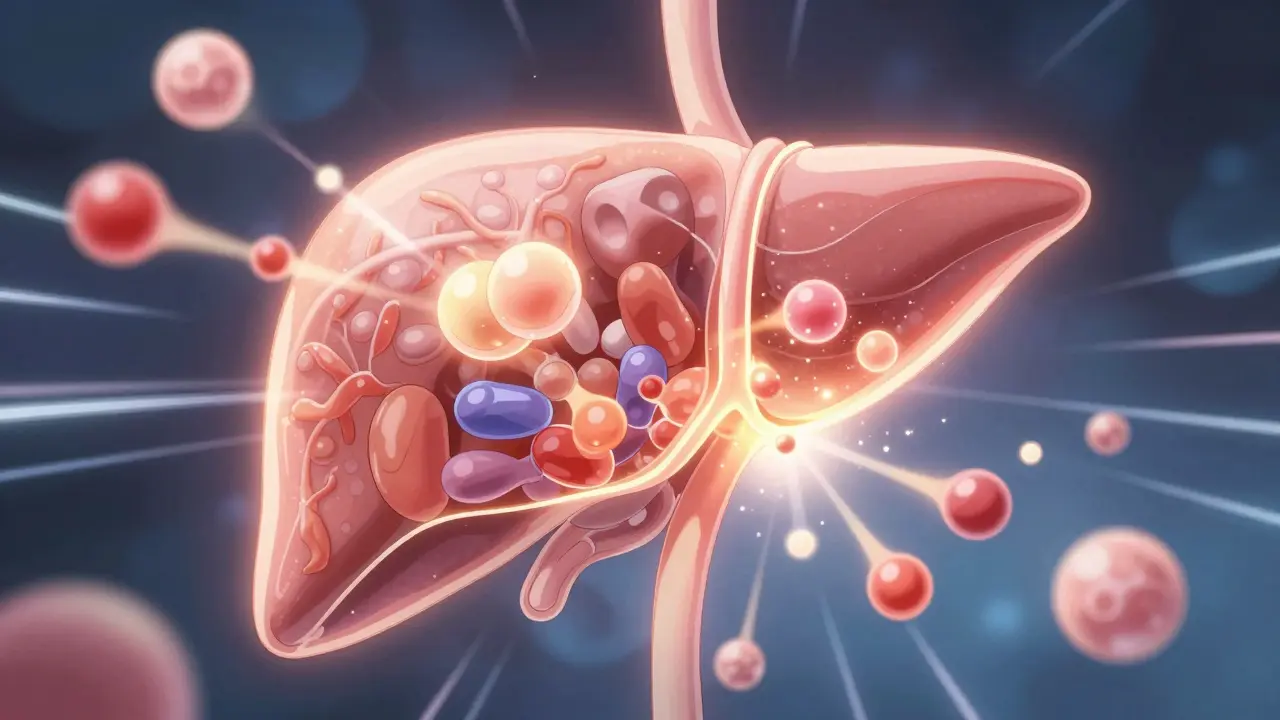
To understand why pregnancy can happen despite perfect pill adherence, you have to look at the liver. Your liver contains a group of proteins called Cytochrome P450 Enzymes is a family of enzymes in the liver responsible for metabolizing drugs and hormones, which rifampin significantly induces. When you take rifampin, it turns these enzymes into overactive workers. They start processing other substances in your body much faster than usual. This process is known as enzyme induction.
Hormonal contraceptives rely on steady levels of estrogen and progestin in your blood to suppress ovulation. When rifampin accelerates the metabolism of these hormones, their levels drop too low to do their job. A 2024 systematic review published in the National Institutes of Health (NIH) archives provides hard numbers on this. The review found that progestin exposure, measured by area under the curve (AUC), was reduced by 30-83% when combined oral contraceptives were taken with rifampin. Similarly, ethinyl estradiol exposure dropped by 42-66% in four out of five studies examined.
This isn't a minor fluctuation. A reduction of this magnitude means the hormone levels fall below the threshold needed to stop your ovaries from releasing an egg. Once ovulation occurs, the contraceptive fails. The metabolism of estrogens is increased fourfold due to this enzyme induction, resulting in both reductions in area under the curve and increased clearance. This rapid clearance means the drug leaves your system before it can effectively block pregnancy.
Clinical Evidence and Risk Classification
The medical community has long recognized this danger. The Centers for Disease Control and Prevention is a US national public health agency that classifies rifampin as a category 3 drug interaction with combined hormonal contraceptives. CDC classifies rifampin as a category 3 drug interaction with combined hormonal contraceptives (CHCs). This classification means the theoretical or proven risk generally outweighs the advantages of using the contraceptive method during concurrent therapy. In simpler terms, the risk of pregnancy is high enough that doctors should advise against relying on the pill alone.
The typical failure rate for combined hormonal contraceptives is around 0.3% with perfect use. When rifampin is introduced, that risk climbs significantly. Case reports from the 1970s first documented women becoming pregnant while using oral contraceptives during tuberculosis treatment. These early warnings led the World Health Organization is an international health agency that issued warnings in 1988 about the rifampin-contraceptive interaction that remain in effect today. to issue warnings in 1988 that remain in effect today. The data has only become clearer since then. The NIH systematic review noted that rifampin increases the frequency of ovulation in two of four clinical studies analyzed. This confirms that the interaction is not just about blood levels; it actually triggers the biological process of ovulation.
Rifampin vs. Other Antibiotics
There is a lot of confusion about whether all antibiotics interfere with birth control. You might have heard that any antibiotic can make your pill less effective, but the evidence does not support this for most drugs. Rifampin is consistently identified across multiple authoritative sources as the only antibiotic with well-documented evidence of reducing hormonal contraceptive effectiveness through enzyme induction. The American Academy of Family Physicians states clearly that other antibiotics frequently suspected of causing interactions have less evidence.
| Antibiotic Type | Effect on Hormonal Contraceptives | Clinical Evidence |
|---|---|---|
| Rifampin | Significant Reduction | Strong evidence of ovulation and pregnancy |
| Rifabutin | Moderate Reduction | Less pronounced effects, limited ovulation data |
| Non-Rifamycin (e.g., Penicillin) | No Significant Effect | 2018 review found no observed differences in ovulation |
For example, rifabutin (marketed as Mycobutin) demonstrates less pronounced effects. Studies show no ovulation detected by serum progesterone when combined oral contraceptives were combined with rifabutin, and pharmacokinetic changes are generally smaller than with rifampin. Non-rifamycin antibiotics show inconsistent evidence. A 2018 systematic review published by OBG Project found no observed differences in ovulation suppression or breakthrough bleeding in any study that combined hormonal contraceptives with any non-rifamycin antibiotic. This distinction is vital because it prevents unnecessary panic over common infections treated with standard antibiotics.
Actionable Steps for Patients
If you are prescribed rifampin, you cannot simply wait and see. The CDC recommends using a backup contraceptive method for the duration of rifampin therapy and for 28 days after discontinuation. This 28-day window is critical because the enzyme induction effect persists even after you stop taking the drug. Your liver enzymes remain overactive for weeks, continuing to break down contraceptive hormones too quickly.
Condoms are the most accessible backup method, but they must be used consistently. UNC Campus Health advises that people on these antibiotics who also use combined hormonal contraception should use a backup method of birth control while they are taking these antibiotics. Dr. Pelletier's clinical guidance emphasized taking the pill every day and at the same time every day to maximize efficacy when no alternatives exist, though this cannot fully compensate for rifampin's enzyme induction. You need a second layer of protection that does not rely on hormones.

Alternative Contraceptive Methods
For women who need long-term tuberculosis treatment, relying on the pill with backup condoms can be stressful. There are contraceptive methods that are not affected by enzyme inducers. The COSRH guidance recommends considering alternative contraceptive methods such as copper IUDs or progestin-only implants that are not affected by enzyme inducers during rifampin therapy. A copper IUD works by creating a toxic environment for sperm and does not involve hormones, making it immune to liver enzyme changes.
Progestin-only implants are another option, though some data suggests high-dose enzyme inducers might impact them slightly less than oral pills. However, the copper IUD remains the gold standard in this scenario. It provides over 99% effectiveness without relying on the bloodstream levels that rifampin disrupts. Switching methods before starting rifampin is the safest strategy if you are planning a long course of treatment.
Monitoring and Future Developments
Researchers are still working to quantify the precise pregnancy risk better. The NIH systematic review identifies data gaps in the literature regarding the clinical impact of concomitant use of rifamycins and hormonal contraception, particularly for newer contraceptive formulations. The American College of Obstetricians and Gynecologists is developing updated guidelines expected in late 2024 that may provide more precise recommendations based on recent evidence. Dr. Sarah K. Reeves of the Harvard T.H. Chan School of Public Health presented preliminary data suggesting that pharmacogenetic testing might eventually help identify women at highest risk for contraceptive failure during rifampin therapy based on CYP3A4 enzyme expression levels.
However, as of October 2024, no major pharmaceutical companies have announced development of rifampin formulations with reduced enzyme induction properties or contraceptive formulations resistant to enzyme induction. This leaves backup contraception as the primary clinical recommendation for the foreseeable future. Until science provides a different solution, the responsibility falls on you and your healthcare provider to manage this interaction actively.
Does Rifampin affect all types of birth control?
Rifampin significantly reduces the effectiveness of all hormonal contraceptives, including the pill, patch, and ring. It does not affect non-hormonal methods like copper IUDs or condoms.
How long do I need to use backup contraception after stopping Rifampin?
You should use backup contraception for the entire duration of therapy and for 28 days after you stop taking rifampin because the enzyme induction effect persists in the liver.
Can I take a higher dose of birth control to counteract Rifampin?
Some clinicians recommend higher-dose estrogen contraceptives, but there is limited evidence of efficacy. The safest approach is to use a non-hormonal backup method instead of relying on dose adjustment.
Do other antibiotics like Amoxicillin interact with birth control?
No, a 2018 systematic review found no evidence supporting interactions between non-rifamycin antibiotics like amoxicillin or penicillin and hormonal contraceptives.
What is the best alternative contraceptive during Rifampin therapy?
The copper IUD is the best alternative because it is non-hormonal and its effectiveness is not compromised by liver enzyme induction caused by rifampin.
Kevin Y.
March 26, 2026 AT 09:55This is a really important point about the metabolic interactions involved here.
Raphael Schwartz
March 27, 2026 AT 06:58doctors never warn you about this stuf
Caroline Dennis
March 27, 2026 AT 23:46CYP3A4 induction is the primary driver here and requires immediate clinical attention.
Marissa Staples
March 29, 2026 AT 11:44it is strange how biology works this way
Agbogla Bischof
March 31, 2026 AT 04:14This interaction is truly fascinating, from a pharmacokinetic perspective. The liver enzymes, are working overtime, to process the rifampin. They do not distinguish, between the antibiotic and the contraceptive hormones. Consequently, the estrogen levels drop precipitously, within hours of ingestion. Many patients, are unaware of this specific metabolic pathway. It is crucial, that healthcare providers explain this mechanism clearly. The standard advice, regarding backup contraception is not optional. You must continue, the barrier method for a full month after stopping. The enzyme induction, does not cease immediately upon drug discontinuation. Residual activity, in the cytochrome system remains elevated for weeks. This creates, a window of vulnerability for unintended conception. The copper IUD, remains the only reliable non-hormonal alternative. It bypasses, the hepatic metabolism entirely by acting locally. Patients should discuss, this switch before starting the antibiotic regimen. Ignoring this data, puts reproductive health at significant risk.
peter vencken
April 1, 2026 AT 12:03i think the iud is the best way to go since it doesnt use hormones
Chris Crosson
April 3, 2026 AT 10:11The 28 day rule is non negotiable for anyone taking this medication
Katie Putbrese
April 4, 2026 AT 16:57people need to take responsibility for their own health instead of relying on pills that fail
Jefferson Moratin
April 4, 2026 AT 17:23The distinction between rifamycins and other antibiotics is scientifically significant and often misunderstood.
Mihir Patel
April 5, 2026 AT 06:43this is absolutly terrifying news for women everywhere
Jesse Hall
April 6, 2026 AT 11:01so glad we are learning more about this :)
Donna Fogelsong
April 7, 2026 AT 01:55big pharma knows this but hides the pharmacology data from the public to sell more drugs
Sean Bechtelheimer
April 8, 2026 AT 03:12they want us dependent on their pills :)