
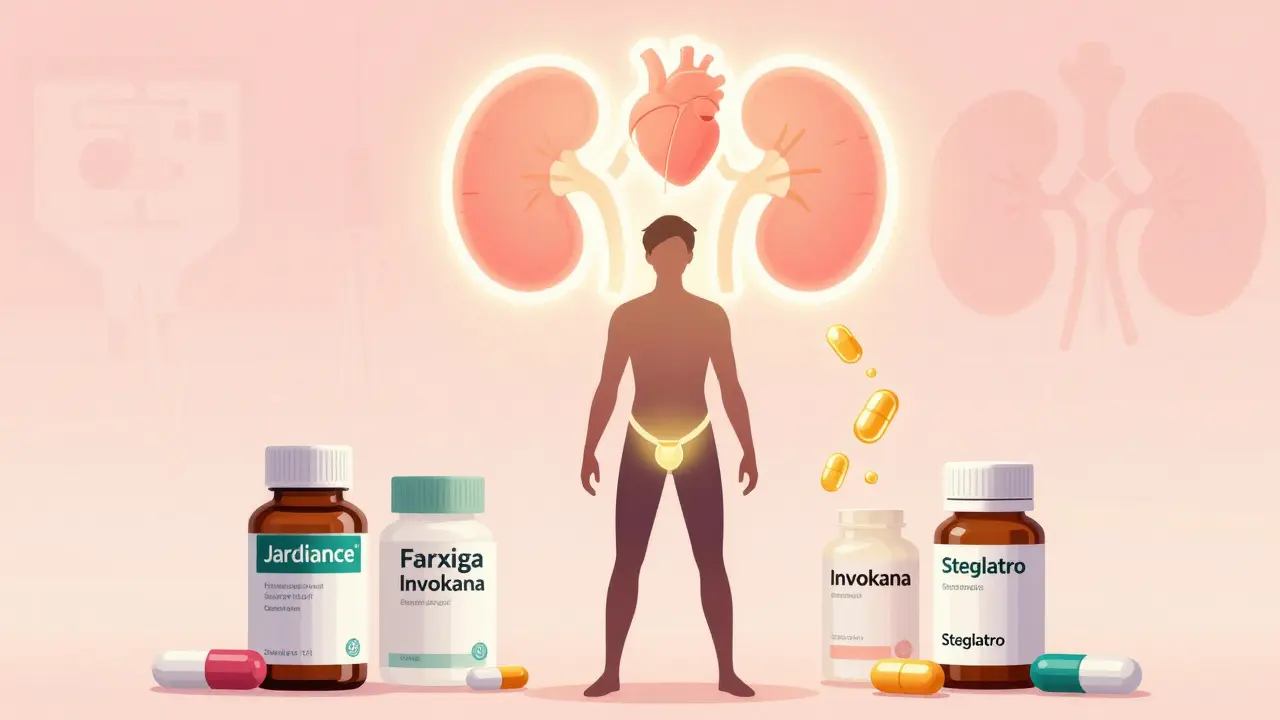
For people with type 2 diabetes, managing blood sugar isn’t just about taking pills anymore. A new generation of medications called SGLT2 inhibitors has changed the game-not just for glucose control, but for heart and kidney health too. These drugs, including Jardiance, Farxiga, Invokana, and Steglatro, were originally designed to lower blood sugar. But what surprised doctors-and patients-is how much more they do. If you’ve been told to consider one of these, you’re not alone. Millions are now using them, and the science behind them is strong. But they’re not without risks. Here’s what actually happens when you take them, what they can do for you, and what might go wrong.
How SGLT2 Inhibitors Work (Without Insulin)
Unlike metformin or insulin, SGLT2 inhibitors don’t rely on your body’s insulin system. Instead, they work in your kidneys. Normally, your kidneys reabsorb glucose back into your bloodstream. SGLT2 inhibitors block that process. The result? Extra sugar leaves your body through urine-about 40 to 100 grams a day. That’s roughly the amount in a large soda. This directly lowers your HbA1c by 0.5% to 1.0%, which is meaningful but not dramatic on its own.
What makes these drugs stand out is what else they do. Because you’re losing sugar, you’re also losing calories. Most people lose 2 to 3 kilograms (4 to 7 pounds) in the first few months. Blood pressure drops too-usually 3 to 5 mmHg. And unlike sulfonylureas or insulin, they rarely cause low blood sugar unless combined with those other drugs. That’s a big deal for older adults or those with unpredictable eating habits.
The Real Game-Changers: Heart and Kidney Protection
The biggest shift in diabetes care over the last decade has been recognizing that SGLT2 inhibitors don’t just treat diabetes-they protect organs damaged by it.
Three major trials changed everything. The EMPA-REG OUTCOME trial showed empagliflozin (Jardiance) reduced cardiovascular death by 38% in people with type 2 diabetes and known heart disease. The CANVAS Program found canagliflozin (Invokana) cut major heart events by 14%. But the most striking result came from the DAPA-HF and EMPEROR-Reduced trials: SGLT2 inhibitors lowered hospitalizations for heart failure by 30% or more-even in people without diabetes. That’s why the American Heart Association now recommends them for heart failure with reduced ejection fraction, regardless of diabetes status.
For kidneys, the results are just as powerful. The CREDENCE trial showed canagliflozin reduced the risk of kidney failure, doubling of creatinine, or kidney-related death by 30%. The EMPA-KIDNEY trial confirmed empagliflozin slowed kidney decline in people with chronic kidney disease-even if they didn’t have diabetes. In 2023, the FDA approved dapagliflozin (Farxiga) for chronic kidney disease in non-diabetic patients too. That’s unprecedented. A drug originally meant for blood sugar is now a standard treatment for kidney protection.
Who Benefits the Most?
These drugs aren’t for everyone. But if you have any of these, they’re likely the best choice:
- Diabetes plus heart failure (even if your ejection fraction is normal)
- Diabetes plus chronic kidney disease (eGFR above 30)
- Diabetes plus a history of heart attack or stroke
- Diabetes with high blood pressure and excess weight
For someone with no heart or kidney problems, the benefits are smaller. The number needed to treat to prevent one major heart event over five years is 52. That means 51 people would take the drug without benefit, just to help one person. In those cases, cost and side effects might outweigh the upside.

The Side Effects You Can’t Ignore
For all their benefits, SGLT2 inhibitors come with real risks. The most common are genital yeast infections. About 6% to 11% of women and 3% to 5% of men get them. It’s not dangerous, but it’s uncomfortable-itching, burning, discharge. Many people stop taking the drug because of it. Men can get balanitis; women, recurrent vulvovaginal candidiasis. Antifungal creams help, but prevention matters: drink water, avoid tight clothing, and wipe front to back.
Urinary tract infections (UTIs) are also more common. About 6% to 9% of users get them, compared to 4% on placebo. Most are mild, but if you get frequent UTIs, this might not be the right drug for you.
The most serious risk is diabetic ketoacidosis (DKA), but it’s rare-about 0.1% to 0.3% of users. What’s scary is that it can happen even when blood sugar isn’t very high. This is called euglycemic DKA. It’s often triggered by illness, surgery, fasting, or heavy alcohol use. Symptoms: nausea, vomiting, stomach pain, confusion, rapid breathing. If you feel this way, stop the drug and get checked immediately. Don’t wait for your sugar to spike.
Another rare but severe risk is Fournier’s gangrene-a life-threatening infection of the genitals and perineum. Only 0.002% of users get it, but it’s deadly if missed. If you have sudden pain, swelling, redness, or fever in that area, go to the ER.
Who Should Avoid These Drugs?
These drugs aren’t safe for everyone:
- People with type 1 diabetes (risk of DKA is too high)
- Those with eGFR below 30 mL/min/1.73m² (kidneys can’t process them)
- People with severe bladder problems or history of bladder cancer (canagliflozin has a warning)
- Those prone to dehydration (elderly, on diuretics, in hot climates)
- People with a history of amputation (canagliflozin increases risk slightly)
Also, avoid them if you’re planning surgery or will be fasting for long periods. Talk to your doctor about pausing the drug 3 days before any procedure.
Cost and Access: The Hidden Barrier
These drugs are expensive. A 30-day supply costs about $600 without insurance. That’s why many people stop taking them. But most insurance plans cover them, and patient assistance programs from manufacturers can bring the cost down to $10-$25 per month. If you’re paying full price, ask your pharmacist about coupons or savings cards. Generic versions won’t be available until 2027-2029, so don’t expect relief soon.
Adherence is a problem. Studies show only 68% of people are still taking SGLT2 inhibitors after a year. The top reasons? Cost, yeast infections, and feeling dizzy or lightheaded from low blood pressure. If you’re struggling, talk to your doctor. There might be ways to manage side effects without quitting.

How They Compare to Other Diabetes Drugs
Compared to other classes:
- vs Metformin: Metformin is cheaper and safer for kidneys, but doesn’t protect the heart or kidneys like SGLT2 inhibitors do.
- vs GLP-1 RAs (like Ozempic): GLP-1 drugs help more with weight loss and prevent heart attacks better. SGLT2 inhibitors are better for heart failure and kidney protection.
- vs DPP-4 inhibitors: DPP-4 drugs are weight-neutral and have fewer side effects, but offer no heart or kidney benefits.
Many doctors now start with either a GLP-1 RA or an SGLT2 inhibitor for patients with heart or kidney disease. Some even combine them.
What to Do Before and While Taking Them
If your doctor recommends an SGLT2 inhibitor:
- Get your eGFR checked before starting. If it’s below 45, your dose may need adjustment.
- Stay hydrated. Drink water regularly, especially in heat or during exercise.
- Monitor for signs of infection-itching, burning, pain, fever.
- Don’t skip meals or fast without talking to your doctor.
- Stop the drug and seek help if you feel nauseous, vomit, or have abdominal pain.
- Check your blood sugar more often if you’re sick-it’s easy to miss euglycemic DKA.
Most people tolerate these drugs well. The key is knowing the warning signs and acting fast if something feels off.
Final Thoughts: A Powerful Tool, Not a Magic Bullet
SGLT2 inhibitors are one of the most important advances in diabetes care in 20 years. They don’t just control sugar-they save lives by protecting the heart and kidneys. But they’re not perfect. Side effects are real. Cost is a barrier. And they’re not right for everyone.
If you have diabetes and heart or kidney disease, these drugs should be at the top of your treatment list. If you’re healthy otherwise, the benefits are smaller-and the cost and risks may not justify it. Talk to your doctor about your specific risks and goals. Don’t let marketing or hype drive your decision. This isn’t about taking the latest drug. It’s about choosing the right tool for your body.