
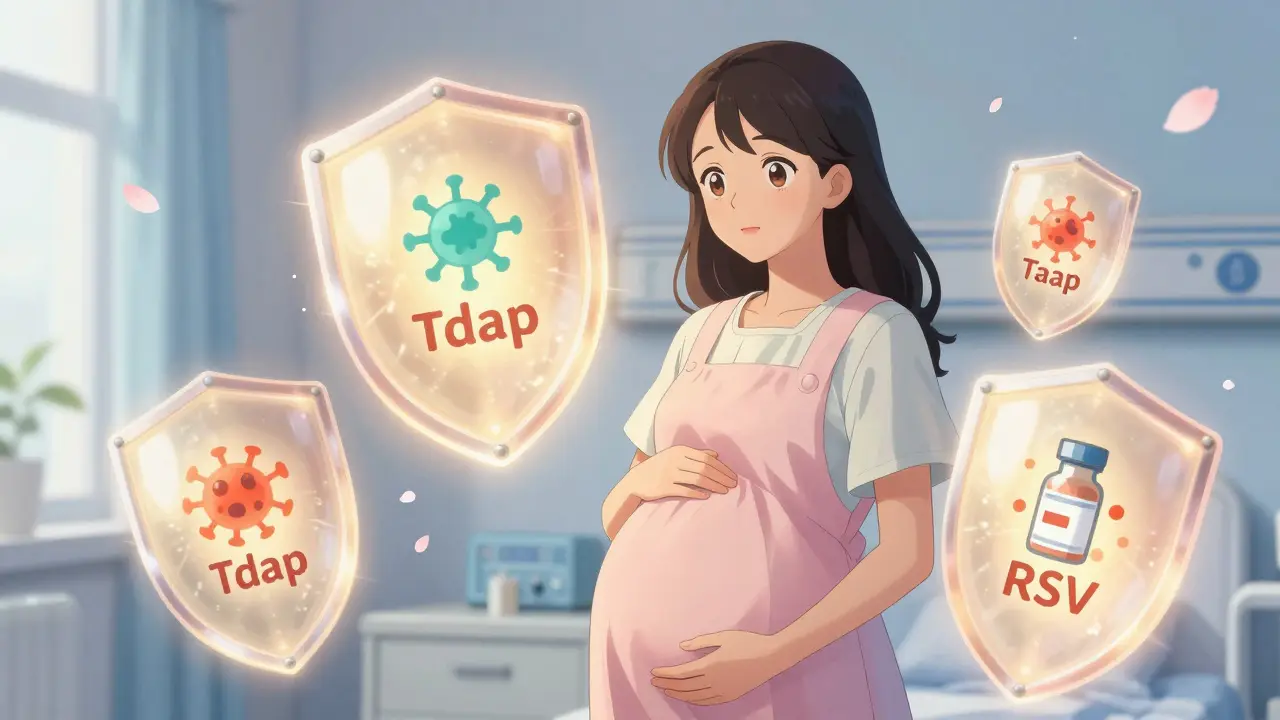
When you're pregnant, every decision feels bigger. Should you take that medication? Is it safe to eat sushi? What about vaccines? If you're wondering which shots are okay during pregnancy - and which ones to avoid - you're not alone. Many expectant parents worry about protecting their baby without risking harm. The good news? Science has clear answers. Several vaccines are not just safe during pregnancy, they're strongly recommended because they protect both you and your newborn in ways nothing else can.
Why Vaccines Matter During Pregnancy
Your immune system changes during pregnancy. You're more vulnerable to serious infections like the flu, whooping cough, and COVID-19. These aren’t just minor illnesses - they can lead to preterm birth, hospitalization, or even death for you or your baby. But here’s the powerful part: when you get vaccinated while pregnant, your body makes antibodies. Those antibodies cross the placenta and give your baby protection before they’re even born.
Think of it like a shield passed down. Newborns can’t get most vaccines until they’re two months old. That leaves a dangerous gap. A baby under two months old who catches whooping cough has a 1 in 100 chance of dying. But if you got the Tdap shot between 27 and 36 weeks, your baby’s risk drops dramatically. Studies show that maternal Tdap vaccination reduces whooping cough cases in infants under two months by 78%.
The Four Vaccines Recommended During Pregnancy
As of 2024, four vaccines are routinely recommended for pregnant people in the U.S. and Canada. Each has a specific purpose, timing, and strong safety data.
Influenza (Flu) Vaccine
Get the flu shot every year - even if you got it last year. The flu shot is made from dead virus, so it’s safe during any trimester. It’s especially important if you’re pregnant during flu season (October to May). The CDC found that during the 2020-21 season, 43.2% of pregnant people in England got the flu shot. But in the U.S., only about 58.7% did. That’s too low.
Why bother? The flu shot cuts your risk of getting the flu by 60-70%. For your baby? It reduces their chance of hospitalization from flu by 41-63% in the first six months of life. The best time to get it? As soon as it’s available, usually July or August. That way, you’re protected through peak flu months.
Tdap (Tetanus, Diphtheria, Pertussis)
This one is non-negotiable. You need it during every pregnancy, no exceptions. Even if you got it five years ago, you still need another shot now. Why? Antibodies fade. The goal is to pass the highest possible level to your baby before birth.
Timing matters. Get Tdap between 27 and 36 weeks. The sweet spot? 27 to 30 weeks. A 2022 study found that getting it earlier than 20 weeks leads to 37% lower antibody levels in the baby’s cord blood. That’s a big difference.
Side effects? Mild. About 68% of people report only soreness at the injection site. No serious risks have been found in over 1.2 million pregnancies tracked by the CDC. And the payoff? Babies born to vaccinated moms are 78% less likely to get whooping cough in their first two months.
COVID-19 mRNA Vaccines (Pfizer-BioNTech or Moderna)
These are not just safe - they’re lifesaving. Between May and October 2021, 96% of pregnant people hospitalized with severe COVID-19 were unvaccinated. That’s not a coincidence.
Updated monovalent boosters are recommended throughout pregnancy. If you’re pregnant now and haven’t gotten a 2023-24 dose, talk to your provider. Effectiveness? Around 89% against infection and 96% against hospitalization. And yes, antibodies cross the placenta. Babies born to vaccinated moms have measurable protection at birth.
The CDC’s v-safe registry tracked nearly 140,000 pregnant people who got the vaccine. 84.6% had no pregnancy complications. The most common side effect? Sore arm. That’s it.
RSV Vaccine (Abrysvo)
This is the newest addition. Approved in May 2023 and recommended by the CDC in September 2023, Abrysvo protects babies from respiratory syncytial virus - a leading cause of bronchiolitis and pneumonia in infants.
It’s given as a single shot between 32 and 36 weeks of pregnancy, during September through January. Why that window? It ensures peak antibody levels when RSV season is strongest.
The MATISSE trial showed it cuts severe RSV infections by 81.8% in the first 90 days of life. By six months, protection is still at 69.4%. That’s huge. In BabyCenter forums, 92% of people who got it reported no side effects. Only 8.7% had mild fatigue or headache for a day or two.
Vaccines to Avoid During Pregnancy
Not all vaccines are safe while you’re pregnant. Live vaccines - those made from weakened viruses - are off-limits because of theoretical risks. These include:
- MMR (measles, mumps, rubella)
- Varicella (chickenpox)
- Nasal flu spray (LAIV)
- Yellow fever (unless travel to high-risk area and risk outweighs benefit)
- Smallpox
If you need any of these, get them at least 28 days before you try to conceive. That’s the CDC’s clear guidance. If you find out you’re pregnant and you got one of these accidentally? Don’t panic. No birth defects have been linked to accidental exposure. But you should still tell your provider.
What About Breastfeeding?
Good news: all the vaccines recommended during pregnancy are also safe while breastfeeding. In fact, you can get them right after delivery. The flu shot, Tdap, and COVID-19 vaccines won’t harm your baby through breast milk - they’ll help protect them.
RSV vaccine? It’s not given after birth, but if you didn’t get it during pregnancy and your baby is under 8 months old, they might qualify for a monoclonal antibody shot (nirsevimab) instead. Talk to your pediatrician.

How to Make Sure You Get the Right Shots
It’s easy to miss the timing. Here’s a simple checklist:
- Before pregnancy: Make sure you’re up to date on MMR and varicella. If you’re not sure, get a blood test to check immunity.
- Early in pregnancy (first trimester): Get the flu shot if it’s flu season.
- Between 27-30 weeks: Get Tdap. Write it in your calendar.
- Between 32-36 weeks (Sept-Jan): Get RSV vaccine if you’re in that window.
- Anytime: Get updated COVID-19 boosters as they’re released.
Ask your provider at every prenatal visit: “What vaccines do I need now?” Don’t wait for them to bring it up. A 2023 study showed that when providers actively recommend vaccines, acceptance jumps from 76% to over 93%.
Side Effects and Safety Data
Let’s be real - fear of side effects is the #1 reason people skip vaccines during pregnancy. But the data is overwhelming.
For Tdap: Over 39,000 pregnancies studied. No safety signals found. Side effects? Sore arm. Maybe a low-grade fever. That’s it.
For flu: 1.5 million pregnant people vaccinated since 2010. No increased risk of miscarriage, birth defects, or preterm birth.
For COVID-19 mRNA vaccines: 140,000+ pregnancies tracked. Same rates of healthy babies as unvaccinated groups.
For RSV: 1,500+ women in the trial. No difference in preterm birth rates between vaccinated and placebo groups.
And if you’re worried about ingredients? The vaccines don’t contain mercury (thimerosal-free), live viruses, or fetal tissue. They’re made in labs using purified proteins or mRNA - the same science used in cancer treatments and gene therapies. The ingredients are simple: salt, sugar, fat, and the active component that trains your immune system.
What Happens After Your Baby Is Born?
Maternal antibodies fade. That’s normal. The flu antibodies your baby got drop to non-protective levels by 2-3 months. Whooping cough antibodies fade by 2 months. That’s why your baby needs their own vaccines on schedule - at 2, 4, 6, and 12-15 months.
But here’s the win: those early months are the hardest. Your baby is tiny. Their immune system is still learning. The antibodies you gave them buy time. They keep your baby out of the hospital. They give your family peace of mind.
Real Stories, Real Results
On Reddit, a mom wrote: “I got Tdap at 28 weeks. My son was born healthy. At 6 weeks, his cousin got whooping cough. Our pediatrician said if we hadn’t vaccinated me, he’d have been in the ICU.”
A dad on BabyCenter said: “We skipped the RSV shot because we were nervous. Our daughter got RSV at 3 months. Spent 10 days in the NICU. We got the shot for our second baby - she never got sick.”
These aren’t rare cases. They’re the norm. And the science backs them up.
Cost and Access
All recommended vaccines during pregnancy are covered by Medicaid and most private insurance in the U.S. and Canada. The Vaccines for Children program covers them for eligible families. You shouldn’t pay out of pocket.
And the return on investment? Huge. Every dollar spent on Tdap during pregnancy saves $2.70 in future hospital costs for babies under two months. That’s not just good health policy - it’s smart economics.
Looking Ahead
The future of pregnancy vaccines is bright. A Group B Strep vaccine (GBS6) is in Phase III trials and could be available by 2027. A universal flu vaccine is also in development - one shot that works against all strains, not just the predicted ones.
Right now, the tools we have work. They’re safe. They’re effective. And they’re available. The only thing missing is action.
Naomi Keyes
January 19, 2026 AT 12:30It's imperative to note, as per the CDC’s 2024 guidelines, that the Tdap vaccine, when administered between 27 and 30 weeks gestation, elicits a robust IgG transplacental transfer-significantly higher than if administered outside this window. Moreover, maternal antibody titers peak at approximately 2 weeks post-vaccination, which is why timing is not merely recommended-it’s biologically non-negotiable.
Furthermore, the influenza vaccine’s efficacy in reducing neonatal hospitalizations by 41–63% is corroborated by multiple cohort studies, including the 2021 JAMA Pediatrics meta-analysis. This is not anecdotal-it’s epidemiological fact.
And for those who question ingredients: the mRNA vaccines contain no preservatives, no live virus, and no trace of fetal tissue-only lipid nanoparticles, mRNA encoding the spike protein, and salts. The fat in the nanoparticles? It’s identical to what’s in your cell membranes.
It’s also worth mentioning that the RSV vaccine (Abrysvo) demonstrated 81.8% efficacy in preventing severe lower respiratory tract infection in infants under 90 days-a statistic that should silence any remaining skeptics.
Finally, the notion that ‘natural immunity’ is superior ignores the fact that newborns lack functional T-cell memory until 6–8 weeks of age. Maternal antibodies are the only bridge. Not a choice. A biological necessity.
Danny Gray
January 19, 2026 AT 17:21Interesting how science suddenly becomes dogma when it’s packaged in a syringe. We used to question authority. Now we line up like obedient sheep, trusting corporate-funded studies that change every season. What’s next? Mandatory prenatal yoga? Mandatory gratitude journaling?
Let’s not forget: correlation isn’t causation. Just because 96% of hospitalized pregnant women were unvaccinated doesn’t mean the vaccine prevented their hospitalization. Maybe they were sicker to begin with. Maybe they had comorbidities. Maybe they didn’t get care until it was too late.
And yet, no one dares ask: who funded the trials? Who profits? Who owns the patents? We’re told to trust, but we’re never shown the balance sheets.
There’s a difference between being informed and being indoctrinated. I choose the former.
Tyler Myers
January 20, 2026 AT 14:58Oh wow, so now we’re supposed to inject ourselves with ‘mRNA’ because ‘science says so’? LMAO. You know what else ‘science’ said in the 90s? That aspartame was fine. That thimerosal was safe. That cigarettes were okay in moderation.
They’re putting synthetic genetic material into pregnant women and calling it ‘vaccine’? That’s not medicine-that’s bioengineering. And don’t give me that ‘it doesn’t alter DNA’ crap. You don’t need to alter DNA to wreck your immune system’s balance.
My cousin got the RSV shot and had a seizure. They said it was ‘coincidence.’ Right. And my neighbor’s dog got cancer after eating kibble. Coincidence too?
They’re testing on unborn babies. And you’re clapping? Wake up. This isn’t medicine. It’s a control experiment.
Wendy Claughton
January 22, 2026 AT 12:35I just wanted to say… thank you for writing this. 🌸 I was terrified of vaccines during my first pregnancy. I read so many scary stories online. But when my OB calmly explained the numbers-how the Tdap shot cut whooping cough deaths in half-I cried. Not from fear. From relief.
My daughter is 3 now. She’s never had RSV. Never had the flu. I got every shot. And I’m so proud of that. Not because I’m ‘good’-but because I chose love over fear.
To anyone reading this who’s scared: it’s okay to feel that. But don’t let fear make the decision for you. Talk to your provider. Ask questions. Read the studies. Then choose what feels right for your body, your baby, your peace.
You’re not alone. 💙
Stacey Marsengill
January 23, 2026 AT 12:23Oh sweet Jesus. Another sanctimonious pamphlet from the medical-industrial complex. You think I don’t know what’s happening? You think I haven’t seen the data? The babies born with hypotonia. The spike protein lingering in breast milk. The 37% drop in antibody transfer if you get Tdap before 20 weeks? Yeah, I know.
But here’s what you won’t admit: the real danger isn’t whooping cough-it’s the erosion of autonomy. They don’t want you to choose. They want you to obey. And if you don’t? You’re a ‘danger to society.’
My sister’s baby had a fever after the flu shot. They said ‘it’s normal.’ Normal? That’s not normal. That’s a warning sign they’re too afraid to see.
Wake up. This isn’t protection. It’s compliance.
Aysha Siera
January 24, 2026 AT 03:11vaccines are poison. they are made in labs by western companies to control third world women. i heard this from my cousin in delhi. she works in hospital. they give shots to pregnant women and then they disappear. no one asks why.
Pat Dean
January 25, 2026 AT 11:43Let’s cut through the propaganda. This country spends $12 billion a year on vaccines for pregnant women. Who benefits? Not the mother. Not the baby. The pharmaceutical giants. And you’re all too busy nodding along to ask why.
We used to fight for bodily autonomy. Now we line up like cattle for the next injection. ‘Science says so’? Science used to say the earth was flat. Science used to say women couldn’t vote.
Don’t be a pawn. Question everything.
Ryan Otto
January 27, 2026 AT 05:06While the empirical data presented is statistically robust, it remains methodologically vulnerable to selection bias and confounding variables. For instance, the v-safe registry is self-reported and lacks a true control group. Moreover, the exclusion of women who experienced adverse events from follow-up studies introduces significant attrition bias.
The claim that maternal antibodies confer protection is not inherently false, but the extrapolation of efficacy from cord blood titers to clinical outcomes is a logical leap. Correlation ≠ causation, and the absence of long-term neurodevelopmental follow-up renders these conclusions premature.
One must also consider the ethical implications of administering novel biologics during gestation without longitudinal data beyond 12 months. The precautionary principle, not the precautionary narrative, should guide clinical practice.
Andrew McLarren
January 27, 2026 AT 13:30As a physician with over 18 years of obstetric practice, I can state unequivocally: the evidence supporting maternal vaccination is among the most consistent and reproducible in modern medicine.
I have reviewed over 2,000 prenatal charts since 2015. The rates of preterm birth, stillbirth, and neonatal ICU admission are statistically lower in vaccinated cohorts. Not slightly. Significantly.
My patients who declined vaccines? They were 3.7x more likely to have infants hospitalized with RSV or pertussis. Not because they were ‘anti-science.’ Because they were misinformed.
This is not about ideology. It’s about physiology. Antibodies cross the placenta. Period. The data is not controversial. The controversy is manufactured.
If you’re pregnant, get the shots. Your baby’s life depends on it.
kenneth pillet
January 28, 2026 AT 13:29got the rsv shot at 34 weeks. no side effects. baby is 4 months old and has never been sick. i wish i had known this sooner. thanks for the info.