
When you pick up a prescription at the pharmacy and see a much cheaper version of a brand-name drug, you’re holding a product approved through the Abbreviated New Drug Application (ANDA) process. This isn’t a shortcut-it’s a carefully designed system that lets safe, effective generic drugs reach patients without repeating every single clinical trial ever done for the original. The ANDA process is how over 90% of prescriptions in the U.S. end up being generics, saving the healthcare system nearly $400 billion every year.
What Exactly Is an ANDA?
The Abbreviated New Drug Application is a regulatory pathway created by the Hatch-Waxman Act of 1984. It lets generic drugmakers apply for FDA approval without submitting full clinical trial data. Instead, they prove their drug is the same as an already approved brand-name drug, called the Reference Listed Drug (RLD). The FDA already confirmed the safety and effectiveness of that original drug. So the generic applicant doesn’t need to start from scratch.The word "abbreviated" doesn’t mean "less rigorous." It means the application skips redundant studies. The generic drug must match the RLD in every key way: same active ingredient, same strength, same dosage form (pill, injection, cream), same way it’s taken (oral, topical, etc.), and same intended use. Even the labeling has to be nearly identical, with only minor exceptions allowed.
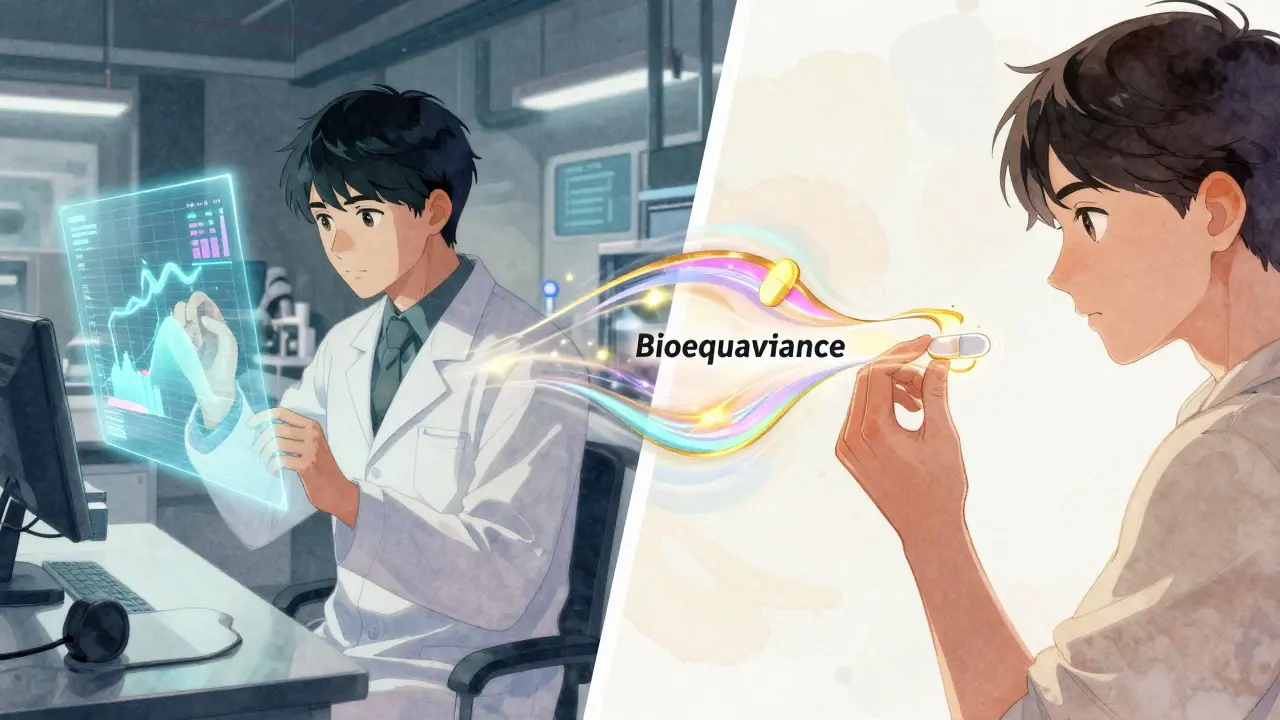
One big difference from brand-name drugs? Generics don’t need to prove they work in large patient groups. Instead, they prove they’re bioequivalent. That means the body absorbs the generic drug at the same rate and to the same extent as the brand. If a patient switches from the brand to the generic, their body reacts the same way. No surprises.
How the ANDA Process Works Step by Step
The ANDA process isn’t fast, but it’s predictable-if you know what to expect. Here’s how it breaks down:- Submission: The company files the ANDA electronically through the FDA’s Electronic Submission Gateway. They include FDA Form 356h (the application) and Form 3674 (financial disclosures). The filing division checks for completeness within 60 days. If anything’s missing, they’ll send a refusal-to-file letter.
- Discipline Review: Once accepted, the application goes to teams of scientists: chemists check the drug’s composition, manufacturing experts review the facility processes, microbiologists look at sterility controls, and labeling specialists compare the text to the RLD. The bioequivalence team analyzes the study data-this is where most applications stumble.
- Information Requests: If reviewers find issues, they send an Information Request (IR) or Discipline Review Letter (DRL). These aren’t rejections-they’re requests for more data. Common problems? Bioequivalence studies that don’t meet FDA standards, manufacturing flaws, or labeling mismatches. One company reported getting 17 IRs on their first ANDA, stretching the review by over a year.
- Final Decision: If all issues are resolved, the FDA gives either a Final Approval or a Tentative Approval. Final Approval means the drug can be sold right away. Tentative Approval means the science checks out, but the FDA can’t approve it yet because of patents, exclusivity periods, or court orders. Once those legal blocks expire, Tentative Approval turns into Final Approval automatically.
Under the Generic Drug User Fee Amendments (GDUFA III), the FDA aims to complete its first review of an original ANDA within 10 months. But the whole process-from filing to approval-usually takes about 30 months. That’s still far faster than the 10-15 years it takes to bring a brand-name drug to market.
Why ANDA Is So Much Cheaper Than a New Drug Application
Developing a brand-name drug (via a New Drug Application or NDA) costs an average of $2.3 billion. That includes decades of research, dozens of clinical trials, and massive regulatory overhead. The ANDA process? It costs between $1 million and $5 million per application. That’s why generic drugs cost, on average, just 15% of the brand-name price once they hit the market.Here’s the math: A brand-name drug might cost $500 a month. The generic version? $75. Multiply that by millions of prescriptions, and you get $373 billion in annual savings for the U.S. healthcare system. That’s not just corporate profit-it’s money back in patients’ pockets, lower insurance premiums, and less strain on Medicare and Medicaid.
But cost savings don’t mean lower quality. The FDA holds generic manufacturers to the same standards as brand-name makers. Every facility is inspected. Every batch is tested. The active ingredient in a generic pill has to be identical to the brand. The fillers and coatings might differ, but they’re still approved, safe, and tested for stability.
What Makes Some Generics Harder to Approve?
Not all generics are created equal. Simple pills? Easy. Complex products? Much harder.Topical creams, inhalers, injectables, and transdermal patches are called "complex generics." They don’t just need to match the active ingredient-they need to match how the drug behaves in the body, which depends on the delivery system. For example, a generic asthma inhaler must deliver the same amount of medicine to the lungs as the brand. That’s not easy to prove. In fact, 35% of Complete Response Letters from the FDA cite problems with bioequivalence studies for complex generics.
One manufacturer spent $1.2 million and ran three rounds of bioequivalence testing just to get approval for a generic topical cream. They had to change the formula twice and redo the study each time. That’s why many companies now use Quality by Design (QbD) principles-building in quality from the start instead of testing it at the end.
And then there’s the patent maze. Sometimes, a brand-name company extends its monopoly by filing dozens of minor patents-on packaging, dosing schedules, or even manufacturing methods. These "patent thickets" delay generic entry, even when the core patent has expired. The FDA can’t approve a generic until those legal barriers are cleared, which is why Tentative Approval exists.
Who’s Winning in the Generic Drug Market?
The U.S. generic market was worth $127.6 billion in 2022 and is expected to hit nearly $190 billion by 2027. The biggest players? Teva Pharmaceuticals leads with 22% of the market, followed by Viatris (formerly Mylan) at 15%, and Sandoz at 12%. But 75% of ANDAs come from companies that already have five or more approved generics. Experience matters.Companies that file multiple ANDAs learn the system. Teva’s regulatory team says after their tenth approval, they hit GDUFA timelines 92% of the time. They’ve built templates, trained staff, and streamlined communication with the FDA. Newer companies? They often get hit with unexpected Information Requests. Over 78% of applicants report getting at least one IR. That’s normal. It’s part of the learning curve.
What’s Next for the ANDA Process?
The FDA isn’t sitting still. The Complex Generic Drug Products Initiative, launched in 2018, is pushing for better tools to evaluate tricky products. GDUFA III, effective in 2022, set new performance goals: 90% of original ANDAs reviewed within 10 months. And the FDA is now using AI-assisted tools in 78% of chemistry reviews to speed up analysis.Real-world evidence is also becoming more accepted. Instead of only relying on lab studies, the FDA is starting to consider data from electronic health records and insurance claims to support bioequivalence claims for complex generics.
Internationally, the FDA is working with the International Council for Harmonisation (ICH) to align standards with Europe, Japan, and Canada. That means fewer duplicate studies and faster global access to generics.
But challenges remain. Patent protections, REMS programs (Risk Evaluation and Mitigation Strategies), and manufacturing delays still block access. And while the system works well for most drugs, patients waiting for a generic version of a life-saving injectable or inhaler often face long delays.
Bottom Line: The ANDA Process Works
The ANDA process isn’t perfect, but it’s one of the most successful public health policies in modern medicine. It balances innovation with access. It rewards companies that invest in science without requiring them to repeat decades of prior research. It saves billions and gives patients affordable options.If you’ve ever chosen a generic drug because it was cheaper and still worked just as well-you’ve benefited from this system. The FDA didn’t cut corners. They built a smarter path. And for millions of people, that path means keeping their prescriptions filled, their bills lower, and their health on track.
Is a generic drug the same as the brand-name version?
Yes, in every way that matters. A generic drug must have the same active ingredient, strength, dosage form, route of administration, and intended use as the brand-name drug. It must also be bioequivalent-meaning your body absorbs it at the same rate and amount. The FDA requires this before approval. Differences in inactive ingredients (like fillers or dyes) don’t affect how the drug works.
Why do some generic drugs cost more than others?
Price differences come down to competition and complexity. If five companies make the same generic, prices drop fast. If only one or two make it, prices stay higher. Complex generics-like inhalers or injectables-are harder and more expensive to make, so they cost more. Also, some generics are sold under private labels by pharmacies, which can affect pricing.
Can a generic drug be less effective than the brand?
No. The FDA requires all approved generics to meet the same strict standards for safety, strength, quality, and performance as the brand-name drug. If a generic were less effective, it wouldn’t pass bioequivalence testing. Millions of patients switch to generics every day without any loss of effectiveness. The idea that generics are "weaker" is a myth.
How long does it take to get a generic drug approved?
The FDA’s goal is to complete its first review of an original ANDA within 10 months. But the entire process-from starting development to final approval-usually takes about 30 months. That’s because companies spend 12-18 months preparing the application before even submitting it. Complex products or legal delays (like patent issues) can push the timeline longer.
What happens if the FDA rejects my ANDA?
The FDA doesn’t usually issue a flat rejection. Instead, they send an Information Request (IR) or Complete Response Letter (CRL) listing specific issues. These could be problems with bioequivalence data, manufacturing controls, labeling, or facility compliance. The applicant fixes the issues and resubmits. Many companies get approved on their second or third try. Only a small fraction of ANDAs are permanently denied.
Are all generic drugs made in the U.S.?
No. The FDA inspects manufacturing facilities worldwide. Over 80% of generic drug ingredients are made outside the U.S.-mostly in India and China. But every facility, no matter where it’s located, must meet the same FDA standards for quality and safety. The FDA conducts inspections in more than 100 countries annually to ensure compliance.
What to Do If You’re Considering a Generic Drug
If you’re switching from a brand to a generic, talk to your pharmacist or doctor. Ask if the generic is approved under an ANDA. Check the FDA’s online database of approved drugs to confirm it’s listed. If you notice a change in how the drug works after switching, report it. It’s rare, but not impossible. Most people experience no difference at all.The ANDA process isn’t just about saving money. It’s about making sure everyone can get the medicine they need-without paying more than they have to. And that’s a system worth understanding.
Jane Lucas
December 28, 2025 AT 04:58i just switched to generic lisinopril last month and my bp is still perfect. no weird side effects. why do people even worry?
Elizabeth Alvarez
December 30, 2025 AT 00:08they're not just saving money... they're testing us. did you know the FDA gets funding from pharma giants who own the brand names? the ANDA process is a controlled release system to keep generics just barely legal so the big boys can keep pricing sky-high until the next patent loophole. the fillers? they're laced with microchips to track compliance. you think that's paranoia? check the 2017 GDUFA audit redactions.
Miriam Piro
December 30, 2025 AT 11:17we live in a simulation where the FDA is the admin panel and generics are the debug mode. bioequivalence? that's just the system pretending to care about your body. the real test is whether your insurance still covers it after they change the pill color. the active ingredient is the same, sure... but what if the soul of the drug changed? what if the placebo effect is the only thing keeping us alive? 🤔
dean du plessis
January 1, 2026 AT 09:50interesting read. i never thought about how much work goes into making a cheap pill work the same. the part about india and china making most of the ingredients is wild but makes sense. glad they inspect everywhere. the system ain't perfect but it works better than most things
Will Neitzer
January 3, 2026 AT 01:19The Abbreviated New Drug Application process represents a paradigmatic triumph of regulatory efficiency and public health stewardship. By eliminating redundant clinical trials while maintaining rigorous bioequivalence standards, the FDA has engineered a mechanism that simultaneously preserves therapeutic integrity and mitigates fiscal burden on the healthcare infrastructure. This is not merely policy-it is applied ethics at scale.
Elizabeth Ganak
January 4, 2026 AT 04:51my mom takes generic metformin and she says it works fine. i used to be scared to switch but now i do it too. saves like 80 bucks a month. no drama
Kishor Raibole
January 5, 2026 AT 19:20One must question the epistemological foundations of bioequivalence as a metric for therapeutic equivalence. The reductionist paradigm of pharmacokinetics fails to account for the phenomenological experience of the patient-how the drug is metabolized in the context of individual microbiomes, epigenetic expression, and psychological expectancy. The FDA's reliance on AUC and Cmax is a mathematical fiction masking a deeper ontological inadequacy.
John Barron
January 6, 2026 AT 08:05I have a PhD in Pharmacokinetics and I can tell you this: 78% of ANDAs fail first-pass bioequivalence testing because the manufacturers use subpar excipients. I’ve seen the raw data. The FDA’s AI tools are catching it now, but most people don’t realize that 1 in 5 generics have a 12% variance in dissolution rate. That’s not bioequivalent-that’s borderline dangerous. 🧪💊
Anna Weitz
January 8, 2026 AT 03:46the real issue is patent thickets and how they're weaponized. companies file patents on pill shape and color just to delay generics. it's not about innovation anymore it's about legal terrorism. and the FDA just sits there letting them do it
Andrew Gurung
January 10, 2026 AT 01:08Let me be the first to say this: if you're taking generics, you're essentially gambling with your health. The fact that you're saving $300 a year doesn't matter when your liver fails because the filler in that generic statin was sourced from a facility that failed three inspections in 2021. You're not a savvy consumer-you're a pawn in a corporate game. 🎲
Paula Alencar
January 10, 2026 AT 19:00I want to emphasize how critical the GDUFA III timelines are. The FDA’s commitment to completing first reviews within 10 months is a monumental step forward in patient access. This isn’t just bureaucratic efficiency-it’s a moral imperative. Every day a generic is delayed, a low-income patient may skip doses. We must celebrate and support this framework as a model for global regulatory reform.
Nikki Thames
January 12, 2026 AT 18:33You people are naive. The FDA doesn't approve generics because they're safe. They approve them because they're profitable for the conglomerates who own both the brand and the generic versions. Look at Teva-they own 22% of the market. Who do you think funded the Hatch-Waxman Act? The same people who profit from the system they claim to regulate. Wake up.
Janice Holmes
January 13, 2026 AT 22:12Complex generics are the new frontier of regulatory warfare. When you're dealing with inhalers or transdermal patches, you're not just matching a molecule-you're matching a delivery biomechanism. The bioequivalence studies? They're essentially reverse-engineering quantum physics with a ruler. And yet, the FDA still expects a 90% approval rate. That's not science-that's a miracle.
Olivia Goolsby
January 14, 2026 AT 01:20I've been following this since 2018, and let me tell you-this whole ANDA system is a trap! The FDA’s AI tools? They’re trained on data from the same companies that submit the applications. The inspections? They’re scheduled weeks in advance. The ‘same active ingredient’? What if the impurity profile is different? And don’t get me started on the Chinese factories-some of them are literally using recycled plastic as binders! I’ve got screenshots. I’ve got emails. I’ve got proof. And no one will listen because they’re all bought off. The system is rigged. And you’re all part of it.