

By the end of 2024, over 277 drugs were still in short supply across the U.S.-a number that hasn’t dropped since the pandemic. Hospitals are scrambling. Pharmacists are spending hours every week tracking down alternatives. Patients are skipping doses because the medicine they need simply isn’t there. And while the federal government has rolled out new plans to fix this, the real question is: are they fixing the right problem?
What’s Really Causing Drug Shortages?
It’s not just one thing. Drug shortages happen because the system is built to be cheap, not reliable. Most of the active pharmaceutical ingredients (APIs)-the actual medicine inside the pill or injection-are made overseas, mostly in China and India. About 80% of them come from there. The U.S. relies on a handful of factories to produce critical drugs like antibiotics, anesthetics, and cancer treatments. Just five facilities make 78% of all sterile injectables. If one of them shuts down for inspection, has a power outage, or faces a supply chain hiccup, hospitals across the country feel it.And the economics don’t make sense. These essential drugs-like saline, insulin, or chemotherapy agents-don’t make much money. Manufacturers won’t invest in backup lines or extra inventory because there’s no profit in it. Meanwhile, the FDA requires companies to report potential shortages six months in advance. But only 58% of them actually do. Small manufacturers? Only 18% comply. That means the government often finds out about a shortage after it’s already happening.
The Strategic Active Pharmaceutical Ingredients Reserve (SAPIR)
In August 2025, President Trump signed Executive Order 14178, expanding the Strategic Active Pharmaceutical Ingredients Reserve-or SAPIR. This isn’t about stockpiling finished drugs. It’s about storing the raw ingredients needed to make them. Why? Because APIs cost 40-60% less to store than finished medicines, and they last 3-5 years longer. The goal is to have enough raw materials on hand to quickly produce 26 critical drugs during a crisis.The list includes life-saving medications: antibiotics like vancomycin, anesthetics like propofol, and oncology drugs like cisplatin. The idea sounds smart: if a factory goes down, you can just whip up more medicine from stored ingredients. But here’s the catch: only 12% of the API production needed for these drugs has been brought back to the U.S. in the last seven years. And the reserve only covers 26 drugs. Meanwhile, 98% of all shortage incidents involve drugs outside that list. Oncology drugs alone make up 31% of all shortages-but only 4% of the SAPIR list.
How the FDA Actually Handles Shortages
The FDA doesn’t just sit back and wait for shortages to happen. They work directly with manufacturers to fix problems. In 2024, they resolved 85% of reported shortages by speeding up inspections, allowing temporary imports, or giving manufacturers extra time to fix quality issues. That’s how they solved the saline shortage in 2018-2020, which affected 90% of U.S. hospitals.They also launched the Enhanced Shortage Monitoring System in November 2025. This new tool uses AI to analyze 17 data streams-shipping logs, factory batch records, hospital purchase patterns-to predict shortages 90 days in advance with 82% accuracy. That’s a big step forward. But here’s the problem: hospitals still have to report shortages manually. And with only 58% compliance, the data is incomplete. If the system doesn’t know a shortage is coming, it can’t warn anyone.

Why Congress Is Trying to Change the Rules
Lawmakers are pushing two major bills. The first, H.R.5316, the Drug Shortage Act, would make it easier for pharmacists to use compounded versions of shortage drugs in emergencies. Right now, those alternatives are often blocked by legal and regulatory red tape. The second, the Drug Shortage Prevention and Mitigation Act, would give Medicare extra payments to hospitals that keep backup suppliers on standby.But here’s the reality: even if these bills pass, they won’t fix the core issue. The Congressional Budget Office estimates H.R.5316 will reduce shortages by only 15-20% over five years-at a cost of $740 million. That’s less than 0.1% of total U.S. drug spending. Meanwhile, the Department of Commerce just announced $285 million in funding for new manufacturing plants under the CHIPS Act. Sounds good? Industry analysts say it covers less than 5% of the $6 billion needed to truly diversify API production.
The Real Problem: No One’s Paying for Prevention
The biggest failure isn’t a lack of technology or stockpiles. It’s a lack of economic incentive. Why would a company spend millions building a second production line for a drug that sells for $2 a vial? The market doesn’t reward reliability. It rewards low cost. And right now, the government doesn’t pay enough to change that.Compare that to the European Union. They require member states to maintain mandatory stockpiles and use a centralized system to track shortages in real time. Between 2022 and 2024, that approach cut shortages by 37%. The U.S. doesn’t have that kind of coordination. In fact, the Government Accountability Office found that HHS has implemented only 35% of its own recommended interventions. And they still don’t have clear metrics to measure if any of this is working.
What’s Happening on the Ground
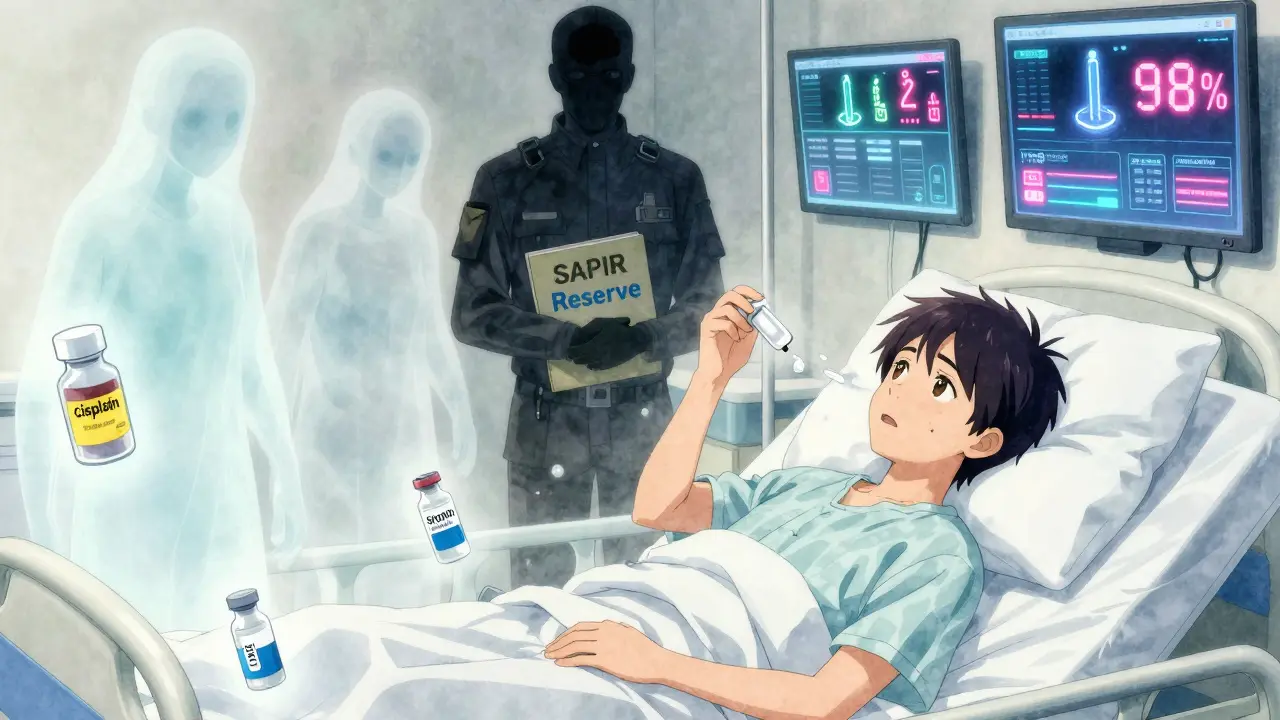
Pharmacists aren’t just managing inventory-they’re making clinical decisions under pressure. A 2025 survey by the American Society of Health-System Pharmacists found that 74% spend 10 or more hours a week tracking down drugs. Forty-one percent have seen near-miss errors because a substitute drug had different dosing or side effects.Patients are suffering, too. A September 2025 report from Patients for Affordable Drugs found that 29% of Americans skipped doses because the drug wasn’t available. For cancer patients, that number jumps to 68%. One Reddit user described having to compound cisplatin from raw powder because the pre-made version was gone. That’s not standard practice. That’s desperation.
Hospitals are spending an average of $1.2 million a year just managing shortages. That’s not profit loss. That’s operational cost. Nurses are double-checking every substitution. Pharmacists are calling five suppliers before lunch. Clinicians are changing treatment plans on the fly. And none of it is sustainable.
The Big Miss: Why Stockpiling Isn’t Enough
The government’s focus on the SAPIR reserve feels like putting a bandage on a broken leg. It helps in emergencies, but it doesn’t heal the injury. Experts like Dr. Luciana Borio, former FDA Acting Chief Scientist, call the current approach “reactive rather than preventative.”Here’s the truth: stockpiling APIs doesn’t solve the problem of manufacturing concentration. It doesn’t fix the 28-36 month FDA approval timeline for new U.S. facilities (compared to 18-24 months in the EU). It doesn’t fix the fact that three companies control 68% of the sterile injectable market. And it doesn’t fix the $5.2 billion annual cost of shortages to the healthcare system.
The FDA’s own leaked review admitted the current strategy will prevent only 15-20% of projected shortages over the next three years. The real solution? Encourage second-source manufacturers. Reduce approval delays. Pay hospitals and pharmacies to keep backup suppliers. Fund research into continuous manufacturing-technology that can turn out a batch of medicine in days instead of months.
What’s Next?
The FDA has started expedited reviews for second-source manufacturers. Fourteen applications are already in process. If approved, they could add redundancy for eight critical drugs by mid-2026. That’s progress. But it’s not a system. It’s a patch.The 2025-2028 HHS Draft Action Plan talks about coordinating, assessing, responding, and preventing. But without funding, without enforcement, and without changing the economic model, these goals are just words on a page. The government can stockpile ingredients. It can predict shortages with AI. It can even pass laws. But until someone pays for the infrastructure that prevents shortages in the first place, the cycle will keep repeating.
Patients shouldn’t have to wonder if their next dose will arrive. Doctors shouldn’t have to guess which drug will be available next week. And pharmacists shouldn’t be forced to become supply chain detectives. The federal government has tools. It has data. It has plans. But it still hasn’t chosen to make drug availability a priority-not just during a crisis, but every day.
What is the Strategic Active Pharmaceutical Ingredients Reserve (SAPIR)?
SAPIR is a federal stockpile of raw active pharmaceutical ingredients (APIs) for 26 essential medicines, including antibiotics, anesthetics, and cancer drugs. Launched in 2020 and expanded in August 2025, it aims to allow rapid production of critical drugs during shortages by storing cheaper, longer-lasting ingredients instead of finished products.
Why aren’t more drug manufacturers making backup supplies?
Most essential drugs-like saline or chemotherapy agents-have very low profit margins. Companies won’t invest in extra production lines or inventory because there’s no financial return. The market rewards low cost, not reliability. Without government incentives or guaranteed payments, manufacturers have no reason to build redundancy.
How effective is the FDA’s new AI shortage prediction system?
The Enhanced Shortage Monitoring System, launched in November 2025, uses AI to predict shortages 90 days in advance with 82% accuracy by analyzing shipping data, factory records, and hospital purchases. But its effectiveness depends on manufacturers reporting potential shortages-which only 58% currently do. Without full compliance, the system can’t see the full picture.
Why do drug shortages affect cancer patients the most?
Cancer drugs like cisplatin and doxorubicin are often sterile injectables made in just a few facilities. They’re complex to produce, have short shelf lives, and are low-margin-making them prime targets for shortages. A September 2025 survey found 68% of oncology practices had to modify treatments due to unavailability, leading to delays, substitutions, and increased patient risk.
Is the U.S. government doing enough compared to other countries?
No. The European Union requires member states to maintain mandatory stockpiles and uses a centralized tracking system that reduced shortages by 37% between 2022 and 2024. The U.S. lacks mandatory reporting, coordinated stockpiling, and consistent funding. Its approach is fragmented, reactive, and underfunded compared to Europe’s structured system.
What can hospitals do right now to manage shortages?
Hospitals can join the FDA’s Early Notification Pilot Program, which has been shown to cut shortage durations by 28%. They can also maintain alternative supplier lists, train pharmacists on substitution protocols, and track inventory in real time. But most community hospitals lack the staff and resources to do this effectively-making federal support critical.
Takeysha Turnquest
December 20, 2025 AT 03:14The system isn't broken it's designed this way
Profit over people isn't a bug it's the feature
We built a machine that thrives on suffering and call it capitalism
And now we're surprised when it eats children's cancer meds
Lynsey Tyson
December 21, 2025 AT 07:05i just wish people would stop treating this like some new crisis
it's been this way for 20 years
we just stopped noticing because we got used to it
Edington Renwick
December 21, 2025 AT 22:59Let me guess
the real problem is that we don't have enough government bureaucrats to micromanage every pill
and somehow the solution is to throw more money at the same broken system
classic
we're not fixing the economy
we're just decorating the funeral home
Aboobakar Muhammedali
December 22, 2025 AT 23:59in india we make most of these drugs but we dont have the money to build our own hospitals
so we export the medicine and import the suffering
its not just america
its the whole chain
we all play our part
and nobody wants to pay for the truth
anthony funes gomez
December 24, 2025 AT 23:35Structural inefficiencies in the API supply chain are exacerbated by regulatory arbitrage, market externalities, and asymmetric information asymmetries-resulting in a suboptimal Nash equilibrium where manufacturers optimize for marginal cost minimization rather than systemic resilience
And yet, we continue to conflate operational band-aids-like SAPIR-with genuine policy intervention
Without internalizing the social cost of drug unavailability-the true externalized burden borne by hospitals, clinicians, and patients-we're merely rearranging deck chairs on the Titanic of pharmaceutical collapse
Laura Hamill
December 25, 2025 AT 13:37Trump's SAPIR is just a distraction
the real plan is to let Big Pharma own everything
and when the kids die from no insulin
they'll say 'it was the left's fault'
and then sell you a new vaccine for $5000
lol 🤡
Alana Koerts
December 25, 2025 AT 19:0115-20% reduction? That's not a solution
That's a PR stat
And $740 million for a 20% bump?
That's like spending $100 to fix a flat tire
and calling it a new car
absolute clown show
Dominic Suyo
December 27, 2025 AT 09:51Let’s be brutally honest: we’ve turned healthcare into a derivatives market
Where APIs are the underlying asset
and patients are the counterparty risk
They don’t need more stockpiles
They need to stop treating life-saving drugs like commodities
and start treating them like public infrastructure
like water
like electricity
like roads
But no
we’d rather watch hospitals beg for saline while CEOs buy private islands
and call it 'market efficiency'
pathetic