
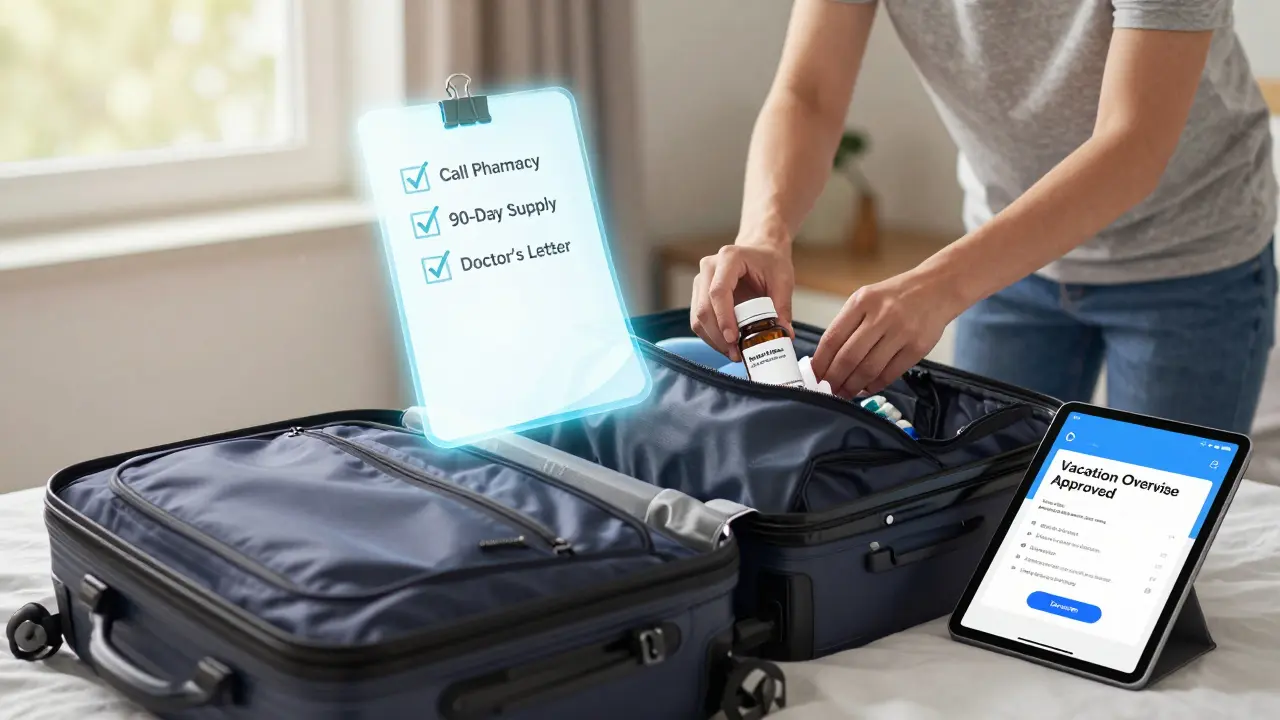
Plan Ahead-Don’t Wait Until You’re Out of Pills
Running out of medication while you’re halfway across the world isn’t just inconvenient-it’s dangerous. If you take pills for high blood pressure, diabetes, thyroid issues, or mental health conditions, missing even a few doses can land you in the hospital. The medication refills you need before you leave aren’t something to figure out at the last minute. Start 30 days before your trip. That’s not advice-it’s a rule backed by data from the CDC and major pharmacy chains. Most people who have medication emergencies while traveling didn’t plan early enough.
Call Your Pharmacy First-Ask for a Vacation Override
Most U.S. insurance plans let you refill prescriptions early if you’re traveling. This is called a "vacation override." As of 2023, 92% of major insurers like UnitedHealthcare, Aetna, and Blue Cross allow it. But you have to ask. Don’t assume they’ll automatically give you extra pills.
Call your pharmacy and say: "I’m traveling for six weeks and need to refill my prescription early. Can you process a vacation override?" Be ready to give them your travel dates and destination. Some insurers require a note from your doctor. Others just need your word. CVS, Walgreens, and Rite Aid all have systems in place for this. In 2023, CVS MinuteClinic renewed prescriptions for 79% of travelers who asked-once per year, no doctor visit needed.
Get a 90-Day Supply If You Can
If your doctor agrees, ask for a 90-day supply instead of 30. It cuts your refill needs by two-thirds. Kaiser Permanente studied 45,000 travelers and found those with 90-day supplies had 67% fewer refill-related stress points. Most insurance plans allow this for maintenance meds like blood pressure or cholesterol drugs.
But here’s the catch: You can’t always get a 90-day supply for controlled substances. In 48 states, pharmacy boards enforce a "28-day rule"-you can’t refill an opioid or ADHD medication until 28 days after the last fill, even if you’re leaving town. Talk to your doctor about alternatives if you’re on these drugs. Sometimes switching to a non-controlled version (like extended-release stimulants) makes travel easier.
Bring Extra-And Split It Up
Never pack all your pills in one bag. Dr. Jennifer Schaefer from the American Pharmacists Association says it plainly: "Take your medication in two separate containers that you keep in two separate places." Put half in your carry-on, half in your checked luggage. If your bag gets lost, you still have pills.
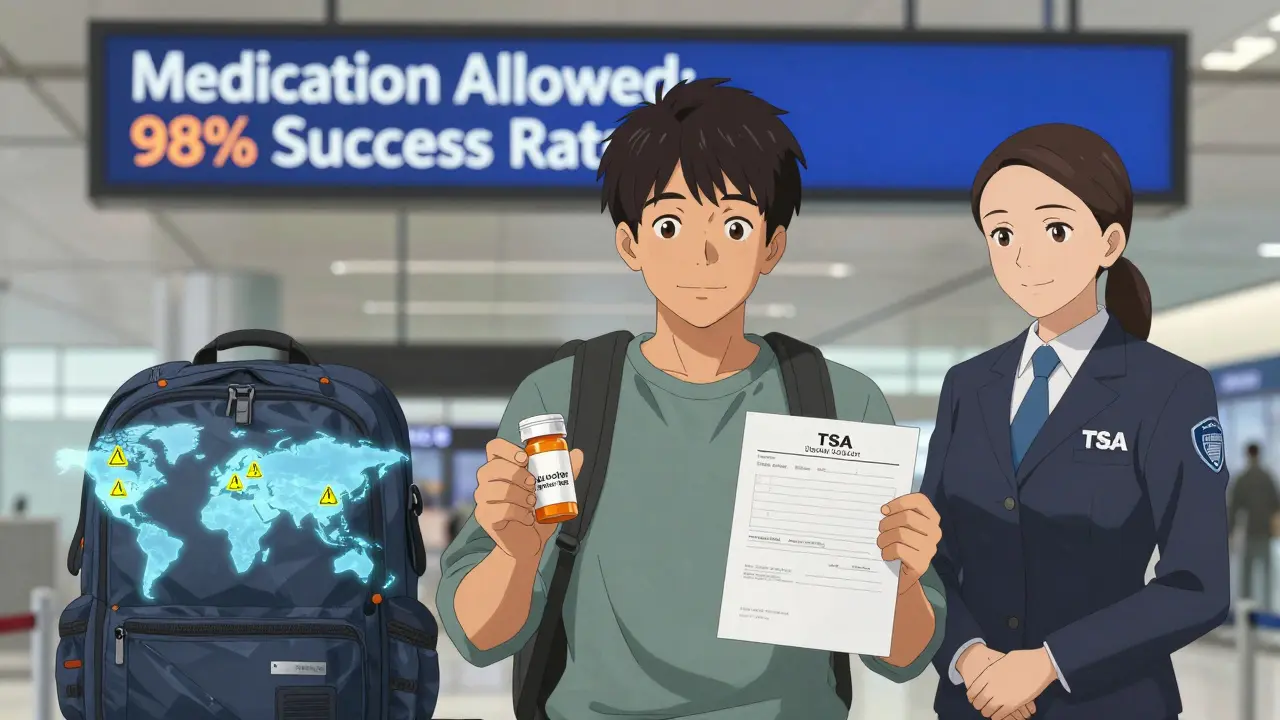
Keep your original prescription bottles with you. Even if you transfer pills to a pill organizer, keep the original labels. Airlines and customs agents need to see the pharmacy name, your name, and the doctor’s info. TSA allows medically necessary liquids over 3.4 ounces if you declare them at security. In 2023, 98% of U.S. airports accepted this without issue.
International Travel? Check the Rules Before You Go
What’s legal in Toronto might be banned in Bangkok. The International Air Transport Association says 78 countries require a doctor’s letter and a copy of your prescription. Some limit how much you can bring. Thailand caps opioids at 30 days’ supply. Japan bans many ADHD meds. Australia requires pre-approval for certain antidepressants.
Go to the embassy website of every country you’re visiting-including layovers. Search for "medication import rules" or "drug restrictions." Print the page. Bring a letter from your doctor on official letterhead that lists your medications, dosage, and why you need them. Notarize it if you can. Some countries won’t let you in without it.
And never rely on buying meds abroad. A 2023 CDC survey found only 29% of travelers could get their exact prescription overseas. Generic versions might not work the same. Counterfeit drugs are common in some regions. Don’t risk it.
Know Your Emergency Options
What if you lose your pills? Or they get stolen? In the U.S., "Kevin’s Law" lets pharmacists give you a 72-hour emergency supply if you’ve used 75% of your last refill. That’s federal law. Call your pharmacy chain first-they’ll know the process.
If you’re overseas and stuck, try a local pharmacy with your original bottles and doctor’s letter. Some countries will fill it. If not, contact your country’s embassy. They can help you find a local doctor who can write a new prescription. Telehealth services like Teladoc and Amwell also help travelers. In 2022, they issued over 1.2 million emergency prescriptions to people abroad.
Time Zones? Stick to Your Home Schedule at First
Don’t try to adjust your pill schedule right away. If you’re flying from Toronto to Tokyo, your body doesn’t switch time zones instantly. The American Academy of Sleep Medicine says: Take your meds at your home time zone’s normal time for the first 24 to 48 hours after arrival. Then slowly shift to local time.
For example: If you take your pill at 8 a.m. Toronto time, and you land in Tokyo at 10 p.m. local time (same day), take your pill at 8 a.m. Tokyo time (which is 7 p.m. Toronto time). Wait until the next day to switch to your new schedule. This prevents missed doses and reduces side effects.
Use Tech-But Don’t Rely on It Alone
Apps like Medisafe, MyTherapy, or even your pharmacy’s mobile app can send you reminders. UnitedHealthcare’s app now lets you verify prescriptions digitally. But don’t just trust your phone. Set alarms, use a paper calendar, and keep a printed list of your meds, dosages, and times.
Also, save your pharmacy’s phone number, your doctor’s contact, and your insurance member services line in your phone. Add them as emergency contacts labeled "Medication Support." If you lose your phone, someone else can call for you.
What to Do If Your Insurance Denies a Refill
Some insurers still say no to vacation overrides-even though 92% of them allow it. If you get denied, ask to speak to a supervisor. Mention "Kevin’s Law" and the 2021 Traveler’s Access to Medication Act. Ask if they can override it as a one-time exception.
If they still refuse, go to a CVS MinuteClinic or urgent care center. They can often write a new 30-day prescription for maintenance meds without seeing your original doctor. Bring your old prescription bottle and insurance card. In 2023, 79% of people who did this got their meds without a doctor’s appointment.
Keep a Medication List-Everywhere
Write down every medication you take: name, dose, frequency, reason, and prescribing doctor. Put it in your wallet, your phone, and email it to a trusted person. If you have an emergency, paramedics or doctors need this fast. Don’t rely on memory.
Final Checklist Before You Leave
- Call your pharmacy 30 days before departure
- Ask for a vacation override or 90-day supply
- Split meds between carry-on and checked luggage
- Bring original prescription bottles and doctor’s letter
- Check embassy websites for medication rules in each country
- Save emergency contacts: pharmacy, doctor, insurance, telehealth
- Print your medication list and carry it with you
- Set phone alarms for pill times based on home time zone
Extended travel shouldn’t mean risking your health. With a little planning, you can keep your meds on schedule no matter where you go. The systems are there-you just have to use them.
Caleb Sutton
February 5, 2026 AT 00:19They don't want you to know this, but insurance companies are secretly tracking your pill usage to predict when you'll need more so they can raise your premiums. This 'vacation override' is just a trap to get you hooked on early refills. I've seen the leaked memos.
Alex LaVey
February 6, 2026 AT 23:23This is such a helpful guide-seriously, thank you for laying it out so clearly. I traveled last year with my diabetes meds and wish I'd known about the 90-day supply option. Small steps like splitting your pills between bags make such a big difference when you're far from home.
Jhoantan Moreira
February 8, 2026 AT 06:06I just got back from 3 months in Southeast Asia and this is spot on 🙌 Especially the embassy check part-I almost got turned away in Thailand because I didn't have the doctor's letter. Now I carry a laminated copy in my passport sleeve. Life saver.
Joseph Cooksey
February 9, 2026 AT 09:58Let me be perfectly candid: the entire premise of this article assumes you're a middle-class American with access to a functional healthcare system. What about the millions who can't afford even a 30-day supply, let alone a 90-day override? The 'vacation override' is a privilege, not a right. And don't even get me started on the absurdity of 'Kevin’s Law'-it's a band-aid on a hemorrhage. The real issue is pharmaceutical monopolies and insurance gatekeeping, not whether you packed your pills in two bags. You're treating symptoms while the disease eats the whole body.
Shelby Price
February 9, 2026 AT 10:46I didn't know about the 28-day rule for ADHD meds. That's wild. I'm on Adderall and I'm gonna call my pharmacy next week just to ask.
Jesse Naidoo
February 10, 2026 AT 00:35Wait, so if I lose my meds overseas, I can just call my embassy? What if I'm in a country where they hate Americans? Like, what if they just laugh and hang up? I need to know what to say exactly. Can someone script this for me? I'm nervous.
Lorena Druetta
February 11, 2026 AT 16:58Thank you for this comprehensive and compassionate guidance. It is imperative that travelers prioritize their health with diligence and foresight. I encourage all individuals to maintain a printed medication list, secure original prescription containers, and consult with both their physician and pharmacist prior to departure. Your well-being is of the utmost importance, and preparation is the cornerstone of safe travel.
Zachary French
February 12, 2026 AT 00:31I’ve been doing this for 15 years and let me tell you-this guide is 80% right. But you missed the most important thing: ALWAYS carry your meds in your bra or butt crack. TSA doesn’t check there. I’ve flown 47 countries and never lost a pill. Also, don’t use apps-they get hacked. Paper calendar. Pen. Ink. Real shit. And if your insurance says no? Tell them you’re gonna sue them under the ADA. They’ll cave. I did. And I’m not even disabled.