

Every year, tens of thousands of people die from opioid overdoses in the U.S. - over 107,000 in 2021 alone. Many of these deaths aren’t from street drugs. They’re from pills sitting in medicine cabinets - leftovers from surgeries, injuries, or chronic pain treatments. If you’ve been prescribed opioids and no longer need them, you’re not alone. About 60% of Americans have unused opioids at home. The problem? These pills are easy targets for teens, relatives, or strangers who might misuse them. The good news? You can stop this before it starts. Proper disposal isn’t just responsible - it’s life-saving.
Why Disposing of Opioids Matters
Most people don’t realize that the number one source of misused prescription opioids isn’t dealers or black markets. It’s family and friends. The 2019 National Survey on Drug Use and Health found that 70% of people who misused prescription painkillers got them from a friend or relative’s medicine cabinet. That means if you keep unused opioids, you’re not just storing medication - you’re storing risk.
Children accidentally ingest these pills. Teens take them to get high. Older adults mix them with other meds and overdose. Even pets can be poisoned. And once someone gets hooked, it’s hard to stop. The CDC calls safe disposal a Tier 1 intervention - one of the most effective ways to prevent opioid misuse before it begins.
It’s not just about safety. It’s about control. When you remove unused opioids from your home, you remove temptation. You reduce the chance of someone you care about getting hurt.
Four Safe Ways to Dispose of Unused Opioids
You have four real, proven options. Not all are equally easy, but all work. Here’s what you need to know.
1. Use a Drug Take-Back Program
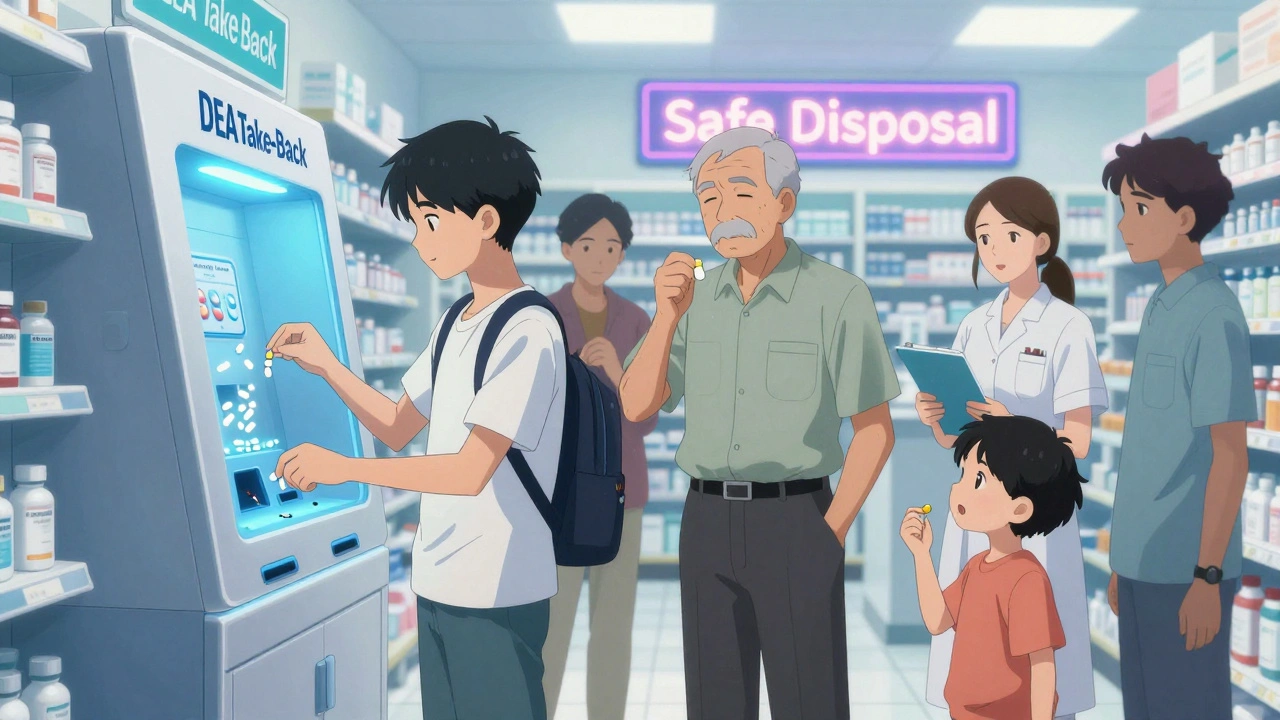
This is the gold standard. Take-back programs collect unused medications and destroy them safely through high-temperature incineration. Over 16,900 collection sites exist across the U.S. as of 2023 - including pharmacies, police stations, hospitals, and clinics.
Major chains like Walgreens and Walmart have drop-off kiosks in over 13,000 locations. Just walk in during business hours. No prescription needed. No questions asked. You can find your nearest site using the DEA’s online locator - it takes 30 seconds. Enter your ZIP code, and it shows you the closest options with hours.
These programs are 98% effective at preventing diversion. They’re free. And they’re the only method that completely eliminates the drug from the environment. If you live near a pharmacy or police station, this is your best bet.
2. Use a Deactivation Pouch
If there’s no take-back site nearby, deactivation pouches are your next best option. These are small, biodegradable bags with activated carbon inside. You put your pills in, add warm water, seal it, and shake for 30 seconds. Within 30 minutes, the opioids are neutralized - no longer usable or dangerous.
Brands like Deterra and SUDS are sold at major pharmacies (85% of chains carry them) for $2.50 to $5 per pouch. They’re FDA-approved, easy to use, and work on all types of opioids - pills, patches, liquids. Lab tests show they deactivate 99.9% of the drug.
One common mistake? Not using enough water. People often just pour a splash. That’s not enough. You need to fill the pouch to the line. If you’re unsure, check the instructions on the box. Some pouches even have QR codes that link to video tutorials.
3. Household Disposal (FDA-Approved Method)
If you can’t get to a take-back site and don’t have a pouch, you can still dispose of opioids safely at home - the FDA-approved way.
Here’s how:
- Take the pills out of their original bottle.
- Mix them with something unappetizing - used coffee grounds, cat litter, or dirt. Don’t use food like peanut butter - someone might dig through the trash.
- Add half a cup of water to make a slurry.
- Seal the mixture in a non-transparent container - a jar with a lid, a sealed plastic bag, or an empty detergent bottle.
- Cover or scratch out your name and prescription info on the empty bottle with a permanent marker.
- Throw the sealed container in the trash.
This method reduces diversion risk by 82%, according to a 2020 study in Lake County, Indiana. It’s not perfect - trash collectors might still find it - but it’s far safer than leaving pills in an open bottle. And it’s free.
4. Flush Only If Listed on the FDA Flush List
Flushing is not generally recommended. It can pollute waterways. But for a few high-risk opioids, the FDA says flushing is the safest option - especially if you live with children or someone at risk of accidental overdose.
Only 15 specific opioids are on the FDA’s flush list. These include:
- Fentanyl patches
- Oxycodone (OxyContin, Percocet)
- Morphine sulfate
- Hydrocodone (Vicodin, Norco)
- Hydromorphone (Dilaudid)
Check the label or ask your pharmacist. If it’s not on the list, don’t flush it. If it is, and you’re worried about someone finding it in the trash - flush it. The FDA says the benefit of preventing accidental overdose outweighs environmental risks in these cases.
What NOT to Do
Don’t flush pills unless they’re on the FDA list.
Don’t pour them down the sink.
Don’t throw them in the trash without mixing them with something unappealing.
Don’t keep them “just in case.” Most people never use them again. And the longer they sit, the more likely they are to be taken.
Don’t try to deactivate pills in their original bottle. The childproof cap won’t seal properly. Use a new container or a pouch.
What If You’re in a Rural Area?
One in five Americans lives in a rural county with no take-back site within 50 miles. That’s over 14 million people. If you’re one of them, deactivation pouches are your lifeline. Many states now give them out for free through health departments or pharmacies.
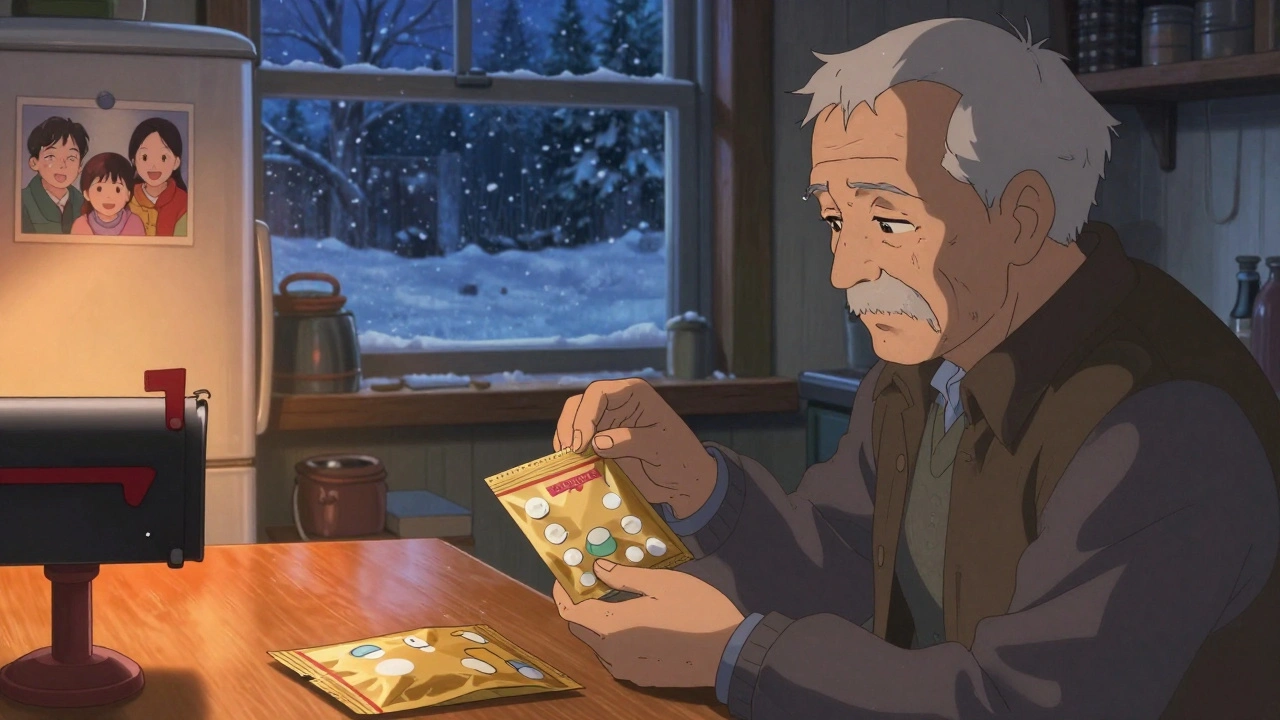
Ask your doctor or pharmacist: “Do you have disposal pouches?” If they say no, ask if they can order them. Or call your county health department. Some rural clinics now offer mail-back pouches - you put your pills in, seal it, and drop it in the mailbox. No postage needed.
Household disposal works too. Just follow the steps above. It’s not ideal, but it’s better than nothing.
How Doctors and Pharmacies Can Help
Only 38% of doctors routinely talk to patients about disposal. That’s a gap. If your doctor prescribes opioids, ask: “What should I do with these if I don’t need them?”
Pharmacies are now required to give disposal instructions with every opioid prescription in 46 states. If they don’t, ask for it. You have the right to know.
Some hospitals - like Mayo Clinic - now include disposal instructions in discharge packets. Their compliance rate? 89%. That’s the standard we should all expect.
What’s Changing in 2025?
The DEA added over 1,200 new collection sites in 2023 - many in tribal communities and rural areas. The FDA is testing QR-code pouches that track usage without revealing names. By 2025, hospitals will be scored on how well they teach patients to dispose of opioids - part of a new national health survey.
States are using money from opioid lawsuits to fund free disposal programs. California spent $5 million on kiosks. Wyoming gave out 200,000 pouches last year. These programs are growing. But they need you to use them.
Real Stories, Real Impact
One mother in Ohio found her 16-year-old son unconscious after taking leftover oxycodone from her cabinet. He survived. She now carries Deterra pouches in her purse. “I don’t leave anything behind,” she says.
A veteran in rural Kentucky drove 60 miles to a police station to drop off his leftover fentanyl patches. “I didn’t want my grandkids to find them,” he told the officer. He didn’t get a thank-you. But he got peace of mind.
These aren’t rare cases. They’re everyday tragedies - and they’re preventable.
Final Step: Do It Now
Don’t wait. Don’t think “I’ll do it later.” Later might be too late.
Check your medicine cabinet today. Look for any opioid pills - oxycodone, hydrocodone, morphine, fentanyl. If you don’t need them, dispose of them. Use a take-back site if you can. If not, use a pouch. If you can’t get one, mix them with coffee grounds and throw them away.
One less pill in your cabinet could mean one less overdose. One less death. That’s not just responsibility. That’s humanity.
Iris Carmen
December 10, 2025 AT 03:50lol i just threw my ex’s oxy in the trash like a week ago. no mixin, no water, no coffee grounds. who’s gonna dig through my stinky diapers anyway? 🤷♀️
Rich Paul
December 11, 2025 AT 11:23yo the DEA take-backs are great but most people don’t realize the carbon in those Deterra pouches is activated charcoal-same shit they use in toxidrome management. 99.9% deactivation isn’t marketing, it’s pharmacokinetics. if you’re not using it, you’re just doing harm reduction theater.
Morgan Tait
December 12, 2025 AT 00:01you know what’s really scary? They say flush only if on the list… but what if the FDA list is just what the pharma companies *want* you to believe? I heard the DEA’s been quietly burying all the data on water contamination from flushes since 2020. They don’t want you to know the real cost. The water’s poisoned. The birds are dying. They’re hiding it. And you’re just shaking your pouch like a good little drone.
Darcie Streeter-Oxland
December 12, 2025 AT 16:00The article, whilst laudable in its intent, exhibits a conspicuous absence of empirical cost-benefit analysis regarding the environmental impact of deactivation pouches vis-à-vis incineration. One is left to wonder whether the purported public health benefit is, in fact, a form of performative altruism.
Raja Herbal
December 13, 2025 AT 15:29man i live in delhi and the only "take-back" is a cop who asks for my aadhaar and then takes the pills and smiles like he just won the lottery. i gave him 12 pills once. he gave me a free chai. i think i got the better deal.
Lola Bchoudi
December 14, 2025 AT 00:35if you’re still keeping opioids ‘just in case,’ you’re not being cautious-you’re being negligent. harm reduction isn’t optional. it’s clinical best practice. your cabinet isn’t a time capsule, it’s a liability. take the pouch. use the kiosk. do the thing. your future self-and their kid-will thank you.
Lauren Dare
December 14, 2025 AT 03:03oh please. you’re telling me a 16-year-old can’t crack open a sealed Deterra pouch? it’s a plastic bag with a zipper. they’ll find it. the real problem is that we treat teens like they’re criminals instead of kids who are curious. maybe if we talked to them instead of hiding pills like contraband, we’d have fewer overdoses.
Gilbert Lacasandile
December 15, 2025 AT 13:41i just did the coffee grounds thing last week. felt kinda weird, but also kinda proud? like i did my civic duty. i’m not a hero, but i’m not the guy whose kid almost died either. small wins, you know?
Katie Harrison
December 17, 2025 AT 09:30I’ve lived in three provinces, and not once has a pharmacist offered me a disposal pouch-despite the fact that it’s legally required in 46 states. Here, we’re still handing out prescriptions like candy. And then we wonder why the crisis persists. This isn’t a personal failure. It’s systemic.
Mona Schmidt
December 18, 2025 AT 14:58The FDA flush list is based on a risk-benefit calculus that prioritizes acute toxicity over environmental persistence. This is scientifically sound, but it requires public education. Many people assume all opioids are equally dangerous to aquatic life-this is inaccurate. Fentanyl, for instance, has a half-life in water of less than 24 hours, whereas non-flushable opioids like tramadol persist for weeks. Knowledge is power.
Guylaine Lapointe
December 19, 2025 AT 06:25I can’t believe people still think mixing pills with coffee grounds is a real solution. That’s what you do when you don’t care enough to drive 10 miles. You’re not protecting anyone-you’re just making the trash smell worse. If you don’t have access to a pouch or take-back, you don’t get to feel virtuous. You get to advocate for better infrastructure.
Sarah Gray
December 20, 2025 AT 18:21Honestly, if you're taking opioids for anything less than terminal cancer, you're part of the problem. This whole 'safe disposal' narrative is just a Band-Aid on a hemorrhage. Stop prescribing them so recklessly. The real solution isn't in your trash can-it's in the prescribing habits of doctors who treat pain like a customer service issue.