
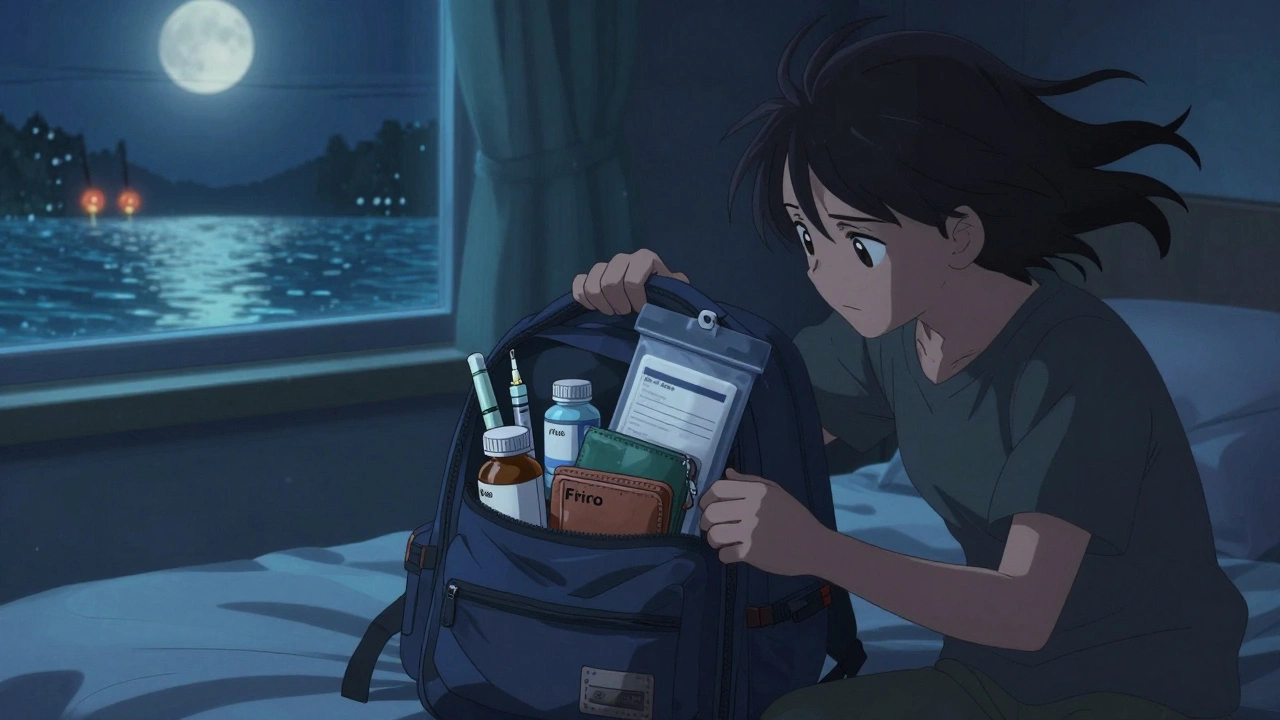
Why Your Medication Go-Bag Could Save Your Life
Imagine this: you’re told to leave your home in 10 minutes. The floodwaters are rising. The fire is closing in. You grab your wallet, phone, and keys-but you forget your insulin, your blood pressure pills, your asthma inhaler. In the chaos, you don’t know if you’ll get to a pharmacy for days. That’s not a hypothetical. It’s what happened to thousands during Hurricane Ida, the California wildfires, and the 2023 Canadian wildfires. And it’s why a simple go-bag filled with the right medications and information isn’t optional-it’s essential.
What Exactly Is a Medication Go-Bag?
A medication go-bag is a portable kit with everything you need to stay safe and healthy if you have to evacuate quickly. It’s not just a few bottles shoved into a backpack. It’s a carefully planned collection of your critical medicines, backup supplies, and medical documents-all ready to grab in under a minute. The idea isn’t new. FEMA started pushing for it after Hurricane Katrina, but most people still don’t have one. Only 22% of U.S. households have enough medication for an emergency, according to the CDC. That’s a dangerous gap.
What to Pack: The Non-Negotiables
You don’t need fancy gear. You need the basics, and you need them in the right amounts. Start with your prescriptions. The minimum is a 7-day supply. But if you live in an area prone to long-term disasters-like earthquakes in California or hurricanes along the Gulf Coast-you need two weeks. That’s not a suggestion. That’s what Alert San Diego and the CDC recommend. Don’t wait until the sirens sound to fill your prescriptions.
- Every prescription you take daily or multiple times a day
- Over-the-counter meds you rely on: pain relievers, antacids, allergy pills, or laxatives
- Any injectables: insulin, epinephrine, or biologics
- Supplements you can’t live without: like iron, vitamin D, or thyroid meds
And don’t forget the containers. Keep meds in their original bottles with clear labels. That’s not just for your own peace of mind-it’s for emergency responders who might need to know exactly what you’re taking. A pill organizer is great for daily use, but never use it as your only storage during an emergency. Labels fade. Bottles break. Original packaging doesn’t.
Temperature-Sensitive Medications Are a Hidden Risk
If you take insulin, certain antibiotics, or biologic drugs, you’re already in a higher-risk group. Heat and cold can destroy these meds fast. A regular go-bag in a hot car or a cold basement won’t cut it. In 2022, the American Diabetes Association found that 62% of insulin users struggled to keep their meds stable during power outages. That’s why you need a cooling solution.
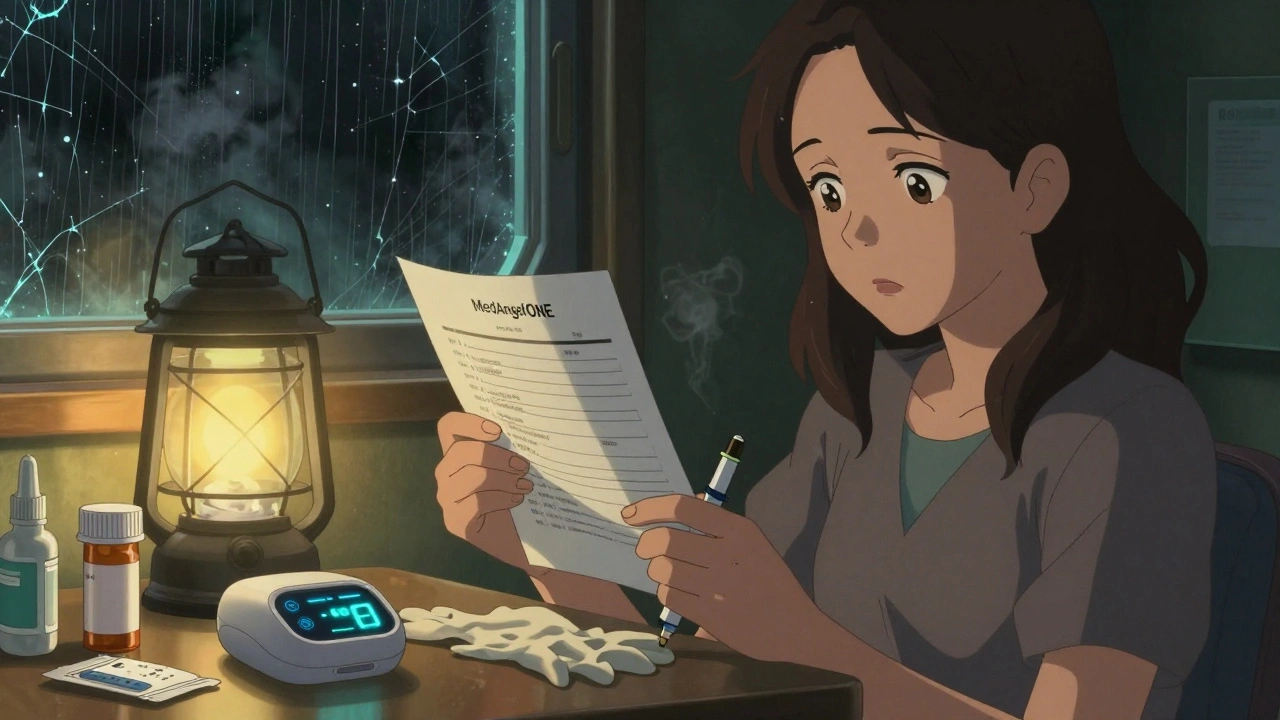
The Frio Wallet is the most tested option-it keeps insulin below 86°F for up to 48 hours without ice or electricity. There are newer options too, like the MedAngel ONE, a small sensor that connects to your phone and alerts you if your meds are getting too hot or cold. It’s FDA-cleared and costs less than a monthly prescription co-pay. If you’re on temperature-sensitive meds, this isn’t a luxury. It’s a necessity.
Documents: The Invisible Lifeline
Your meds mean nothing if no one knows what they are or why you need them. A printed list is your most important item. Write down:
- Medication names (brand and generic)
- Dosage and frequency
- Why you take each one (e.g., “for high blood pressure,” “for asthma”)
- Allergies and past reactions
- Your primary doctor’s name and phone number
- Your pharmacy’s name and number
- Any advance directives or living wills
Put this list in a waterproof pouch. Use a zip-top bag if you don’t have a specialized case. Keep it with your meds-not in your wallet or on your phone. Power’s out? Phone’s dead? Your paper list still works. One woman in Florida told the Red Cross her list helped ER staff avoid a deadly drug interaction during a flash flood. That’s the kind of detail that saves lives.
What Else Belongs in the Bag?
Medications are the core, but you need supporting items too:
- Hand sanitizer and disinfecting wipes
- Disposable gloves (in case you need to help someone else)
- Small scissors (for opening blister packs)
- Alcohol swabs (for injections)
- A list of emergency contacts
- Cash in small bills-ATMs won’t work during outages
- A copy of your insurance card and photo ID
Don’t overpack. Your go-bag needs to be light enough to carry out the door in a hurry. A small duffel bag or backpack with a shoulder strap works best. Keep it by your bed or near the front door-not tucked in the basement or the garage.
When to Check and Replace
Medications expire. So does your memory. Set a reminder on your phone every six months. On January 1 and July 1, open your go-bag and do this:
- Check expiration dates on every pill, inhaler, and injector
- Replace anything that’s expired or close to expiring
- Refill prescriptions early-don’t wait until your last pill
- Update your medication list if you’ve started, stopped, or changed a drug
- Test your cooling device (if you have one) to make sure it still works
Pharmacists in 42 states can give you an emergency refill without a new prescription during a declared disaster. But you still need to ask. And you need to have your list ready. That’s why you check your bag twice a year. It’s not about being paranoid. It’s about being prepared.
Why Younger People Are at Higher Risk
Most go-bags are made by older adults. The CDC found that 34% of people over 65 have one. Only 18% of people under 35 do. That’s a problem. Chronic conditions don’t care how old you are. Millions of young people take daily meds for asthma, epilepsy, diabetes, or mental health. Yet they assume they’ll be fine if they just “grab their phone.” But phones die. Networks go down. Hospitals get overwhelmed. If you’re on meds, you’re not too young to need this. You’re exactly the person who needs it most.
What to Do If You Can’t Afford a Two-Week Supply
Cost is the #1 reason people don’t build go-bags. But you don’t need to buy everything at once. Start small. Ask your pharmacist: “Can I get a 90-day supply instead of 30?” Many insurers allow it for chronic conditions. Some pharmacies even offer free or discounted emergency kits for low-income patients. Call your local health department-they often have programs to help. And if you’re on insulin or epinephrine, ask about patient assistance programs. Many drugmakers give free supplies to people who qualify. Don’t let cost stop you. A single day without your meds could cost you far more than the price of a few extra bottles.
Final Thought: This Isn’t About Fear. It’s About Control.
Disasters don’t care if you’re ready. But you can still choose to be prepared. A go-bag doesn’t make you more anxious. It gives you back control. When everything else is falling apart, you know your meds are safe. You know what to say to the EMT. You know you won’t be the one in the ER because you ran out of your heart medicine. That’s not luck. That’s planning. And it’s the easiest way to protect your health when the world goes sideways.
Can I just rely on my pharmacy to refill my meds during an emergency?
No. Pharmacies may be closed, flooded, or out of stock. Even if they’re open, they may need a prescription from your doctor, which you won’t have access to. In 42 states, pharmacists can give you an emergency refill without a new script-but only if you have your medication list and ID. That’s why your go-bag must include both your meds and your written list. Don’t count on someone else to save you.
What if my medication needs refrigeration and I lose power?
You need a cooling solution. The Frio Wallet is the most trusted option-it works without electricity and keeps insulin cool for 48 hours. Other options include insulated bags with phase-change packs or the MedAngel ONE sensor, which alerts your phone if temps rise. Never store insulin in a cooler with ice; condensation can ruin the vials. And never leave meds in a hot car. If you’re unsure, ask your pharmacist for a tested solution.
Should I include over-the-counter meds in my go-bag?
Yes-if you use them regularly. If you take ibuprofen for arthritis, antacids for GERD, or allergy pills for seasonal issues, include them. In a disaster, you won’t have access to stores. A headache or upset stomach can make an already stressful situation unbearable. Pack what you need, not just what’s “prescribed.”
Can I use a pill organizer instead of original bottles?
No, not as your only storage. Pill organizers are great for daily use, but they don’t have labels, expiration dates, or pharmacy info. Emergency responders need to know exactly what you’re taking. Keep meds in original bottles with clear labels. Use the organizer for daily doses, but pack the originals in your go-bag.
How often should I update my go-bag?
Every six months. Check expiration dates, refill prescriptions early, update your list if your meds changed, and test any cooling devices. Set a calendar reminder for January 1 and July 1. It takes 15 minutes. That’s less time than it takes to scroll through social media. But it could save your life.
Next Steps: Start Today
You don’t need to build the perfect go-bag overnight. Start with one thing: write down your meds. Right now. On a piece of paper. Put it in an envelope. Then, next time you refill a prescription, ask for a 90-day supply. Keep one bottle in your go-bag. Do that, and you’ve already done more than 78% of people your age. Don’t wait for the next emergency. Build your safety net now-before the storm hits.
Arjun Deva
December 5, 2025 AT 13:30So... let me get this straight: the government wants us to stockpile pills like they're toilet paper during a pandemic? And you seriously think some Frio Wallet is gonna save you when the power grid collapses and the zombies start eating the pharmacists? I mean, come on. This is just another fear-mongering scam to sell overpriced gadgets. Who even ARE you? A pharmaceutical lobbyist? I'm not falling for it.
Inna Borovik
December 6, 2025 AT 12:50I appreciate the intent, but the framing is dangerously simplistic. You're assuming universal access to prescriptions, pharmacies, and stable supply chains. What about rural communities without 24/7 pharmacy access? Or people on Medicaid with 30-day limits? This reads like a wealthy suburban checklist, not a public health guide. Also, 'FDA-cleared' doesn't mean 'effective'-it means 'regulatory checkbox passed'.
Andrew Frazier
December 6, 2025 AT 14:56America's got it right. Everyone else is just weak. You think India or some third-world dump is gonna care if you run out of insulin? Nah. You wanna survive? Stop whining and get your act together. This isn't a 'go-bag'-it's a survival kit for people who can't handle reality. We don't need hand sanitizer and gloves-we need grit. And maybe a gun.
Mayur Panchamia
December 8, 2025 AT 03:21Bro... you think this is enough? You're talking about 7 days? In India, when the monsoons hit, we're cut off for MONTHS. And your 'Frio Wallet'? Ha! I've seen people use coconut shells to keep insulin cool. Real people use ingenuity-not Amazon Prime gadgets. Also, why no mention of Ayurvedic alternatives? We've been managing chronic illness for 5,000 years without your Western bureaucracy! This is pathetic.
Nava Jothy
December 9, 2025 AT 09:26I'm so tired of people pretending they're 'prepared' while living in denial... 🥺 I mean, really? You think writing down your meds on paper is going to save you when the ER is flooded and the EMTs are triaging by age? I cried when my cousin lost her heart meds during the floods in Kerala... no one cared. We're not just talking about pills-we're talking about dignity. And no one wants to talk about that. 😭
Myles White
December 10, 2025 AT 20:07I think this is an excellent and deeply necessary framework, but I'd like to expand on the temperature-sensitive medication point-especially regarding biologics like TNF-alpha inhibitors, which are notoriously unstable above 8°C and below 2°C, and even brief excursions outside that range can denature the monoclonal antibodies, rendering them not just ineffective but potentially immunogenic. I've personally had a vial of adalimumab go bad during a power outage in 2021, and the subsequent autoimmune flare-up cost me six weeks of disability. The MedAngel ONE is indeed a game-changer, but I'd also recommend pairing it with a small, rechargeable thermal mass cooler-something like the Yeti Rambler with phase-change inserts-because battery failure is still a risk. Also, don't forget to include a backup power bank rated for at least 48 hours of continuous sensor use, because if your phone dies, your alert system dies with it.
Saketh Sai Rachapudi
December 12, 2025 AT 11:00why do u need all this stuff? just take ur meds and hope for the best. its not that hard. people are too soft now. i lost my inhaler once and i just breathed through my nose. lived. u guys need to stop being babies.
joanne humphreys
December 13, 2025 AT 11:40I’ve been building my go-bag slowly over the past year. Started with just my asthma inhaler and a printed list. Then added my blood pressure meds. Now I’ve got the Frio Wallet and even a small first-aid kit. It doesn’t feel overwhelming anymore-it feels like peace of mind. I used to think I was being paranoid. Now I know I was just being responsible.
Gwyneth Agnes
December 13, 2025 AT 13:11Original bottles only. No exceptions.
Mansi Bansal
December 14, 2025 AT 22:31The entire paradigm of emergency preparedness, as articulated herein, remains fundamentally anthropocentric and technologically myopic. One must consider the ontological vulnerability of the pharmacological subject within the neoliberal biopolitical apparatus-where access to life-sustaining medication is contingent upon insurance matrices, pharmaceutical patent regimes, and infrastructural precarity. The Frio Wallet, while aesthetically convenient, is a commodified palliative that obscures the systemic failure of public health infrastructure. One cannot 'prepare' for collapse when collapse is the condition of existence for the precariat. The go-bag is not a solution-it is a symptom.
Kay Jolie
December 16, 2025 AT 15:34Okay but the MedAngel ONE is literally magic? Like, it syncs with Apple Health and sends push alerts to your family if your meds overheat? I got mine after my insulin got warm during a road trip and I panicked. Now I’m obsessed. Also, it looks so cute on my keychain 💖 Honestly, if you’re on anything temperature-sensitive and you’re not using this, you’re basically playing Russian roulette with your pancreas.