
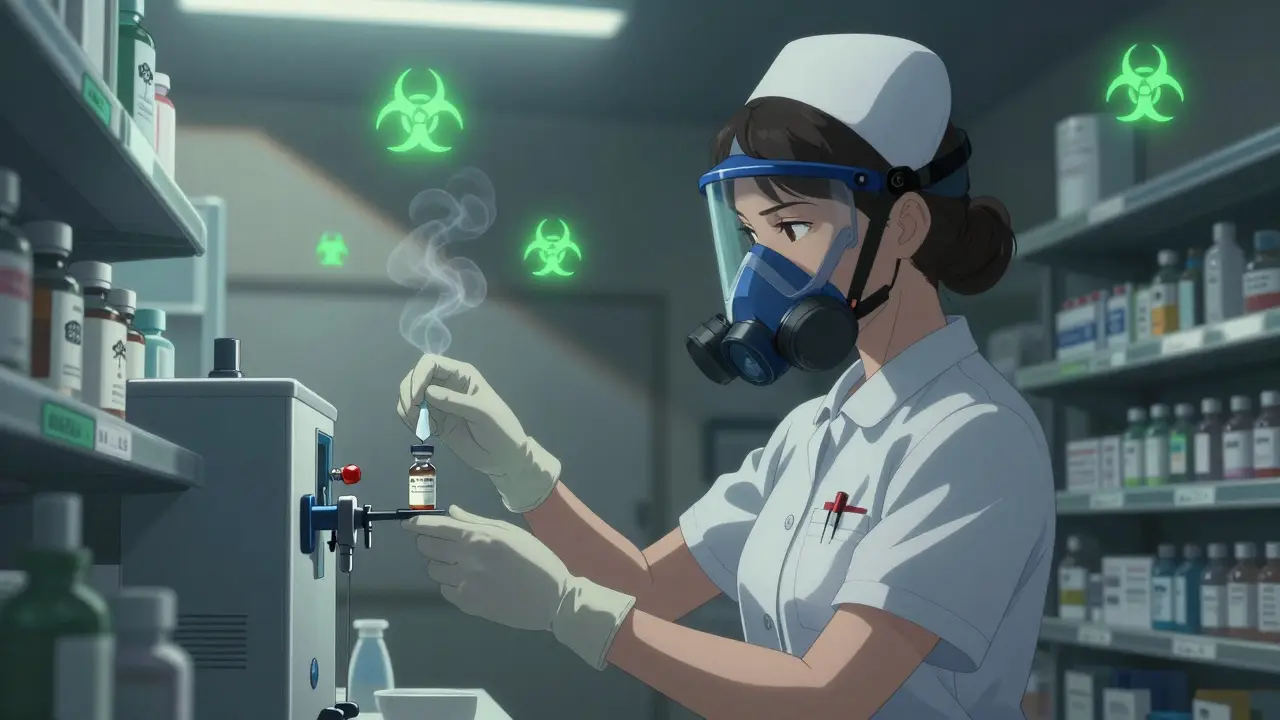
Medication Safety Assessment Tool
Understand the potential risks of your medications and your job's exposure to hazardous drugs. This tool helps assess workplace safety based on common medications and job types.
Every day, millions of workers take medications to manage pain, anxiety, or chronic conditions. At the same time, others handle powerful drugs as part of their job-chemotherapy agents, anesthesia gases, sterilizing chemicals. What most people don’t realize is that medications can be just as dangerous at work as any machine or tool if they’re not managed properly.
Two Sides of the Same Coin
There are two very different, but equally serious, workplace risks tied to medications. One affects workers who take prescription drugs. The other affects workers who handle hazardous drugs as part of their job. Both can lead to injuries, long-term health problems, or even death-and both are often overlooked.Workers on opioids for back pain or benzodiazepines for stress are more likely to fall, make mistakes, or have slow reaction times. Meanwhile, nurses, pharmacists, and lab techs who prepare or administer chemotherapy drugs are being exposed to substances that can cause cancer, infertility, or birth defects-even when they follow all the rules.
Prescription Drugs That Slow You Down
About 18.7% of U.S. workers with musculoskeletal injuries are prescribed opioids. That’s nearly one in five. And 7.2% of workers dealing with workplace stress use benzodiazepines like Xanax or Valium. These aren’t rare cases. They’re common.The problem isn’t just drowsiness. Opioids blunt reflexes and decision-making. Benzodiazepines make it harder to focus, remember instructions, or respond quickly. When you’re operating heavy machinery, driving a truck, or holding a scalpel, that delay can be deadly.
A 2017 study in the Journal of Occupational and Environmental Medicine found that workers taking both opioids and benzodiazepines had an 84% higher chance of falling on the job. That’s not a small risk. It’s a major red flag. And it’s not just about accidents. The same workers are 2.1 times more likely to suffer a workplace injury overall, according to NIOSH data from 2018.
Some employers respond with drug-free workplace policies. SureHire’s 2023 analysis of over 1,200 workplaces showed those policies reduced medication-related incidents by 42%. But there’s a catch. Dr. Robert Gotlin pointed out in a 2021 editorial that 32% of workers who needed these medications for legitimate reasons lost their jobs-not because they were unsafe, but because their prescriptions didn’t fit company policy.
Handling Hazardous Drugs: The Hidden Exposure
Now flip the script. Think about a nurse drawing up a dose of paclitaxel, a pharmacist compounding a cancer drug, or a lab tech cleaning a spill of cyclophosphamide. These aren’t just medications. They’re hazardous drugs.NIOSH’s 2024 list identifies 370 drugs that meet the criteria for being hazardous: they can cause cancer, damage reproductive organs, harm unborn babies, or poison organs even at tiny doses. The list includes 267 antineoplastic drugs (cancer treatments), 78 other toxic drugs, and 25 that affect fertility alone.
Exposure doesn’t require a needle stick. Most exposure happens quietly-through the air, on surfaces, or on skin. WorkSafeBC’s 2022 analysis showed:
- 38% of exposures come from breathing in vapors or aerosols
- 29% from splashes to skin or eyes
- 22% from touching contaminated surfaces
- 7% from poor hand hygiene leading to ingestion
- 4% from needlestick injuries
One chemotherapy nurse on Reddit shared her story: after three years of handling these drugs, she developed chronic skin rashes. Even though she wore gloves and followed protocols, surface tests showed detectable levels of drugs in 68% of her work areas.
Long-term effects are even scarier. A CDC meta-analysis of 47 studies found healthcare workers exposed to hazardous drugs had 2.3 times the risk of adverse reproductive outcomes-miscarriages, birth defects, infertility. OSHA’s review of 12 long-term studies showed these workers were 3.4 times more likely to develop certain cancers.

What’s Being Done-and What’s Not
There are rules. OSHA’s Hazard Communication Standard (29 CFR 1910.1200) requires labeling, training, and safety data sheets for hazardous chemicals. But it doesn’t fully cover drugs. That’s where NIOSH’s guidelines and USP Chapter 800 come in.USP Chapter 800, effective since December 2019, sets strict standards for handling hazardous drugs in pharmacies. It requires closed-system transfer devices, special ventilation, and strict PPE protocols. Facilities that followed it saw surface contamination drop by 94.7%, according to WorkSafeBC’s 2021 tests.
But here’s the gap: USP Chapter 800 only applies to compounding pharmacies. That covers about 58,000 workers. There are 8 million healthcare workers in the U.S. who could be exposed. The other 7.9 million? They’re often working under outdated or incomplete safety rules.
Mayo Clinic cut hazardous drug exposures by 89% between 2017 and 2020 by combining engineering controls (like ventilated cabinets), better training, and peer accountability. But only 78% of large hospitals (200+ beds) have full programs. Just 34% of small clinics do.
Real Solutions That Work
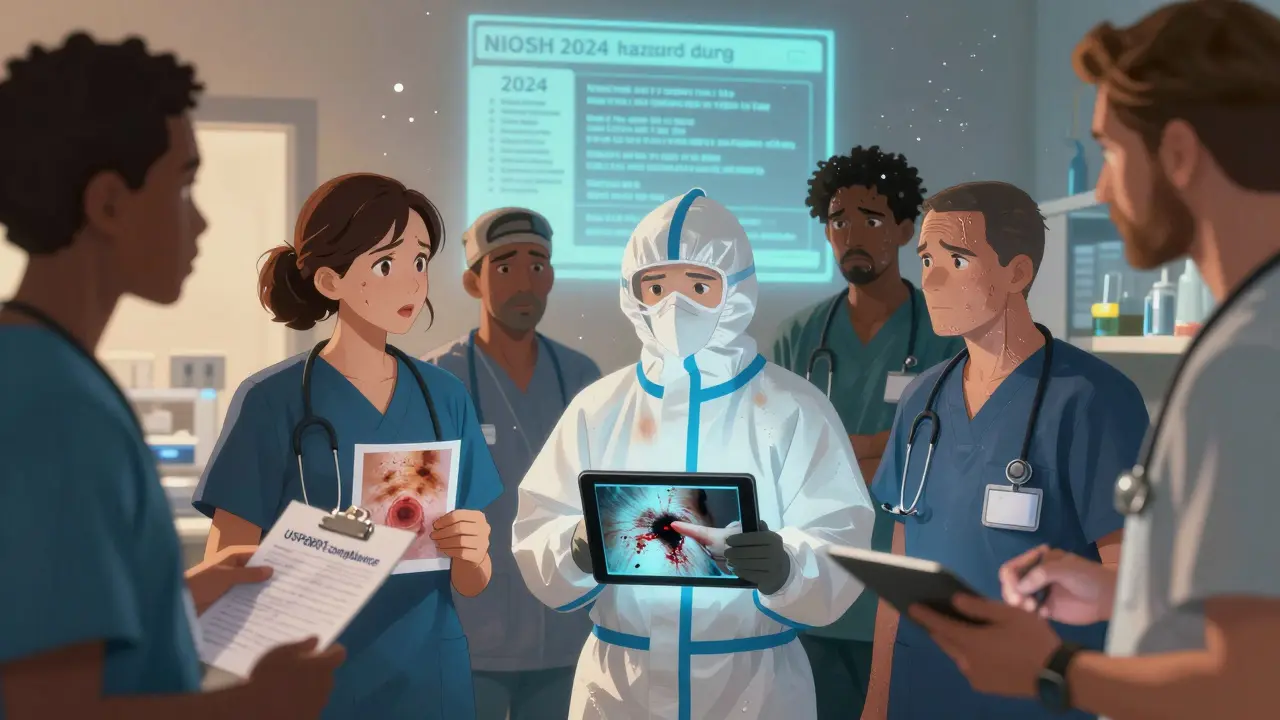
You can’t just rely on gloves and good intentions. Real protection needs layers:- Identify which drugs are hazardous using NIOSH’s 2024 list
- Test for contamination with air and surface sampling
- Control exposure with engineering fixes: closed-system transfer devices, negative-pressure rooms, automated dispensing
- Train staff with hands-on practice-16 to 24 hours for new hires, 4 to 8 hours yearly
- Verify effectiveness with ongoing monitoring
- Document everything for OSHA compliance
Training works. NIOSH found that after 8 hours of hands-on PPE training, 92% of workers could correctly don and doff protective gear. But in CDC field studies, 43% of staff still skipped gloves or masks when rushed.
Unionized healthcare workers had 22% fewer medication-related incidents than non-unionized ones, according to AFL-CIO’s 2023 analysis. Why? Better safety culture, stronger reporting systems, and more accountability.
What’s Next
The field is changing fast. In February 2024, NIOSH removed liraglutide and pertuzumab from the hazardous list after new data showed lower risks. The FDA now requires boxed warnings on 27 cancer drugs about occupational exposure.At Johns Hopkins, AI systems are being tested to predict high-risk moments-like when a nurse is about to open a vial in a crowded room. Early results show 92% accuracy.
OSHA is expected to propose a surface contamination limit of 0.1 ng/cm² by late 2024. That’s a tiny amount-less than a grain of salt. But it’s a step toward real protection.
Meanwhile, the market for safety gear-closed-system devices, protective suits, air monitors-is growing fast. It was worth $2.3 billion in 2023 and is projected to hit $3.8 billion by 2028.
What Workers Need to Know
If you take prescription opioids or benzodiazepines:- Don’t hide it from your employer-but don’t assume you’ll be fired for it
- Ask: Does this affect my alertness? My balance? My reaction time?
- Talk to your doctor about alternatives that don’t impair performance
If you handle hazardous drugs:
- Know the NIOSH 2024 list. If it’s on there, treat it like poison
- Report spills, leaks, or broken equipment immediately
- Use closed-system transfer devices-even if they’re not required yet
- Wash hands before eating, drinking, or touching your face
- Track your health. Skin rashes? Nausea? Hair loss? These aren’t normal
Workplace safety isn’t just about hard hats and warning signs. It’s about the pills in your pocket and the drugs in your vial. Both can kill. And both deserve the same level of respect.
Can I be fired for taking prescribed opioids or benzodiazepines?
It depends on your job and your employer’s policy. If your medication impairs your ability to perform essential duties safely, your employer may ask you to adjust your treatment or reassign tasks. But firing you just because you have a prescription-without evidence of risk-is illegal under the Americans with Disabilities Act. Document your doctor’s notes and request reasonable accommodations.
Are all chemotherapy drugs considered hazardous?
Yes, according to NIOSH’s 2024 list, all antineoplastic agents are classified as hazardous. This includes drugs like paclitaxel, doxorubicin, and cyclophosphamide. Even newer targeted therapies are included unless specifically removed. Always check the current NIOSH list before handling any cancer drug.
Do I need special training if I only occasionally handle hazardous drugs?
Yes. NIOSH and USP Chapter 800 require training for anyone who might come into contact with hazardous drugs-even once a month. Exposure doesn’t need to be daily to be dangerous. A single spill or accidental splash can cause harm. Training should cover exposure routes, PPE use, spill response, and symptom recognition.
What should I do if I think I’ve been exposed to a hazardous drug?
Immediately wash exposed skin with soap and water. If your eyes are affected, flush them for 15 minutes. Report the incident to your supervisor and seek medical evaluation-even if you feel fine. Symptoms can be delayed. Keep records of the drug name, exposure route, and time. Your employer should have an exposure incident protocol in place.
Is it safe to take my prescription meds before work?
It depends on the drug and your job. Opioids and benzodiazepines can impair motor skills and judgment. If your job involves driving, operating equipment, or making critical decisions, take your medication after work if possible. Talk to your doctor about timing and alternatives. Never assume a prescription is automatically safe for work.
Can I test my workplace for hazardous drug contamination?
Yes, but it’s not something you do alone. Environmental sampling for hazardous drugs requires specialized kits and lab analysis. Most employers should be doing this quarterly or after major changes. If your workplace doesn’t monitor contamination, ask for it. You have the right to a safe workplace under OSHA. You can also request a safety inspection from your union or local occupational health agency.
Damario Brown
January 13, 2026 AT 20:02bro i work in a pharma warehouse and we got these chemo drugs sitting next to band-aids in the storage room. no joke. one time i spilled paclitaxel on my glove and i just wiped it with a rag. thought it was just some fancy lotion. now my hands itch all the time. no one trained me. no one even asked if i knew what i was handling. this is insane.
Priyanka Kumari
January 14, 2026 AT 21:16Thank you for writing this with such clarity. As a nurse in a small rural clinic, I’ve seen firsthand how under-resourced we are. We don’t have closed-system transfer devices, and our PPE is reused because the budget won’t stretch. But I’ve started doing quick 5-minute safety huddles before shifts - just reminding everyone to check gloves, wash hands, and report spills. Small steps, but they matter. You’re not alone in this.
Avneet Singh
January 16, 2026 AT 18:07Let’s be real - USP Chapter 800 is a bureaucratic farce. It’s only enforceable in compounding pharmacies, which means the real exposure risk - in oncology floors, ERs, and home care - is being ignored by regulators who think ‘hazardous’ means ‘labeled in Comic Sans.’ If you’re not using a Class II biosafety cabinet for every vial, you’re just playing Russian roulette with your gonads. And don’t get me started on ‘training’ that’s just a 10-minute video on LMS.
vishnu priyanka
January 18, 2026 AT 15:52in india, we call this ‘kam mein dawa, dawa mein kam’ - work in medicine, medicine in work. my cousin, a lab tech in bangalore, got a rash after 6 months of handling methotrexate. they told her to use more lotion. no one tested the air. no one even knew what NIOSH was. we don’t have safety officers. we have ‘helpers.’ this isn’t just an american problem - it’s a global blind spot.
Pankaj Singh
January 19, 2026 AT 14:27you people are being ridiculous. if you can’t handle your job because you’re on Xanax, get off it. if you’re getting exposed to chemo drugs, get a better job. stop whining. this isn’t a daycare. workplaces aren’t responsible for your bad choices or your laziness. if you can’t follow basic safety, you deserve to get hurt. stop demanding more rules - start being responsible.
Scottie Baker
January 19, 2026 AT 18:19my buddy got fired from his trucking job because he took gabapentin for nerve pain. doctor said it was fine. company said ‘zero tolerance.’ he lost his house. meanwhile, the guy who mixes chemo drugs in the same town? no one checks his skin for rashes. double standard? yeah. but the system’s rigged. if you’re poor and on meds, you’re a liability. if you’re a nurse getting poisoned? you’re just ‘part of the job.’
Anny Kaettano
January 20, 2026 AT 09:21Just wanted to add something important - if you’re taking opioids or benzos and you’re in a safety-sensitive role, talk to your doctor about non-sedating alternatives. There are so many now: SNRIs for chronic pain, CBT for anxiety, even non-addictive neuropathic meds like pregabalin (with caution). And if you handle hazardous drugs - please, PLEASE don’t skip glove changes. I’ve seen nurses wipe their noses with the same gloves they used to prep doxorubicin. It’s not bravery. It’s a death sentence in slow motion. You’re not a hero. You’re a statistic waiting to happen.
Kimberly Mitchell
January 21, 2026 AT 13:11There’s no excuse for this. If your workplace doesn’t have air monitoring, PPE protocols, and documented training for hazardous drugs, it’s not just negligent - it’s criminal. And if your employer fires you for taking legally prescribed medication without proving impairment, that’s a disability discrimination lawsuit waiting to happen. Stop accepting ‘culture’ as an excuse for safety failures. Document everything. File an OSHA complaint. And if you’re reading this and still using expired gloves? You’re part of the problem.