
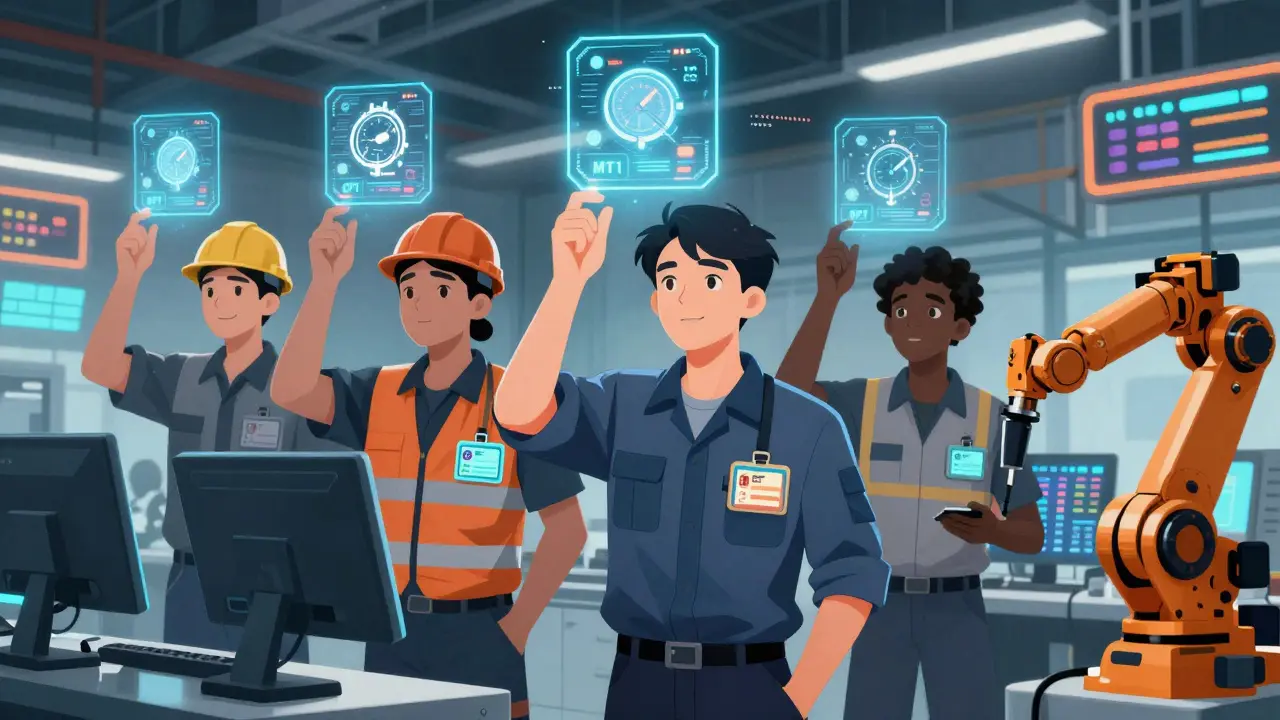
Why manufacturing staff need more than just a high school diploma
Most people think hiring for a factory job means finding someone who can show up on time and follow simple instructions. But today’s manufacturing floors aren’t what they were 20 years ago. Machines talk to each other. Robots handle precision tasks. Sensors flag defects before a product leaves the line. If your staff doesn’t know how to read a digital dashboard, interpret a tolerance chart, or respond to an emergency shutdown, they’re not just underperforming-they’re a risk.
According to the National Association of Manufacturers, 78% of manufacturers say they can’t fill open roles because workers lack the right skills. And it’s not just about technical know-how. Communication breakdowns cause 70% of production failures, according to Harvard Business School research. That means even the most skilled operator can cause costly errors if they don’t speak up when something’s wrong.
What qualifications actually matter on the shop floor
Not all manufacturing jobs are the same. The qualifications you need depend on the role. For entry-level positions like machine operator or assembler, a high school diploma or GED is often the only formal requirement. In fact, 92% of employers accept this as a baseline. But here’s the catch: workers with just a diploma have a 37% higher turnover rate than those with certifications. That’s not just bad for morale-it’s expensive. Replacing a worker can cost up to 50% of their annual salary.
For technical roles-like welders, CNC programmers, or quality inspectors-most companies expect at least 1-2 years of post-secondary training. That could mean a certificate from a community college in Welding Technology or an associate degree in Mechanical Engineering Technology. These programs teach more than how to run a machine. They cover blueprint reading, metrology, preventive maintenance, and basic troubleshooting.
Management and engineering roles require a bachelor’s degree, usually in Industrial Engineering or a related field. These programs include courses in process design, statistics, supply chain logistics, and quality control systems. Without this foundation, even experienced supervisors struggle to reduce waste or improve efficiency.
The big three certifications that move the needle
If you’re serious about building a skilled workforce, certifications aren’t optional-they’re essential. Three stand out in today’s manufacturing environment.
Certified Production Technician (CPT) from the Manufacturing Skill Standards Council (MSSC) is the most widely recognized entry-level credential. It covers four areas: safety, quality practices, manufacturing processes, and maintenance awareness. Workers who earn it see a 76% higher wage potential than those without it, according to U.S. Department of Labor data. The test is practical, not theoretical. You don’t just memorize rules-you show you can follow lockout/tagout procedures or use a micrometer correctly.
Six Sigma is the gold standard for improving quality and reducing defects. It’s not one certification-it’s a ladder. White Belt is a 1-day intro. Green Belt takes 100-160 hours and requires completing a real project. Black Belt? That’s 200+ hours and leading multiple process improvements. Green Belts earn a median salary of $85,000. Black Belts? $110,000. But here’s what most people miss: retention jumps from 57% to 85% when certification is paired with mentorship. Training alone doesn’t stick. Coaching does.
Manufacturing Technician Level 1 (MT1) from the Manufacturing Skills Institute is gaining traction, especially in schools and state-funded programs. Virginia, for example, pays $2,200 per teacher to get certified to teach MT1 in high schools. It’s designed to be a stepping stone, not a finish line. The credential is valid for three years and requires ongoing professional development to renew. It’s not as flashy as Six Sigma, but it’s trusted in 42 states and integrates well with apprenticeships.
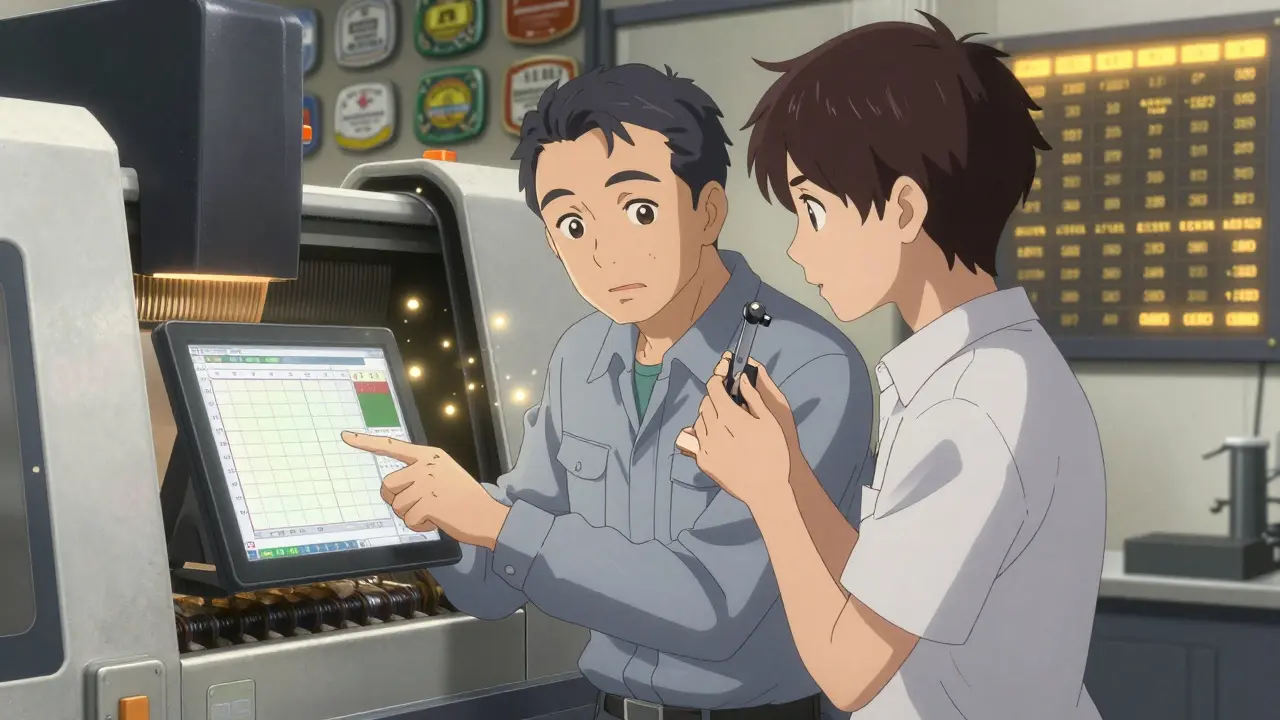
What training programs must include
Not all training is created equal. A good program doesn’t just hand out a certificate. It builds competence. The best manufacturing training programs have four non-negotiable components.
- Safety protocols: OSHA says proper training cuts workplace injuries by 52%. That means real practice with PPE, emergency stops, and hazard reporting-not just watching a video. Only 38% of small manufacturers do regular safety recertification, which is why accidents keep happening.
- Equipment operation: Workers need to know how to start, stop, and troubleshoot machines. That includes understanding error codes, performing basic calibrations, and knowing when to call for help. One manufacturer saw a 41% drop in machine downtime after rotating staff through different stations.
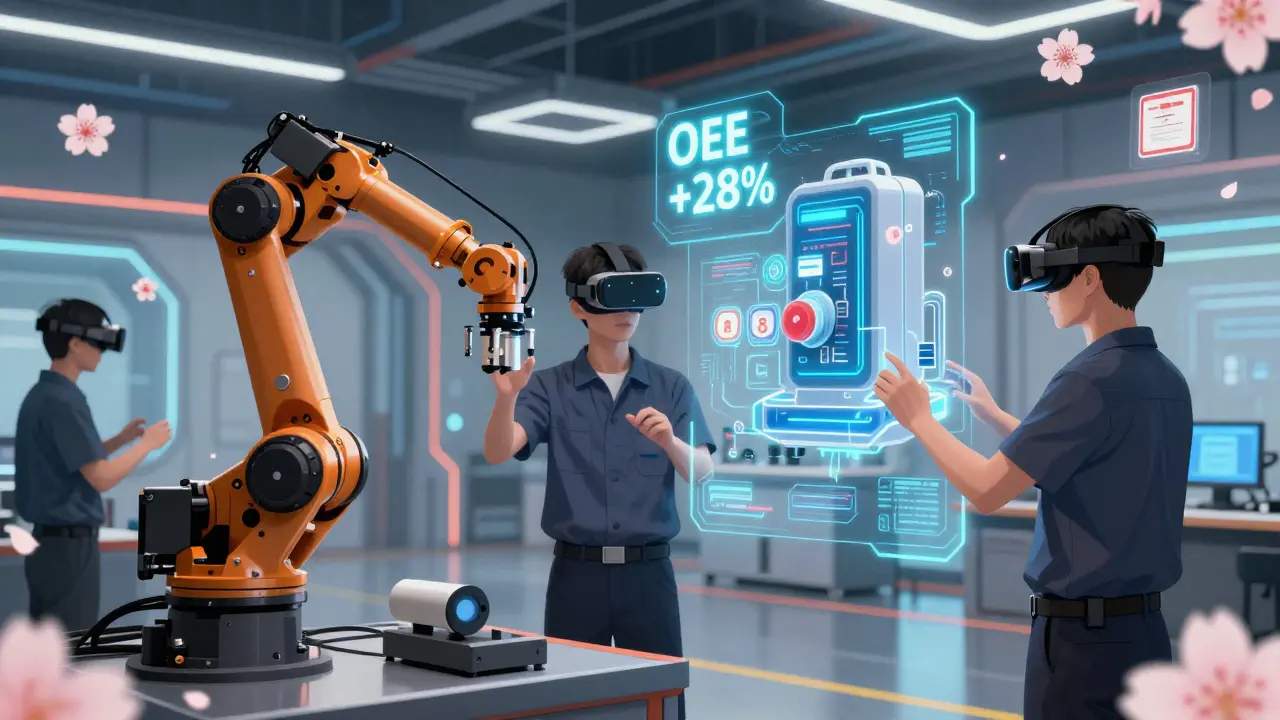
- Quality control: This isn’t about spotting a scratch on a part. It’s about understanding tolerances, using gauges correctly, interpreting SPC charts, and knowing the difference between random variation and a real problem. Workers trained in quality practices improve Overall Equipment Effectiveness (OEE) by 28%.
- Industry-specific processes: A plant making medical devices needs different training than one making automotive parts. Electronics assembly requires electrostatic discharge (ESD) safety. Chemical plants need hazardous material handling. Generic training won’t cut it.
Why some certifications don’t work-and what to do instead
There are over 247 different manufacturing certifications out there. That’s not a strength-it’s a mess. MIT professor David Autor found that 43% of these certifications don’t actually predict job performance. They’re expensive, time-consuming, and sometimes exclude people who could do the job just fine.
Small manufacturers, especially, struggle with this. 63% say they can’t afford comprehensive training programs. But you don’t need to buy every certification. Start with the ones that solve your biggest problems.
If your defect rate is high? Focus on Six Sigma Green Belt. If you’re losing workers fast? Get everyone CPT certified. If you’re trying to get more young people interested? Partner with a local high school offering MT1. Stackable credentials are the future. Workers earn one small badge, then another, then another. That’s how you build skills without overwhelming people.
The hidden cost of skipping training
Some managers think training is a cost. It’s not. It’s an investment with a quick return.
Companies that track skills with digital matrices and documented development plans see 27% higher retention. Workers who feel like they’re growing stay longer. Those who feel stuck leave.
Large manufacturers see ROI on training in as little as 14 months-through fewer errors, less downtime, and lower turnover. Small shops can do it too. The Manufacturing Extension Partnership offers free training consultations at over 1,400 centers nationwide. Reddit’s r/manufacturing community has real-world tips-like using augmented reality to train workers on complex assemblies, which one user reported reduced errors by 39%.
What’s next for manufacturing training
The future of manufacturing training is digital, modular, and personalized.
AI-powered adaptive learning is already being tested in MT1 programs. It adjusts the pace and content based on how each worker learns. Six Sigma is adding Python and SQL to its 2025 curriculum because data skills are now as important as wrench skills.
States are stepping in. Seventeen now fund teacher certifications to bring manufacturing training into high schools. Gartner predicts virtual reality training will be standard by 2026. Companies that don’t adopt it will lose 35% of their training market share.
But here’s the real takeaway: it’s not about having the fanciest program. It’s about making sure every worker-whether they’ve been on the line for 25 years or just started-has the tools to do their job safely, efficiently, and with confidence.
How to start building a better training program
Don’t try to fix everything at once. Start here:
- Look at your data. Where are the biggest problems? High defect rates? Frequent machine breakdowns? High turnover? That tells you where to focus.
- Choose one certification that matches your biggest gap. CPT for safety and basics. Six Sigma Green Belt for quality. MT1 for entry-level pipeline.
- Pair it with mentorship. Assign experienced workers to coach new hires. It’s free, it works, and it builds culture.
- Track progress. Use a simple skills matrix. Mark who’s trained on what. Update it every quarter.
- Look for free help. Contact your local Manufacturing Extension Partnership center. They’ll help you design a plan.
Manufacturing isn’t dying. It’s evolving. And the workers who thrive aren’t the ones who know the most-they’re the ones who keep learning.
Do manufacturing workers need a college degree?
No, not all manufacturing roles require a college degree. Entry-level positions like machine operator or assembler often only need a high school diploma or GED. However, technical roles such as CNC programmer, welder, or quality inspector typically require 1-2 years of post-secondary training from a community college or technical school. Engineering and management roles usually require a bachelor’s degree in industrial engineering or a related field.
What’s the difference between CPT and Six Sigma certifications?
CPT (Certified Production Technician) is an entry-level credential focused on foundational skills: safety, quality practices, manufacturing processes, and maintenance awareness. It’s designed for frontline workers. Six Sigma is a process improvement methodology with multiple levels-White Belt to Master Black Belt. It’s aimed at reducing defects and waste, and is often held by supervisors, engineers, and quality managers. CPT gets you started. Six Sigma helps you lead improvements.
Are manufacturing certifications worth the cost?
Yes, for most roles. Workers with CPT certification earn 76% more than those without. Six Sigma Green Belts make $85,000 on average; Black Belts make $110,000. Companies see ROI within 14 months through reduced errors, less downtime, and lower turnover. While some certifications cost thousands, many are subsidized-like Virginia’s $2,200 teacher training grant-or offered through free programs like the Manufacturing Extension Partnership.
How can small manufacturers afford training?
Small manufacturers don’t need to buy expensive programs. Start with free resources: the Manufacturing Extension Partnership offers free training consultations at over 1,400 centers nationwide. Look for state-funded programs-17 states now pay for high school teachers to get MT1 certified. Use stackable micro-credentials instead of full certifications. Pair training with mentorship-experienced workers coaching new ones costs nothing but builds loyalty and skill.
Why do some workers resist new training programs?
Veteran workers often struggle with digital tools and new systems-68% report initial resistance, according to Vector Solutions. The key is not forcing change, but showing value. Cross-train employees so they rotate through different roles. This builds versatility and reduces fear. Also, involve them in designing the training. When workers help shape the program, they’re more likely to buy in.
What’s the biggest mistake companies make with training?
The biggest mistake is treating training as a one-time event instead of an ongoing process. Giving someone a certificate and calling it done leads to 57% retention rates. Add mentorship, and retention jumps to 85%. Also, many companies chase every certification available, even if it doesn’t solve their actual problems. Focus on 1-2 key certifications that address your biggest gaps, not the ones that sound impressive.
Ashley Porter
January 27, 2026 AT 01:26CPT is the real MVP for frontline folks. I've seen shops go from chaos to calm just by getting everyone certified. Safety + quality + maintenance awareness? That's the trifecta. No fluff, just functional literacy. And the wage bump? Real. 76% isn't a number-it's a lifeline for people who never thought they'd get ahead without a four-year degree.
Mohammed Rizvi
January 28, 2026 AT 22:19Let’s be real-most managers treat training like a tax write-off instead of a growth engine. They hand out a certificate like it’s a participation trophy and wonder why people leave. Six Sigma Green Belt doesn’t magically fix your defect rate if you don’t pair it with someone who actually cares enough to sit with new hires and explain why the red light means ‘stop,’ not ‘ignore.’
Nicholas Miter
January 29, 2026 AT 14:23i've worked in 3 different plants and the only thing that stuck was mentorship. not the certs, not the fancy lms, not the posters on the wall. just an old guy showing you how to read a micrometer without making you feel dumb. the mt1 program is solid, but if you don’t have someone to ask ‘why?’ after the test, you’re just memorizing. and honestly? that’s why turnover’s so high.
TONY ADAMS
January 31, 2026 AT 04:39why do we even care about all this training crap? just pay people more and shut up. i worked at a plant for 12 years and never read a blueprint. i just did my job. now they want me to learn python? lol. we’re not building rockets, we’re bolting things together.
George Rahn
February 1, 2026 AT 20:23The erosion of foundational industrial competence in this nation is not merely a logistical failure-it is a civilizational dereliction of duty. We have replaced the dignity of skilled labor with the hollow ritual of credentialism, while outsourcing our manufacturing soul to nations that still understand the sanctity of the wrench. This is not progress. This is surrender dressed in a Six Sigma belt.
Ashley Karanja
February 2, 2026 AT 05:58I’ve been thinking about this a lot-training isn’t just about skill acquisition, it’s about identity. When someone earns a CPT, they don’t just learn how to do lockout/tagout-they start seeing themselves as a professional, not just a body on the line. That shift changes everything. Add mentorship? Now you’re building legacy, not just compliance. And when you pair that with SPC charts and real-time feedback loops? You’re not training workers-you’re cultivating problem-solvers who stay because they feel seen, not just used. It’s not HR policy. It’s human development.
Neil Thorogood
February 3, 2026 AT 16:15The fact that we’re still having this conversation in 2025 is wild. We have VR sims that can teach a kid how to weld without burning their eyebrows off, and yet some plant still makes new hires watch a 15-minute video on OSHA and call it ‘training.’ If your safety program looks like a PowerPoint from 2012, you’re not saving money-you’re just betting on someone getting hurt before you fix it.
Angie Thompson
February 5, 2026 AT 09:35just had a 17yo ask me if she should do MT1 before college. i told her yes. not because she needs a job tomorrow, but because she needs to know she can build things. and that’s powerful. we’re not just training workers-we’re giving kids a reason to stay in their towns, to feel proud of their hands, to see tech and steel as something they can master. this isn’t just about productivity. it’s about dignity.
rasna saha
February 7, 2026 AT 02:10In India, we don’t have the luxury of fancy certs or VR labs. But we do have people who learn by watching, by doing, by fixing things that break. The best training I’ve seen? A senior guy letting a new hire take apart a machine, then putting it back together with him. No slides. No test. Just patience. Maybe we don’t need more certifications. Maybe we just need more time.