
SPF Protection Calculator
How Much Protection Do You Really Have?
Most people think SPF 30 is enough. But for photosensitive individuals, even small differences matter. This calculator shows you exactly what your sunscreen protects against.
When the sun comes out, most people enjoy the warmth. But if you’re photosensitive, even a short walk to your car can trigger a painful rash, burning skin, or blisters that last for days. This isn’t just a bad sunburn-it’s your body reacting to UV light in a way that shouldn’t happen. Photosensitivity isn’t rare. About 1 in 5 Americans will develop skin cancer by age 70, and many of those cases are linked to repeated UV exposure, especially in people who don’t realize how sensitive they are. If you’re on certain medications, have lupus, or just react badly to the sun, your protection plan needs to be smarter than just slapping on sunscreen.
What Exactly Is Photosensitivity?
Photosensitivity means your skin reacts abnormally to sunlight. It’s not one thing-it’s two main types. Phototoxic reactions are more common. They look like a bad sunburn, but they happen faster and with less exposure. Think of it like your skin’s alarm system is broken. You get redness, swelling, and pain within minutes or hours of being in the sun, even on cloudy days. The second type, photoallergic, is rarer. It’s an immune response, like an allergy. It shows up as an itchy, bumpy rash, sometimes days after sun exposure. Both can be triggered by medications, skincare products, or even certain medical conditions.
Common culprits? Antibiotics like doxycycline and tetracycline, diuretics like hydrochlorothiazide, NSAIDs like ibuprofen, and even some acne treatments with retinoids or alpha-hydroxy acids. Essential oils like bergamot in perfumes or lotions can also set off reactions. If you’ve noticed your skin flares up after starting a new pill or cream, talk to your pharmacist. They can check if it’s photosensitizing.
Why SPF 30 Isn’t Enough Anymore
Most people think SPF 30 is the gold standard. For the average person, maybe. But if you’re photosensitive, you need more. SPF 30 blocks about 97% of UVB rays. SPF 50 blocks 98%. That 1% difference might sound small, but for someone who breaks out from walking across a parking lot, it matters. The NCBI Bookshelf and the Skin Cancer Foundation both recommend SPF 50 or higher for photosensitive individuals.
But SPF only measures UVB protection-the rays that cause sunburn. What you really need is broad-spectrum coverage, meaning it also blocks UVA rays. UVA penetrates deeper, causes aging, and triggers most photoallergic reactions. And here’s the kicker: standard windows block 97% of UVB but only 37% of UVA. So if you sit by a window at home or in your car, you’re still getting hit with damaging rays. That’s why people with severe photosensitivity install UV-blocking window film-some block up to 99% of UVA.
UPF Clothing: Your Best Shield
Sunscreen wears off. It rubs off. You forget to reapply. That’s where UPF clothing comes in. UPF stands for Ultraviolet Protection Factor. A UPF 50 fabric lets only 1/50th (2%) of UV radiation through. That’s better than most sunscreens. And unlike sunscreen, it doesn’t need reapplication. It works when wet. It doesn’t wash off with sweat.
Look for tightly woven, dark-colored fabrics like polyester, denim, or wool. They block more UV than light cotton or linen. But if you live in a warm climate like Toronto, you don’t want to suffocate. New UPF 50+ fabrics are designed to be lightweight and breathable. Brands now make UPF shirts, hats, and even swimwear that feel like regular clothes. A wide-brimmed hat with a 3-inch brim protects your neck, ears, and face-areas most people miss when applying sunscreen.
One patient I spoke with, a nurse with lupus, switched to UPF clothing full-time. She used to get rashes every summer. Now, she walks her dog at noon without fear. Her secret? She wears a UPF 50+ long-sleeve shirt, wide-brimmed hat, and UV-blocking sunglasses. No sunscreen needed for daily errands.
The Sunscreen Mistake Everyone Makes
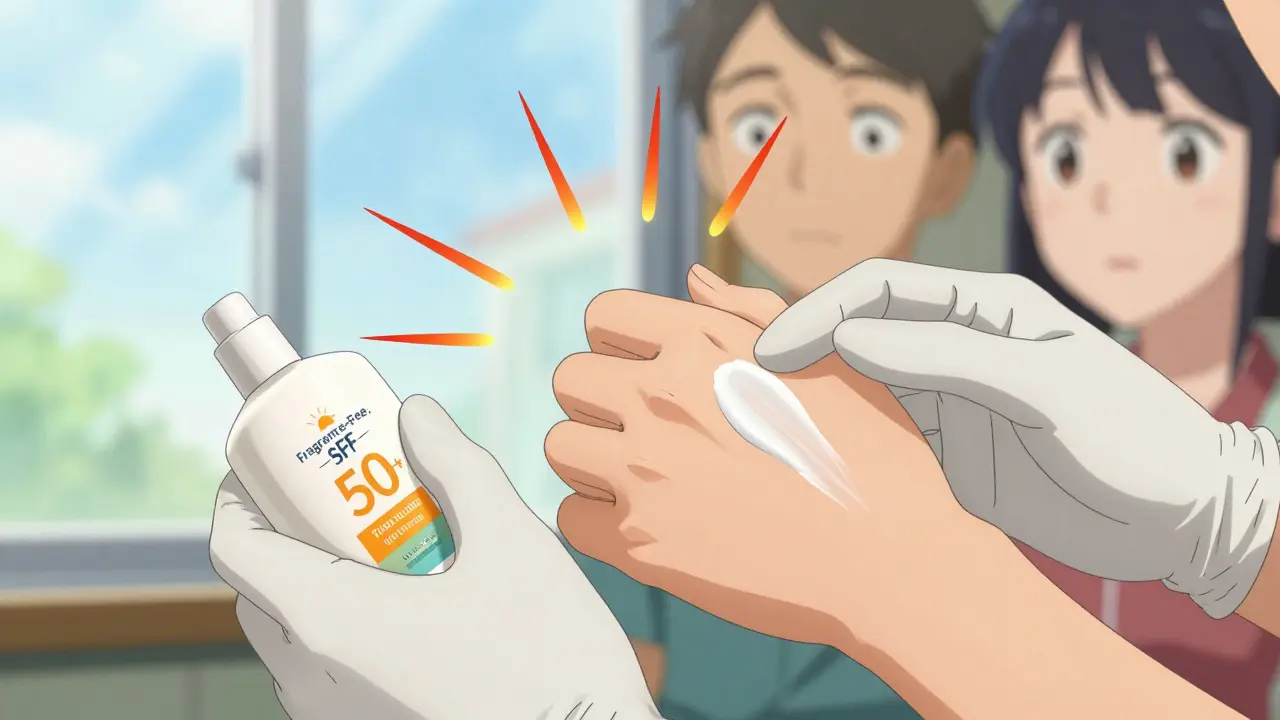
Most people use too little. The FDA says you need 2 milligrams of sunscreen per square centimeter of skin. That’s about one ounce-enough to fill a shot glass-for your whole body. Most people use half that. And they miss spots: ears, back of the neck, tops of feet, lips. You need to reapply every two hours, and right after swimming or sweating. If you’re at work, set a phone alarm. One Reddit user in r/skincancer said they set hourly reminders for a year. It worked.
Also, skip chemical sunscreens if you’re sensitive. Ingredients like oxybenzone and avobenzone can irritate or even trigger photoallergic reactions. Go for physical blockers: zinc oxide and titanium dioxide. They sit on top of your skin and reflect UV. They work immediately. They’re less likely to cause reactions. Look for mineral-based, fragrance-free formulas. Some even come in tinted versions that blend with skin tone-no white cast.
What You Can’t See Is Hurting You
UV doesn’t just come from above. It reflects off surfaces. Water, sand, snow, and even concrete can bounce UV rays back up at you. That’s why skiers get sunburned noses and beachgoers burn under their chins. Shade helps-but not enough. A tree or umbrella blocks 50-95% of UV, depending on how dense it is. But you still need sunscreen or clothing underneath.
And don’t forget blue light. New research from the Skin Cancer Foundation suggests that some photosensitive conditions, like certain forms of lupus, can react to high-energy visible (HEV) light from screens and LED lighting. It’s not as strong as UV, but if you’re extremely sensitive, reducing screen time during peak sun hours or using blue-light filters may help.
Supplements That Might Help
While nothing replaces physical protection, some supplements show promise. Polypodium leucotomos, an extract from a Central American fern, has been shown to provide about SPF 3-5 equivalent protection when taken daily. It’s not a substitute-it’s a backup. Nicotinamide (vitamin B3) is even more proven. A landmark 2015 study in the New England Journal of Medicine found that taking 500mg twice daily reduced new non-melanoma skin cancers by 23% in high-risk patients. It’s not a cure, but for someone with chronic photosensitivity, it’s a meaningful layer of defense.
Carotenoids like beta-carotene and lycopene may offer mild protection too. But don’t go overboard. High doses of beta-carotene can turn your skin orange. Stick to food sources: carrots, tomatoes, sweet potatoes. Supplements should be discussed with your doctor, especially if you’re on other meds.
Living with Photosensitivity: Real-Life Adjustments
Managing this isn’t about being paranoid. It’s about being smart. Here’s what works for people who’ve lived with it for years:
- Plan outdoor time before 10 a.m. or after 4 p.m., when UV is lowest. If your shadow is shorter than you are, the sun is too strong.
- Wear UPF 50+ clothing every day-even in spring and fall. UV is present year-round.
- Install UV-blocking film on home and car windows. It costs $5-$15 per square foot but can cut UVA exposure by 99%.
- Check every product: lotions, perfumes, toothpaste. Some contain photosensitizing ingredients you wouldn’t expect.
- Keep a sun diary. Note what you were doing, what you wore, and how your skin reacted. Patterns emerge over time.
Some people with severe cases work night shifts or sleep during the day. That’s extreme, but it shows how serious this can be. You don’t have to go that far-but you do need to treat sun exposure like a medical risk, not a lifestyle choice.
What’s Changing in 2026
Science is catching up. Researchers are developing smart fabrics that change color when UV exposure gets too high. New window films now block 99.9% of both UVA and UVB without tinting. And dermatologists are moving toward personalized sun protection-testing your skin’s sensitivity threshold and tailoring advice based on your meds, genetics, and lifestyle.
Climate change is making this harder. Since the 1980s, surface UV levels have risen 1-2% per decade. That means even on cloudy days, you’re getting more radiation than your parents did. What worked for them won’t work for you.
Can I still go outside if I’m photosensitive?
Yes, but you need a solid plan. Use UPF 50+ clothing, broad-spectrum SPF 50+ sunscreen, wide-brimmed hats, and UV-blocking sunglasses. Avoid direct sun between 10 a.m. and 4 p.m. Plan outdoor activities for early morning or late afternoon. With the right tools, you can enjoy the outdoors safely.
Is sunscreen enough to protect me?
No. Sunscreen is just one layer. It wears off, you miss spots, and you forget to reapply. UPF clothing provides consistent, all-day protection without reapplication. Combine it with sunscreen, hats, and shade for the best defense. Think of it like wearing a seatbelt-no single thing is enough, but together they save lives.
Do I need to avoid the sun completely?
Not unless your doctor says so. Most people can manage photosensitivity with smart habits. Complete avoidance isn’t practical or healthy-it can lead to vitamin D deficiency and social isolation. The goal is smart exposure: short, protected, and scheduled. A few minutes of sun through a window or under shade is fine. Just don’t let your skin burn.
What medications cause photosensitivity?
Common ones include doxycycline, tetracycline, hydrochlorothiazide, ibuprofen, naproxen, and certain antidepressants. Topical retinoids, AHAs, and bergamot oil in skincare can also trigger reactions. Always ask your pharmacist or doctor if a new medication increases sun sensitivity. Keep a list of your meds and review it every 6 months.
Can I use tanning beds if I’m photosensitive?
Absolutely not. Tanning beds emit intense UVA radiation-often stronger than natural sunlight-and can trigger severe reactions in photosensitive people. They also increase skin cancer risk dramatically. Avoid them completely. There’s no safe tan for someone with photosensitivity.
How do I know if my window film is working?
Ask for the UV transmission rating. Good films block 99% of UVA and UVB. You can also test it: place a UV-sensitive card (available online) behind the glass. If it doesn’t change color after 10 minutes in direct sun, the film is working. If it turns dark, you still have exposure.
Next Steps
Start today. Look at your current sunscreen. Is it SPF 50+ and broad-spectrum? Is it mineral-based? Check your closet. Do you have a UPF 50+ hat or shirt? Review your medications with your pharmacist. Install UV film on your car’s side windows if you drive during the day. Small changes add up. Photosensitivity doesn’t mean giving up life-it means protecting it better.
Jason Xin
February 1, 2026 AT 08:52Just spent 3 hours in the yard yesterday. UPF shirt, hat, zinc oxide on every exposed inch. Didn't get a single spot. It's not glamorous, but it works.
Also, switched to mineral sunscreen after my face broke out like a volcano. No more burning. Just a weird white cast that I now rock like a fashion statement.
Yanaton Whittaker
February 2, 2026 AT 22:58LOL so now we gotta wear space suits to go to the mailbox? 😂
Next they'll ban sunshine because 'climate change' and 'UVA rays' and 'blue light from your toaster'.
My grandpa worked in the fields all day in 1952 and lived to 98. You people are weak.
Also, sunscreen is a Big Pharma scam. Just eat more carrots and stop being a snowflake.
Kathleen Riley
February 4, 2026 AT 05:41One is compelled to observe that the ontological framework of photosensitivity is not merely a dermatological phenomenon, but rather an existential confrontation with the anthropogenic alteration of the electromagnetic spectrum.
Our modern existence, saturated with synthetic compounds, artificial lighting, and pharmacological interventions, has rendered the human integument vulnerable to a multispectral assault that nature never intended.
It is not merely a matter of SPF, but of epistemic humility - acknowledging that our bodies are no longer in harmony with the primordial conditions of terrestrial irradiance.
Thus, the adoption of UPF textiles and UV-blocking film constitutes not a precaution, but a necessary re-alignment with the cosmological order - a quiet act of resistance against the accelerating entropy of environmental degradation.
Beth Cooper
February 5, 2026 AT 17:15Wait - so you're telling me the government doesn't want us to get vitamin D because they're scared we'll live too long?
And that window film? That's just to keep us from seeing the sun - part of the 5G-UV surveillance program.
Also, did you know the FDA approves sunscreen ingredients that are banned in Europe? They're testing them on us.
And the 'lupus' thing? That's just a label for people who are too sensitive to the truth. The real cause is mold in your AC unit.
Just go outside barefoot and scream at the sky. It works better than any cream.
Donna Fleetwood
February 7, 2026 AT 04:45I used to be terrified of the sun. Now I walk my dog at 7 a.m. in a UPF shirt and feel like a superhero.
It’s not about fear - it’s about freedom. Freedom to be outside without pain.
And hey, if you’re reading this and thinking ‘I can’t do that’ - start small. Just wear a hat today. You’ve got this.
Also, I tried the polypodium supplement. My skin hasn’t flared up in 6 months. Not magic, but definitely a win.
You’re not alone. We’re all figuring this out together.
Melissa Cogswell
February 8, 2026 AT 09:23Just wanted to add - if you're on doxycycline, check the expiration date. Old pills can become more photosensitizing.
Also, some generic brands use different fillers that trigger reactions even if the active ingredient is the same.
Ask your pharmacist for the brand name version if you're having issues. It’s not always more expensive, and it’s worth it.
And yes, the back of your knees matters. I learned that the hard way.
Carolyn Whitehead
February 9, 2026 AT 10:16so i just wear long sleeves and call it a day
no sunscreen no hat no drama
my skin is fine
maybe im just lucky
or maybe everyone else is overthinking it
who knows
Amy Insalaco
February 10, 2026 AT 12:32While the author’s recommendations are superficially pragmatic, they fail to engage with the deeper semiotic rupture between photobiological vulnerability and the neoliberal commodification of photoprotection.
UPF textiles, though statistically efficacious, are merely symptomatic interventions within a pathological paradigm that pathologizes natural exposure while profiting from the anxiety it manufactures.
The elevation of SPF 50+ as a panacea ignores the epistemic hegemony of dermatological orthodoxy, which marginalizes alternative paradigms - such as circadian entrainment, melanin optimization, and phytochemical photoprotection - as ‘anecdotal’ despite robust ethnobotanical precedent.
Furthermore, the recommendation to install UV-blocking film presupposes a Cartesian separation between self and environment, a dualism that contradicts the embodied phenomenology of photosensitivity, wherein the boundary between interior and exterior becomes ontologically porous.
True protection, then, is not a product, but a reconfiguration of one’s relationship to solar radiation - a hermeneutic practice, not a consumer choice.
And while nicotinamide shows promise, its mechanism is likely mediated through SIRT1 modulation and NAD+ salvage pathways, not ‘immune support’ - a term so vague it borders on pseudoscientific branding.
One must ask: are we protecting our skin, or are we surrendering to a regime of surveillance and control disguised as wellness?