
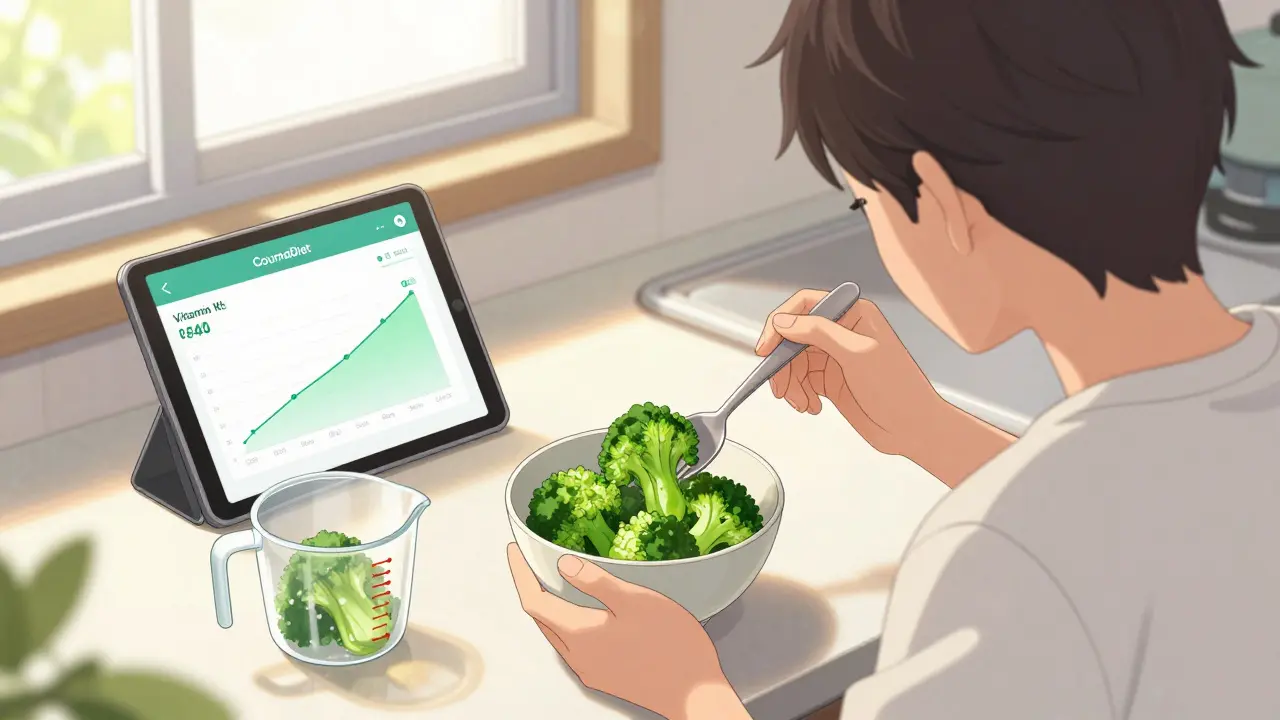
If you’re taking warfarin, you’ve probably heard that vitamin K can mess with your INR. But here’s the truth: it’s not about avoiding vitamin K. It’s about keeping it consistent. One day you eat a big salad, the next day you skip it - and suddenly your INR spikes or crashes. That’s not luck. That’s diet. And it’s the number one reason people on warfarin end up in the ER.
Why Vitamin K and Warfarin Don’t Get Along
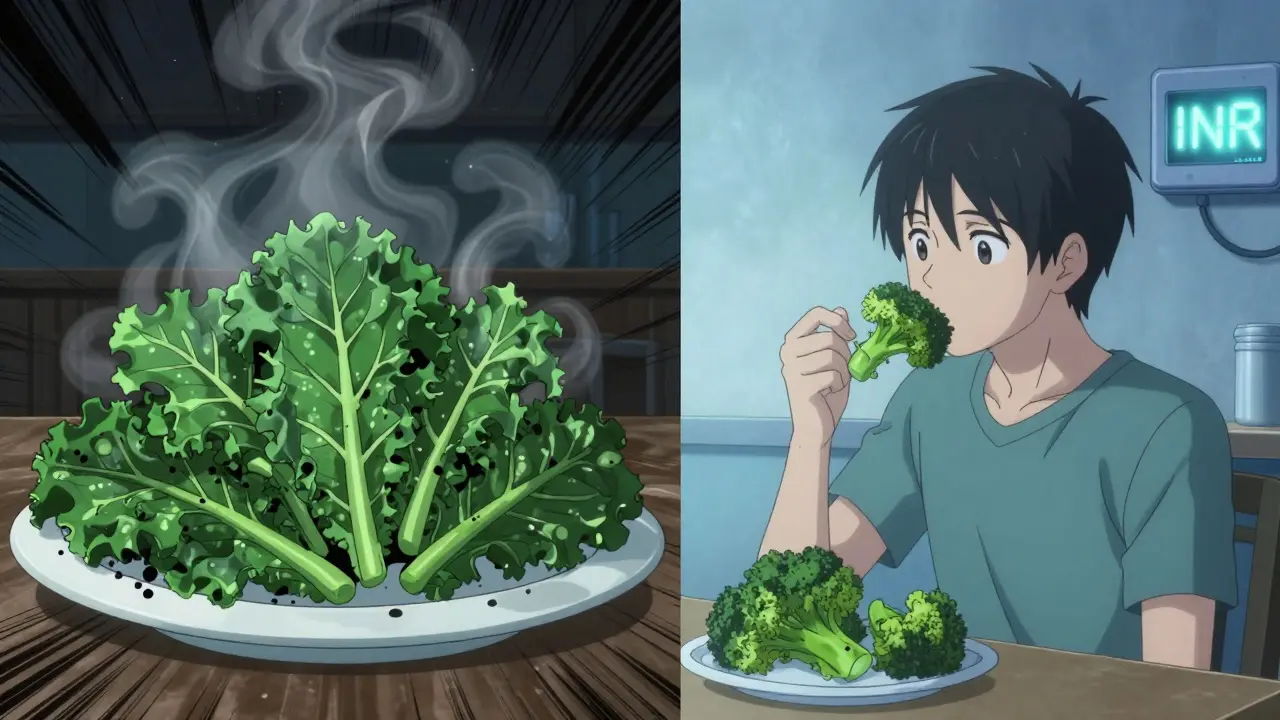
Warfarin works by blocking your body’s ability to recycle vitamin K. Without enough active vitamin K, your blood can’t form clots the way it should. That’s the whole point - to keep you from having strokes or clots. But vitamin K doesn’t disappear when you take warfarin. It’s still in your food. And every time you eat it, you’re fighting against the drug.The key isn’t to stop eating vitamin K. It’s to eat about the same amount every single day. Your liver doesn’t care if you had 50 mcg or 200 mcg last week. It only cares what’s in your system today. If you suddenly eat a cup of cooked kale (547 mcg of vitamin K), your body has a surge of the stuff. That tells your clotting factors to wake up. Warfarin can’t keep up. Your INR drops. Now you’re at risk for a clot.
On the flip side, if you switch from spinach to iceberg lettuce for a week, your vitamin K intake plummets. Now warfarin has too much power. Your INR climbs. You’re at risk for bleeding. That’s why 68% of INR instability cases are tied to dietary changes, according to the American Heart Association.
What Foods Are High in Vitamin K?
Not all greens are created equal. Some have barely any vitamin K. Others have enough to throw your INR off for days.Here’s what to watch out for - these foods contain more than 60 mcg of vitamin K per serving:
- Cooked spinach: 889 mcg per cup
- Cooked kale: 547 mcg per cup
- Cooked broccoli: 220 mcg per cup
- Cooked Brussels sprouts: 219 mcg per cup
- Cooked collard greens: 1055 mcg per cup
- Cabbage: 108 mcg per cup cooked
- Green tea: 100-200 mcg per cup (varies by brand and steeping time)
- Prune juice: 60 mcg per cup
- Edamame: 120 mcg per cup
These are safe in normal portions - under 35 mcg per serving:
- Iceberg lettuce: 17 mcg per cup
- Cucumber: 10 mcg per cup
- Carrots: 12 mcg per cup
- Tomatoes: 7 mcg per cup
- Apples: 4 mcg per medium fruit
- Chicken, beef, eggs: low to moderate (not a major source)
Here’s the catch: cooking changes things. Boiling spinach can knock out 30-50% of its vitamin K. Steaming? Almost no loss. So if you’re used to eating boiled greens and suddenly switch to steamed, you’re getting way more vitamin K than you think.
What Does Consistent Mean? (And How to Actually Do It)
"Consistent" doesn’t mean "low." It means steady. If you normally eat one cup of cooked broccoli every day, keep doing it. If you eat a small spinach salad three times a week, stick to that. Don’t switch to kale on the weekend. Don’t skip your greens during holidays.People who keep their daily vitamin K intake within 10% of their usual amount have a 70%+ chance of staying in their target INR range. Those who swing wildly? Only 34% stay stable.
Here’s how to make it work:
- Track your intake for two weeks. Use an app like CoumaDiet (rated 4.6/5 by over 1,200 users). Log everything - even that handful of almonds or the dressing on your salad.
- Find your average daily intake. If you’re eating 120 mcg/day, aim to stay between 108-132 mcg every day.
- Plan meals around that number. If you’re having kale for dinner, skip the broccoli at lunch. If you’re eating a big salad, don’t add cheese or nuts that might bump you over.
- Use measuring cups. A "cup" of spinach raw is not the same as a cup cooked. Cooked spinach is dense. Raw is fluffy. You’ll get 5x more vitamin K in the cooked version.
- Stick to one or two high-vitamin K foods, not all of them. Pick your favorite. Eat it the same way, same portion, same frequency. That’s your anchor.
One patient in Toronto kept his INR rock-solid for six months by eating exactly one cup of cooked broccoli every morning. Not because broccoli is magic - but because he made it predictable.
What About Supplements and Vitamin K Pills?
Some doctors now recommend daily low-dose vitamin K supplements - 100-200 mcg - for patients who struggle with inconsistent diets. Sounds backwards, right? But here’s why it works: if you’re eating random amounts of vitamin K every day, your body is in chaos. Giving yourself a steady, small dose every day tells your liver, "This is normal." It stops overreacting to spikes.A 2018 study found that patients on 150 mcg of vitamin K daily were 83% more likely to get their INR back into range within a week than those who didn’t. It’s not a fix for bad habits - it’s a buffer. Think of it like a thermostat. If your house temperature swings between 60 and 85 degrees, the heater works overtime. But if you set it at 72, it runs smoothly.
Don’t start taking vitamin K pills without talking to your doctor. But if you’re tired of guessing, ask about it. It’s becoming a standard tool in anticoagulation clinics.
When Things Go Wrong - What to Do
You had a big bowl of kale at a restaurant. Your INR dropped from 2.7 to 1.8. Now what?Don’t panic. Don’t skip your next warfarin dose. Don’t eat nothing but lettuce for a week.
Here’s what actually helps:
- Call your anticoagulation clinic. They’ll likely check your INR again in 2-3 days.
- Go back to your normal vitamin K routine. Eat your usual portion of your usual food.
- Don’t change your warfarin dose yourself. Your doctor will adjust it based on your trend, not one bad day.
Same goes if your INR spikes after switching to iceberg lettuce. Don’t eat more kale to "fix" it. That’s a recipe for the next crash. Just return to your baseline and wait for your next INR test.
Emergency department visits for INR issues? 63% happen after travel or eating out. Restaurants don’t measure vitamin K. They pile on the greens. That’s why 89% of patients who stick to home-cooked meals report fewer problems.
What’s Changed in the Last Few Years
Ten years ago, doctors told patients to avoid vitamin K. Now? They say the opposite.The 2023 American College of Chest Physicians Guidelines say: "Patients should consume approximately the same amount of vitamin K daily (within 10-15% variation) rather than adhering to a low-vitamin K diet." That’s huge. Restriction doesn’t work. Consistency does.
Even better - new research shows that daily vitamin K supplements (150 mcg) can actually reduce INR swings by 28% in people with erratic diets. And apps that predict your INR based on your food log are hitting 89% accuracy in early trials.
Warfarin isn’t going away. It’s still the only option for people with mechanical heart valves. And for those patients, vitamin K management isn’t optional - it’s life-saving.
What You Need to Do Right Now
You don’t need to become a nutritionist. You just need to be predictable.- Write down what you eat for three days. Use your phone or a notebook.
- Find your average vitamin K intake. Don’t worry about hitting 90 mcg - just find your number.
- Choose one high-vitamin K food you like. Eat it the same way, same portion, every day.
- Use an app like CoumaDiet to track it. It’s free and works offline.
- Call your anticoagulation clinic and ask if they offer dietitian support. Most do - and it cuts INR problems by 37%.
Your INR isn’t about being perfect. It’s about being steady. One cup of broccoli. One salad. One consistent day at a time.
Can I eat spinach if I’m on warfarin?
Yes - but only if you eat the same amount every day. One cup of cooked spinach has 889 mcg of vitamin K. If you eat that every day, your body adjusts. If you eat it one day and skip it the next, your INR will swing. Consistency beats restriction.
Does cooking affect vitamin K in greens?
Yes. Boiling can reduce vitamin K by 30-50%, especially in leafy greens like spinach or kale. Steaming, sautéing, or eating raw keeps most of the vitamin K intact. So if you switch from boiled to steamed spinach, you’re getting more vitamin K than you think - and your INR might drop.
Is it safe to take vitamin K supplements while on warfarin?
It can be - and it’s becoming more common. A daily 100-200 mcg dose can stabilize INR in people with inconsistent diets. But never start supplements without talking to your doctor. They’ll need to adjust your warfarin dose to match.
Why do some people say vitamin K doesn’t matter for warfarin?
Some studies, especially those focused on genetics, found that vitamin K intake had little effect once CYP2C9 and VKORC1 genes were accounted for. But those studies looked at average populations. Real-world data from patients shows that sudden changes in vitamin K intake cause 68% of INR instability. Genetics explain why you need a certain dose. Diet explains why your INR keeps changing.
What’s the best way to track vitamin K intake?
Use a food-tracking app like CoumaDiet, which is designed for warfarin users and includes vitamin K values for over 1,000 foods. You can also use MyFitnessPal and manually add vitamin K values from the USDA database. The key is logging everything consistently - not just the big meals.
Can I eat out on warfarin?
Yes - but be careful. Restaurants use way more greens than you think. Ask for sauces on the side, skip the added greens, and choose grilled proteins with steamed vegetables. Avoid dishes labeled "healthy" or "garden fresh" - they’re often loaded with kale or spinach. If you’re unsure, stick to simple meals: grilled chicken, rice, and carrots.
Next Steps: What to Do Today
1. Look at your last three INR results. Did they swing more than 0.5 points? If yes, your diet is likely a factor. 2. Pick one high-vitamin K food you eat. Write down how much and how often. 3. Download CoumaDiet or use a food log app. Start tracking for 3 days. 4. Call your anticoagulation clinic. Ask: "Do you have a dietitian who helps with vitamin K?" If they say no, ask for a referral. 5. Don’t change your warfarin dose. Change your plate.Warfarin works best when your life is predictable. Not perfect. Not restrictive. Just steady.
venkatesh karumanchi
January 24, 2026 AT 12:49Been on warfarin for 4 years now. Started eating one cup of cooked broccoli every morning like the post said. My INR hasn't budged since. No more ER visits. No more panic calls. Just broccoli. Simple. Predictable. Life changed.
Thanks for this.
Jenna Allison
January 25, 2026 AT 08:16Important note: cooking method matters more than people realize. Boiling spinach reduces vitamin K by up to 50%, but steaming keeps nearly all of it. So if you switch from boiled to steamed without adjusting your warfarin, your INR will drop. I’ve seen it happen twice in my clinic. Always track the prep method, not just the food.
Also - green tea varies wildly. Some brands have 3x the K of others. Check labels if you drink it daily.
Vatsal Patel
January 26, 2026 AT 15:04So let me get this straight. The solution to a drug that interferes with vitamin K… is to eat more vitamin K? Genius. Absolute genius. Why didn’t we think of this before we invented anticoagulants?
Next up: people with diabetes will be told to eat more sugar - but consistently.
Maybe we should just call warfarin ‘vitamin K’s nemesis’ and be done with it. At least then we’d be honest about the absurdity.
Sharon Biggins
January 27, 2026 AT 12:33You got this. I know it feels overwhelming at first - tracking food, checking INRs, worrying about every salad - but consistency is your superpower. You don’t have to be perfect. Just steady.
I used to stress over every bite. Now I just eat my one cup of broccoli every day. Same time. Same pot. Same spoon. And guess what? My numbers are calm. You can do this too. 💪
lorraine england
January 27, 2026 AT 14:42Okay but can we talk about how ridiculous it is that we’re being told to eat MORE of something that’s literally fighting our medication? Like… is this science or a cult?
Also - I tried CoumaDiet. It’s fine. But why does it cost $5 to unlock the USDA database? That’s sketchy. Use MyFitnessPal + manual entry. Free. Works fine.
And PLEASE stop eating kale if you’re not tracking it. I’ve seen people crash their INR after ‘health food’ weekends. Don’t be that person.
Kat Peterson
January 29, 2026 AT 07:44OMG I JUST ATE A KALE SMOOTHIE AND MY INR DROPPED TO 1.2 😭😭😭
My doctor said I’m fine but I’m crying in the shower. I thought kale was healthy. I thought I was doing right. I thought I was being good.
Now I’m scared to eat anything green. What if I die? 😭
Can someone please hug me? Or at least tell me it’s okay to eat mashed potatoes instead?
Himanshu Singh
January 29, 2026 AT 23:10There’s a deeper truth here: we’re not fighting vitamin K. We’re fighting chaos. Warfarin needs rhythm. Your body needs routine. The broccoli isn’t magic - it’s medicine because it’s reliable.
Think of your liver like a musician. It doesn’t care what note you play. It just wants you to play the same one, every day, at the same volume.
That’s all. Not more. Not less. Just steady.
That’s the real wisdom here. Not diet. Discipline.
Elizabeth Cannon
January 30, 2026 AT 13:21People always say "just be consistent" like it's easy. But what if you're poor? What if you can't afford to buy fresh greens every week? What if your only grocery store sells canned spinach and frozen broccoli?
And don't get me started on restaurants. I work two jobs. I don't have time to track mcg. This advice is for people who have the luxury of time, money, and a fridge that doesn't leak.
Stop blaming patients. Fix the system.
Don Foster
February 1, 2026 AT 12:08Everyone’s overcomplicating this. Vitamin K doesn’t matter if you’re on DOACs. Why are we even talking about warfarin in 2025? It’s 2025. Apixaban exists. It doesn’t care about your kale. If you’re still on warfarin you’re either on a mechanical valve or your doctor is lazy. Fix the drug not the diet.
Also the USDA database is outdated. Use the Australian one. More accurate.
And stop using apps. Just write it down. Pen and paper. Like a real human.
siva lingam
February 2, 2026 AT 16:13So eat the same greens every day. Wow. Groundbreaking. Next you’ll tell us to breathe air consistently to avoid oxygen toxicity.
Also I’m pretty sure this whole post was written by a dietitian who hates their job.
Peace out.