
Reporting a safety violation, financial fraud, or unethical behavior at work isn’t just the right thing to do-it’s legally protected. But if you’ve ever thought about speaking up, you’ve probably wondered: Will I get fired? The answer isn’t simple. Whistleblower laws exist to shield you, but the reality is messy. Many people still lose their jobs, get pushed out, or face quiet punishment after reporting wrongdoing. This isn’t because the laws don’t exist-it’s because they’re complicated, unevenly enforced, and often misunderstood.
What Counts as Protected Reporting?
You don’t need proof of a crime to be protected. Under California’s Labor Code Section 1102.5, you’re covered if you have a reasonable belief that your employer is breaking state or federal law. That means if you see unsafe equipment, falsified records, or illegal billing practices, and you report it to your boss, HR, or a government agency, you’re legally shielded. The law doesn’t require you to be 100% right-just that your belief was honest and based on facts you could reasonably know. Federal laws work similarly but are narrower. The Sarbanes-Oxley Act protects employees of public companies who report securities fraud. The False Claims Act covers those exposing fraud against government programs like Medicare or defense contracts. The Clean Air Act and FDA regulations protect workers who report environmental or drug safety violations. But here’s the catch: each law only applies to specific industries and types of misconduct. If you’re reporting something outside those boundaries, you might not be covered unless you’re in California, where the law is broader.What Retaliation Looks Like (And What’s Illegal)
Retaliation doesn’t always mean getting fired. It’s often quieter-and harder to prove. Common tactics include:- Being moved to a night shift with no notice
- Having your hours cut or schedule changed unfairly
- Being passed over for promotions you clearly qualified for
- Receiving sudden negative performance reviews after reporting
- Being excluded from meetings or team activities
- Being subjected to constant criticism or public humiliation
California’s New 2025 Rules: A Major Shift
Starting January 1, 2025, every employer in California must post a clear, visible notice about whistleblower rights. The notice must include the Attorney General’s hotline number (1-800-952-5225) and be printed in at least 14-point font. It must be displayed where employees can easily see it-break rooms, time clocks, bulletin boards. Failure to post it? That’s a civil penalty of up to $10,000 per violation. This is the strongest state-level enforcement tool in the U.S. No other state requires physical posting. It’s designed to make sure even part-time workers, warehouse staff, or remote employees who rarely see HR know their rights. The California Chamber of Commerce estimates this will cost small businesses $150-$300 per location for printing and compliance. But the goal isn’t to punish businesses-it’s to prevent retaliation before it happens by making the law impossible to ignore.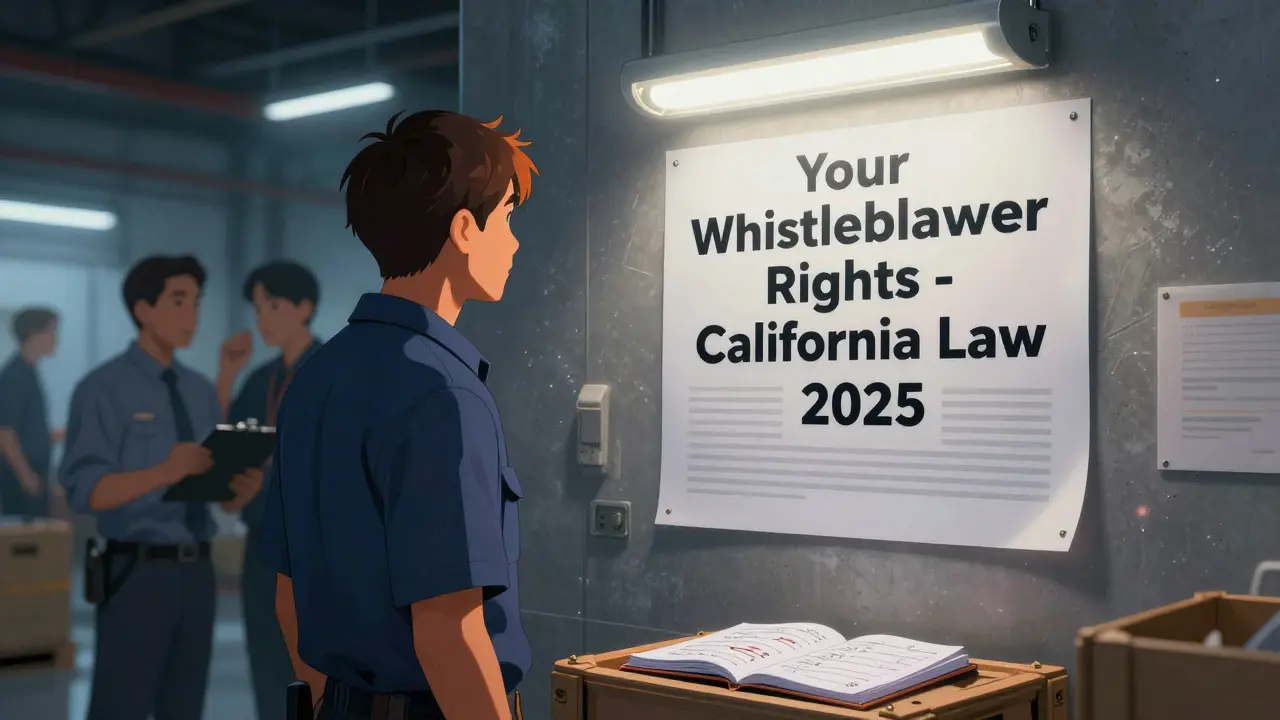
Federal vs. State: What’s Better?
California’s law is broader, covering any violation of any law. Federal laws are more limited. For example:- Sarbanes-Oxley: Only applies to public companies reporting financial fraud.
- Dodd-Frank: Offers financial rewards-10% to 30% of recovered funds-if your tip leads to a $1 million+ penalty. The SEC paid out $637 million to 131 whistleblowers in 2023 alone.
- AIR21: Protects airline workers, but has a known loophole: the FAA can delay investigations indefinitely.
How to Protect Yourself Before You Speak Up
If you’re thinking about reporting, don’t wait until you’re in trouble. Here’s what to do now:- Document everything. Save emails, texts, performance reviews, shift schedules, and notes from conversations. California requires “clear and convincing evidence” to prove retaliation. Without paper trails, your case collapses.
- Know the deadlines. Federal claims have strict time limits: 30 days for environmental violations, 90 days for financial fraud, 180 days for consumer safety. Miss the window, and you lose your right to file.
- Use official channels. Reporting to your manager might feel safer, but if they’re involved in the violation, go straight to OSHA (800-321-6742) or California’s Labor Commissioner. You’re protected whether you report internally or externally.
- Consult a lawyer. The National Whistleblower Center says 78% of successful cases had legal representation. Many nonprofit groups offer free advice. Don’t rely on HR-they work for the company, not you.
What Happens After You Report?
The process is slow. The average California whistleblower case takes 22 months to resolve, according to the Division of Labor Standards Enforcement. That’s two years without a paycheck, fighting bureaucracy. Some cases settle early. Others go to trial. A 2023 case in Los Angeles saw a nurse awarded $287,000 in back wages after being fired for reporting unsafe patient care. But many don’t make it that far. A Reddit user, u/SafetyFirstCA, described being assigned graveyard shifts after reporting OSHA violations-forcing them to quit. That’s called constructive dismissal. It’s illegal, but hard to prove without documentation.
Emerging Threats and New Frontiers
Whistleblower protections are expanding beyond traditional industries. In May 2025, Senator Grassley introduced the AI Whistleblower Protection Act. It would shield employees in artificial intelligence companies who report unethical algorithms, biased data sets, or hidden corporate manipulation. This is critical. AI systems can cause real harm-misdiagnosing patients, denying loans, or influencing elections-but no one’s been legally protected for speaking up about it… until now. The European Union already has a strong whistleblower directive. The U.S. is playing catch-up. California is leading the charge, but federal law still lags. The Department of Labor is expected to propose new rules in late 2025 to shorten investigation timelines from 90 to 60 days. That’s progress-but it’s still not enough.Where to Get Help Right Now
You don’t have to face this alone:- California Attorney General’s Whistleblower Hotline: 1-800-952-5225 (free, confidential)
- OSHA Whistleblower Protection Program: 800-321-6742
- National Whistleblower Center: Offers free legal referrals and support to over 1,200 whistleblowers in 2024
- Local legal aid clinics: Many offer free consultations for employment law
Final Reality Check
Whistleblower laws are not a magic shield. They’re tools-powerful, but only if you use them correctly. The system is stacked against you. Employers know the delays, the paperwork, the emotional toll. That’s why so many people stay silent. But if you report, and you document, and you act within the deadlines, you have a real chance. Thousands have won their cases. Thousands more have forced companies to fix dangerous practices. The law isn’t perfect, but it’s the only thing standing between corruption and the public. Don’t wait for someone else to speak up. If you see something wrong, and you’re ready to act-know your rights. Use the hotline. Save your records. Call a lawyer. You’re not just protecting yourself. You’re protecting patients, consumers, and the public.Can I be fired for reporting a violation if I’m an at-will employee?
Yes, employers can fire at-will employees for almost any reason-but not if the firing is retaliation for protected whistleblowing. Whistleblower laws override at-will employment. If you’re fired after reporting a violation, you can still file a claim. The burden shifts to the employer to prove the firing was unrelated to your report.
Do I need to report internally before going to the government?
No. You can report directly to OSHA, the SEC, or other agencies without telling your employer first. In fact, going straight to a government agency often gives you stronger legal protection. Some employers retaliate even if you report internally, so skipping internal channels can be safer.
What if I report anonymously?
You can report anonymously to agencies like OSHA or the SEC, but anonymity makes it harder to prove retaliation later. If you’re fired and claim it’s because you reported, but no one knows you were the source, your case weakens. It’s better to report your name and ask for confidentiality-agencies are legally required to protect your identity.
Can I get paid for reporting fraud?
Only under certain federal laws. The False Claims Act and Dodd-Frank Act offer rewards-10% to 30% of money recovered-if your information leads to a successful enforcement action over $1 million. California’s law doesn’t offer rewards, but it does allow you to sue for back pay, emotional distress, and attorney fees.
What if I’m a remote worker in California?
You’re still protected under California law. Employers must send you the whistleblower notice electronically if you work remotely. If you don’t receive it, you can still report violations. The law applies to all employees working for California-based companies, regardless of where they live.
Lu Jelonek
December 24, 2025 AT 14:03I worked at a clinic where they were cutting corners on sterilization. I reported it anonymously to the state board. Took 14 months, but they shut down the unit. No reward, no applause-just the quiet satisfaction of knowing patients won’t get infected because I spoke up.
Documentation saved me. Every shift change, every ignored complaint, every time HR said 'don’t make waves.' I kept it all.
Don’t wait for the perfect moment. The perfect moment never comes.
Just keep the receipts.
And call the AG hotline. They’re actually helpful.
You’re not crazy for wanting safety. You’re just smart.
And you’re not alone.
I’m still scared too. But I did it anyway.
So can you.
Ademola Madehin
December 26, 2025 AT 10:11Bro this is just another way for lawyers to get rich while you get ghosted by your job. I reported a guy for stealing coffee from the breakroom and got moved to the basement. No joke. They said ‘it’s for your safety.’ 😂
Whistleblower laws? More like whistleblower nightmares.
Stay quiet. Live longer.
siddharth tiwari
December 27, 2025 AT 10:26they say california is the best but did u know the feds are working with big pharma to bury real whistleblowers? i read a thread once where a guy reported a vaccine data lie and his laptop got hacked the next day… then he disappeared.
the ag hotline? that’s just a front. they forward everything to the same ppl who run the companies.
you think they want you to win? nah. they want you to shut up.
and that 2025 posting rule? total distraction. they’re just making sure you feel safe while they erase your emails.
trust no one. not hr. not the law. not even this post.
if you report… burn your phone first.
suhani mathur
December 27, 2025 AT 19:58Oh wow, so now we’re supposed to be grateful that California forces companies to post signs instead of actually enforcing the law? How cute.
Let me guess-next they’ll hand out stickers that say ‘I Support Whistleblowers’ and call it a day.
Meanwhile, people are still getting fired for reporting unsafe conditions. The law is paper. The retaliation is real.
But hey, at least the font size is 14-point. Progress.
PS: If you’re remote and didn’t get the notice? File a complaint. They can’t claim ignorance if you send them a screenshot of your empty breakroom wall.
And yes, HR is not your friend. They’re the company’s lawyer in a cardigan.
Andrea Di Candia
December 29, 2025 AT 00:12It’s strange how we treat whistleblowers like heroes when it’s too late, but like traitors while they’re still alive.
What if we stopped asking ‘what’s the risk?’ and started asking ‘what’s the cost of silence?’
One nurse speaks up about unsafe staffing. A child survives. A hospital changes policy. That’s not a lawsuit-it’s a ripple.
Yes, the system is broken. Yes, it takes years. Yes, you’ll be tired.
But someone has to be the first to say it out loud.
Maybe that someone is you.
Not because it’s easy.
But because it matters.
Harsh Khandelwal
December 29, 2025 AT 17:14so the feds give out millions in rewards but california just says ‘here’s a poster’? lol. what a joke.
and that ‘reasonable belief’ thing? that’s just legal glitter. if your boss is shady, they’ll make you look like the crazy one.
also, who the hell has time to document every text and email? i work 60 hours a week just to keep my job.
and don’t even get me started on ‘consult a lawyer’-that’s like saying ‘just buy a yacht’ when you’re broke.
real talk? if you’re not rich, you’re screwed.
and the ai whistleblower bill? lol. they’ll pass it and then bury it under 12 layers of bureaucracy.
stay quiet. it’s safer. and honestly? less dramatic.
Andy Grace
December 30, 2025 AT 08:55I worked in mining in Australia. Saw a safety report get buried. Didn’t report it right away. Too scared.
Three months later, a guy broke his back. They said it was ‘an accident.’
I wish I’d spoken up sooner.
Now I tell every new hire: ‘If you see something, write it down. Even if you think no one cares.’
It’s not about being brave.
It’s about not living with regret.
And yeah, the system sucks.
But silence hurts more.
John Pearce CP
January 1, 2026 AT 02:22Let me be perfectly clear: the notion that American workers need special protection to report misconduct is an affront to personal responsibility and the rule of law.
Whistleblower statutes are bureaucratic overreach masquerading as justice.
Employers are not criminals because an employee feels slighted.
California’s 2025 notice law is a taxpayer-funded propaganda campaign.
And the suggestion that HR cannot be trusted? That is not a legal insight-it is a cultural collapse.
If you cannot navigate corporate hierarchy with integrity, then you lack the character to lead, serve, or even work.
Stop demanding special protections. Start behaving like an adult.
The law is not your babysitter.
Gray Dedoiko
January 2, 2026 AT 23:20I’ve been on both sides of this. Worked in a place where people reported fraud and got promoted. Worked in another where they got canned.
The difference? Leadership.
It’s not about the law-it’s about culture.
If your boss actually cares about ethics, you’re safe.
If they don’t? The law helps, but it’s not enough.
So if you’re thinking about speaking up… ask yourself: does my manager even care about doing the right thing?
If the answer’s no… then document. Then go external.
And please, for the love of God, save your emails.
I’ve seen too many good people lose everything because they trusted a handshake.
Katie Taylor
January 4, 2026 AT 01:26Stop being polite. Stop waiting for permission. Stop hoping HR will do the right thing.
If you see fraud, report it. TODAY.
Don’t wait for a ‘safe time.’ There is no safe time.
Send the email. Call the hotline. File the complaint.
They can fire you. But they can’t erase what you did.
And guess what? They’re already lying to you.
So lie back harder.
Document everything.
Be the pain they didn’t see coming.
And if they try to bury you?
Then you’ll be the reason they change.
Isaac Bonillo Alcaina
January 5, 2026 AT 15:57Let’s be honest: 90% of whistleblowers are disgruntled employees with a grudge. They’re not heroes-they’re litigants with a vendetta.
The law doesn’t protect the righteous. It protects the litigious.
And now we’re handing out $600 million in rewards? To people who didn’t even try to fix things internally?
That’s not justice. That’s a lottery for malcontents.
California’s poster law? Pathetic. It’s a PR stunt for voters, not a deterrent for criminals.
Real reform? Fire the CEOs who enable this. Not the employees who report it.
But we won’t do that.
Because we’d rather punish the messenger than the mafia.
Bhargav Patel
January 6, 2026 AT 17:16The philosophical underpinning of whistleblower protections lies in the tension between individual conscience and institutional authority.
When an employee reports misconduct, they are not merely invoking statutory rights-they are exercising moral agency in the face of systemic complicity.
Legal frameworks, however imperfect, serve as institutional acknowledgments of this moral imperative.
California’s 2025 notice requirement, while administratively burdensome, represents a form of epistemic democratization: knowledge of rights becomes visible, accessible, and non-negotiable.
Yet the real challenge remains: how to cultivate organizational cultures where speaking up is not an act of courage, but a normalized expectation.
Until then, the law remains the last, fragile bridge between silence and justice.
Charles Barry
January 7, 2026 AT 00:33Oh wow, so now we’re supposed to believe the government isn’t in on the cover-up?
OSHA missed deadlines in 63% of cases? That’s not incompetence. That’s collusion.
And the ‘AI whistleblower’ bill? Please. They’re just trying to make you think they’re doing something before the next election.
Meanwhile, the SEC paid out $637 million? To who? Lawyers? Corporate insiders who flipped?
They’re all playing the same game.
You think you’re fighting the system?
You’re just another pawn.
And the poster? It’s a joke.
They’re not protecting you.
They’re making you feel safe so you don’t burn the whole thing down.
Rosemary O'Shea
January 8, 2026 AT 18:23Can we talk about how ridiculous it is that the only reason whistleblowers get protection is because the media catches wind of it?
Otherwise? You’re just a ‘problem employee.’
And now California wants to print a poster? Like we’re toddlers who need a sticker chart?
Meanwhile, the same companies that ignore the law are donating to the Attorney General’s campaign.
Don’t you see?
This isn’t about justice.
It’s about optics.
And you? You’re the prop.
Go ahead. Report.
They’ll still fire you.
Then they’ll thank you for ‘raising awareness.’
And the poster? It’ll be in the dumpster by January.
Joe Jeter
January 9, 2026 AT 17:51So let me get this straight-you’re telling me I can’t be fired for reporting a violation… but I can be fired for ‘poor cultural fit’ or ‘restructuring’?
That’s not protection. That’s a loophole with a smiley face.
And why does California get all the love? Because they have a big state budget and a governor who wants to look good?
Meanwhile, in 49 other states? You’re on your own.
And don’t even get me started on the ‘free lawyer’ advice.
Those ‘nonprofits’ are just waiting for you to lose so they can take your case for a percentage.
This isn’t justice.
This is a scam dressed up as a safety net.